Function
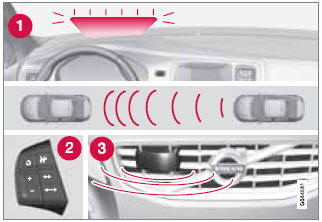
Function overview
1 Warning light, braking by driver required
2 Controls in steering wheel
3 Radar sensor in front grille
Adaptive Cruise Control consists of:
• A cruise control system to maintain a set speed
• A system to maintain a set distance to the vehicle ahead, which is expressed as a time interval. For example, you can choose to remain approximately 2 seconds behind the vehicle ahead. The actual distance required to maintain a 2-second interval will vary according the speed of the vehicles.
The distance to the vehicle ahead (in the same lane) is monitored by a radar sensor. Your vehicle's speed is regulated by accelerating and braking. The brakes may emit a sound when they are being modulated by the adaptive cruise control system. This is normal.
The ACC system is designed to smoothly regulate speed. However, the driver must apply the brakes in situations that require immediate braking. This applies when there are great differences in speed between vehicles, or if the vehicle ahead brakes suddenly.
Adaptive Cruise Control can be put in active mode at any permitted speed. However, if the vehicle's speed falls below 30 km/h or if engine speed (rpm) becomes too low, ACC disengages (goes into standby mode) and will no longer modulate the brakes2. The driver will then have to maintain a safe distance to the vehicle ahead.
The driver must assume full control over the vehicle.
Test yourself
A quick Volvo XC60 quiz: every answer comes with an explanation and a link to the manual page.