Locations Where Child Seats Can Be Installed
Permitted Child Seat Anchorage Options

1 = Only with the front passenger airbag deactivated. If the child restraint system is secured with a three-point seat belt, use the height adjuster to set the seat to its highest position and make sure the shoulder portion of the seat belt runs forward from the upper belt anchorage.
2 = Seats with ISOFIX and Top Tether anchorages.
U = Universal, suitable for use with a three-point seat belt.
X = Child restraint systems are not permitted for this weight group.
Permitted ISOFIX Child Restraint Installation Options
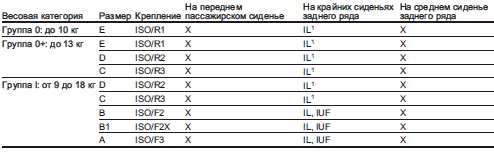
IL = Permitted with ISOFIX child restraint systems specific to this vehicle, restricted use or semi-universal type. The ISOFIX child restraint system must be approved for this vehicle model.
IUF = Permitted with a forward-facing universal ISOFIX child restraint approved for this weight group.
X = ISOFIX child restraint systems are not permitted for this weight group.
1 = Move the front seat forward fully, or until the child seat no longer contacts the front seatback.
ISOFIX Size Class Group and Child Restraint Type
A - ISO/F3 = Forward-facing child seat for the upper weight range of 9 to 18 kg.
B - ISO/F2 = Forward-facing child seat for the lower weight range of 9 to 18 kg.
B1 - ISO/F2X = Forward-facing child seat for the lower weight range of 9 to 18 kg.
C - ISO/R3 = Rear-facing child seat for the upper weight range up to 13 kg.
D - ISO/R2 = Rear-facing child seat for the lower weight range up to 13 kg.
E - ISO/R1 = Rear-facing child seat for small children, weight up to 13 kg.
Test yourself
A quick Chevrolet Cruze quiz: every answer comes with an explanation and a link to the manual page.