Checking fluid levels
Check fluid levels in accordance with the manufacturer's maintenance schedule. If necessary, top up the level, provided there are no contraindications.
If a fluid level drops significantly, contact a CITROËN dealer or a specialist workshop to inspect the system concerned.
Take care when working under the bonnet: some components are extremely hot (risk of burns), and the radiator fan may start at any time (even with the ignition off).Engine oil level
 To check the engine oil level, use the oil level indicator on the instrument cluster, which operates when the ignition is switched on on vehicles with an electronic indicator, or the manual dipstick.
Topping up engine oil between services (or oil changes) is normal. CITROËN recommends checking and topping up the oil every 5000 km.
Checking with the manual dipstick
- Locate the dipstick in the engine bay.
Additional information on petrol or diesel engines can be found in the relevant section.
- Grasp the dipstick by the coloured handle and pull it out completely.
- Wipe the dipstick with a clean, lint-free cloth.
- Reinsert the dipstick fully, then remove it again and check the level visually: the correct level must be between marks A and B.
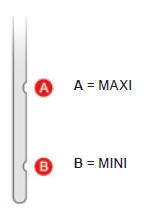
If the level is above mark A or below mark B, do not start the engine.
- If the MAXI level is exceeded (risk of engine damage), contact a CITROËN dealer or a specialist workshop.
- If the MINI level is not reached, be sure to add engine oil.
Oil specifications
Before topping up or changing the oil, check that the oil is suitable for the engine and meets the manufacturer's requirements.
Topping up engine oil level
- Locate the oil filler cap in the engine bay.
Additional information on petrol or diesel engines can be found in the relevant section.
- Unscrew the filler cap to access the filler opening.
- Pour the oil in small amounts, taking care not to splash it onto engine components (fire risk).
- Wait a few minutes before checking the level with the dipstick.
- Top up the level if necessary.
- After checking the level, tighten the filler cap securely and refit the dipstick.
30 minutes after topping up, the level can be checked with the instrument cluster indicator, after switching the ignition on.
Oil change
For the frequency of this operation, refer to the manufacturer's maintenance schedule.
To ensure engine and emissions control system performance, never use engine oil additives.
Brake fluid level
 The fluid level should be close to the "MAXI" mark.
Otherwise, check the brake pad wear.
Brake fluid change
In accordance with the manufacturer's maintenance schedule.
Fluid specification
The fluid must meet the manufacturer's requirements.
Coolant level
The level of this fluid should be close to the "MAXI" mark, never exceeding it
When the engine is warm, the coolant temperature is regulated by the radiator fan.
The radiator fan may start after the engine has been switched off: take care with objects or clothing that could get caught in the blades. As the cooling system operates under pressure, wait at least one hour after switching off the engine before removing the cap.
To avoid scalding, turn the cap back two turns to release the pressure. Once the pressure has dropped, remove the cap and top up the coolant level.
Fluid specification
This fluid must meet the manufacturer's requirements.
Windscreen washer fluid level
 Top up the fluid level
whenever necessary.
Fluid specification
To ensure optimum cleaning performance and prevent freezing, do not top up or replace the fluid with water.
In winter conditions, a fluid based on ethyl alcohol or methanol is recommended.
Diesel fuel additive level (diesel with particulate filter)
 The minimum additive level is indicated by this warning lamp staying on permanently, accompanied by a warning tone and a message in the multifunction display.
Topping up The additive must be topped up immediately at an authorised Dacia dealer or specialist workshop.
Used oils and fluids
Avoid prolonged skin contact with used oil and fluids. Most fluids are harmful to health and highly corrosive. Do not pour used oil and fluids into drains or onto the ground. Pour used oil into the containers provided for this purpose at CITROËN dealers or a specialist workshop.Test yourself
A quick Citroen DS3 quiz: every answer comes with an explanation and a link to the manual page.