Panel Replacement/Partial Panel Replacement. Description and Operation
Partial Panel Replacement
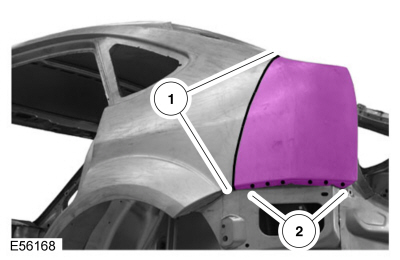
| Item | Description |
| 1 | Cross-Sectional Area |
| 2 | Weld Seam Preparation |
Decision Criteria
The following points are critical when deciding whether to fully or partially replace the component(s).
- Is the repair economically viable?
- Preservation/integrity of the original joint.
In addition, sectioning or partial panel replacement must follow standardized guidelines or approved procedures in the vehicle-specific repair manual to decide on sectioning in the damaged area.
For more information, refer to Body Panel Sectioning. (501-26 Body Repairs - Vehicle Specific Information and Tolerance Checks, General Procedures).
Depending on the damaged area, the following points must be considered when determining whether to perform a partial repair or full replacement:
- Cut sections must be as short as possible.
- Characteristic lines and edges of panels must match the original manufacturer's design.
For additional information, refer to: Body and Frame (501-26 Body Repairs - Vehicle Specific Information and Tolerance Checks, Description and Operation).
- Internal reinforcement panels must not restrict straightening operations.
- Internal reinforcement profiles in the pillar area must allow for sectioning.
- Partial replacement of frame sections must be permitted for the specific vehicle being repaired.
- Large-area weld seams at joints must be restored.
Advantages of Partial Replacement
Partial panel replacement offers many advantages for professional repair of collision damage:
- Repairs can be made in external panel areas (e.g., side rail) and in internal areas (e.g., structural member, luggage compartment floor).
- Repair can be limited to the actual damaged area.
- Reduced repair costs, as assemblies and other components can usually remain on the vehicle.
Full Panel Replacement
With full panel replacement, the original joints are mainly reused.
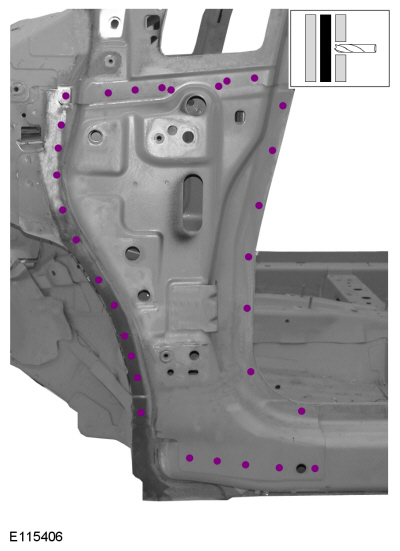
Full panel replacement is advantageous if the damaged body section can be separated from its original joints and the replacement part can be installed without creating additional joints.
Complete replacement is required if no sectioning repair solution is available.
Test yourself
A quick Ford Fiesta quiz: every answer comes with an explanation and a link to the manual page.