Plastic Repair. Description and Operation
Plastic Components
The following illustrations do not include all trim levels available. The actual interior trim level of the vehicle will determine whether plastic repair is practical. Components with molded-in color or textured finish are generally not considered repairable components.
Front Exterior Plastic Components, 4-Door

| Item | Description | Material |
| 1 | Front bumper cover | Thermoplastic Olefin (TPO) |
Rear Body Plastic Components, 4-Door
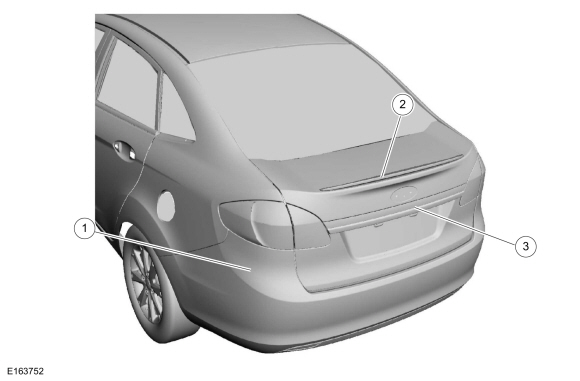
| Item | Description | Material |
| 1 | Rear bumper cover | Thermoplastic Olefin (TPO) |
| 2 | Rear spoiler | Acrylonitrile Butadiene Styrene (ABS) |
| 3 | Luggage Compartment Lid Handle | Acrylonitrile Butadiene Styrene (ABS) |
Front Exterior Plastic Components, 5-Door
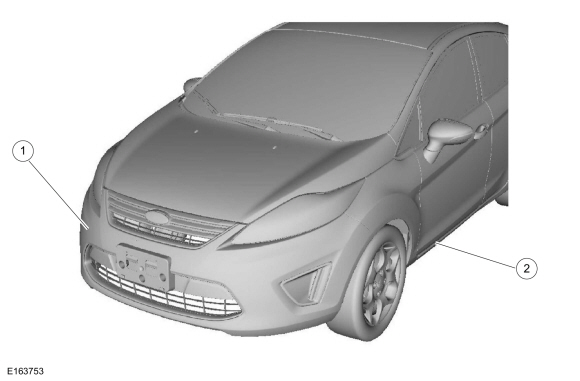
| Item | Description | Material |
| 1 | Front bumper cover | Thermoplastic Olefin (TPO) |
| 2 | Sill molding | Thermoplastic Olefin (TPO) |
Rear Body Plastic Components, 5-Door

| Item | Description | Material |
| 1 | Rear bumper cover | Thermoplastic Olefin (TPO) |
| 2 | Rear spoiler | Acrylonitrile Butadiene Styrene (ABS) |
| 3 | Rear Door Handle | Acrylonitrile Butadiene Styrene (ABS) |
Repair Recommendations
Several considerations will determine the feasibility of the plastic repair procedure(s):
- Is the damage cosmetic or structural?
- Is the component repairable?
- Is the replacement part readily available?
- Is repairing the component the most economical method?
- Will the repair allow the fastest and highest-quality restoration?
Several types of plastic are used in automotive applications. However, all plastics are divided into two main categories: thermoplastics or thermosets.
Thermoset Plastic
In general, thermoset plastics are made from two-part thermosetting resins. When mixed together, heat is released, producing a chemically cured material that is irreversible. Because of this, thermoset plastics require the use of a two-part adhesive for repair.
Sheet Molding Compound (SMC):
- Sheet Molding Compound (SMC) is a type of thermoset plastic that uses glass or nylon fibers in combination with thermosetting polyester resins. When fully cured, Sheet Molding Compound (SMC) is strong and rigid.
- Sheet Molding Compound (SMC) is similar to, but not identical to, fiberglass. Ford Motor Company uses Sheet Molding Compound (SMC) in components such as fenders, hood and tailgate.
Thermoplastic Compounds
Thermoplastic compounds are produced by a process that is reversible. Thermoplastics can be reformed by reheating. This characteristic of thermoplastics makes plastic welding a possible repair alternative. Repair of thermoplastic compounds is still possible by using two-part adhesive and filler repair materials and reinforcement as needed. Thermoplastics are widely used for interior trim elements, wheel arches, side body cladding and bumper covers.
Polyolefin
Polyolefins belong to the thermoplastic family and have one unique characteristic: a greasy or waxy feel when the material is sanded or abraded. Polyolefin can be easily reshaped using heat. Because of this, components made from this material are well suited to plastic welding. Most adhesive repair materials and paints will not bond to a polyolefin surface unless an adhesion promoter designed specifically for plastics is first applied to the exposed bare surface. Otherwise, polyolefins are repaired the same way as most other thermoplastics. Polyolefins are used in bumper covers, fan shrouds and wheel arch liners.
Correct identification of the various types of plastic is necessary to select the appropriate repair method(s) to perform a high-quality plastic repair.
For additional information, refer to Plastic Repair (501-25 Body Repairs - General Information, General Procedures).
Test yourself
A quick Ford Fiesta quiz: every answer comes with an explanation and a link to the manual page.