Jump Starting
Jump starting can be dangerous if it is not performed correctly. Follow the jump starting procedure in this section to avoid serious injury or damage to your vehicle. If you are in doubt about how to start your vehicle correctly, we strongly recommend that you have a service technician or towing service do it for you.
WARNING
To avoid SERIOUS INJURY or DEATH to yourself or others, always follow these precautions when working near or handling the battery:
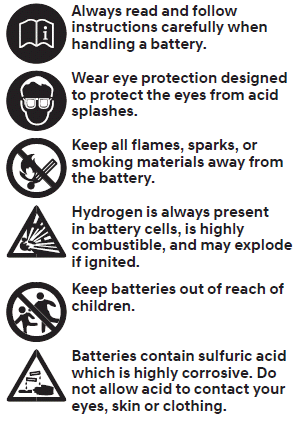
If acid gets into your eyes, flush your eyes with clean water for at least 15 minutes and get immediate medical attention. If acid gets on your skin, wash the area thoroughly. If you feel pain or burning, consult a doctor immediately.
- When lifting a plastic-cased battery, excessive pressure on the case may cause battery acid leakage. Lift the battery with a battery carrier or with your hands on opposite corners.
- Do not attempt to start your vehicle if the battery is frozen.
- NEVER attempt to recharge the battery while the battery cables are connected to the battery.
- The electronic ignition system operates with high voltage. NEVER touch these components with the engine running or when the ignition switch is in the ON position.
Information
Improper battery disposal can be harmful to the environment and human health. Dispose of the battery in accordance with your local laws or regulations.
NOTICE
To prevent damage to your vehicle:
- Use only a 12-volt power source (battery or jumper cable system) to jump start your vehicle.
- Do not attempt to start your vehicle by push starting.
Jump Starting Procedure
1. Position the vehicles close enough for the jumper cables to reach, but do not allow the vehicles to touch.
2. Avoid fans or any moving parts in the engine compartment at all times, even when the vehicles are off.
3. Turn off all electrical devices, such as the radio, lights, and air conditioner. Place the shift lever in P (Park) and set the parking brakes. Turn both vehicles OFF.
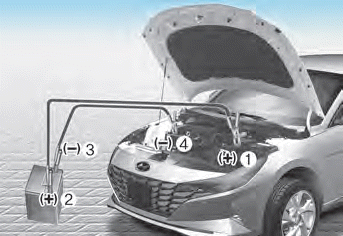
4. Connect the jumper cables in the exact sequence shown in the illustration. First, connect one jumper cable to the red, positive (+) jumper terminal of your vehicle (1).
5. Connect the other end of the jumper cable to the red, positive (+) battery/jumper terminal of the assisting vehicle (2).
6. Connect the second jumper cable to the black, negative (-) battery/ground of the assisting vehicle (3).
7. Connect the other end of the second jumper cable to the black, negative (-) chassis ground of your vehicle (4).
8. Do not allow contact with anything other than the correct battery or jumper terminal or the correct ground. Do not lean over the battery when making connections.
9. Operate the vehicle for at least 30 minutes of driving or at least 60 minutes of engine idling before turning off the engine. Without sufficient time for charging, the vehicle battery will likely not start the engine again. You may also visit your nearest dealer to have the battery charged and tested.
If your vehicle does not start after several attempts, it probably requires service. In this case, contact qualified assistance. If the cause of battery discharge is not obvious, have your vehicle checked by an authorized HYUNDAI dealer.
Disconnect the jumper cables in the exact reverse order from which you connected them:
1. Disconnect the jumper cable from the black, negative (-) chassis ground of your vehicle (4).
2. Disconnect the other end of the jumper cable from the black, negative (-) battery/chassis ground of the assisting vehicle (3).
3. Disconnect the second jumper cable from the red, positive (+) battery/jumper terminal of the assisting vehicle (2).
4. Disconnect the other end of the jumper cable from the red, positive (+) jumper terminal of your vehicle (1).
Test yourself
A quick Hyundai Elantra CN7 quiz: every answer comes with an explanation and a link to the manual page.