Body Electrical System
Description and Operation
In this manual: Body Electrical System
~3min read
Description
The immobilizer system disables the vehicle if the correct ignition key is not used. In addition to existing anti-theft systems, such as the car alarm, the immobilizer system is designed to sharply reduce the number of vehicle thefts.- SMARTRA Type Encrypted Immobilizer
A. The SMARTRA system consists of a passive challenge-response (mutual authentication) transponder located in the ignition key, antenna coil, SMARTRA encoded unit, indicator light, and PCM (ECM). B. SMARTRA communicates with the PCM (ECM) (engine control module) via a dedicated communication line. Since the engine control system is capable of controlling engine immobilization, this is the most suitable device to control SMARTRA. C. When the key is inserted into the ignition switch and turned to the ON position, the antenna coil sends power to the transponder in the ignition key. The transponder then sends an encoded signal back through the SMARTRA unit to the PCM (ECM). D. If the correct key was used, the PCM (ECM) will enable the fuel supply system. The immobilizer indicator in the instrument cluster will illuminate for more than five seconds at the same time, indicating that the SMARTRA unit has recognized the code sent by the transponder. E. If an incorrect key was used and the code is not received or not recognized by the PCM (ECM), the indicator will continue to flash until the ignition switch is turned off. F. If it is necessary to rewrite the PCM (ECM) to learn a new key, the dealer needs the customer's vehicle, all of its keys, and Hi-scan (pro) equipped with the immobilizer software card. Any key that was not learned during the rewrite will no longer start the engine. G. The immobilizer system can store up to eight key codes. H. If the customer has lost a key and cannot start the engine, contact a Hyundai service center. 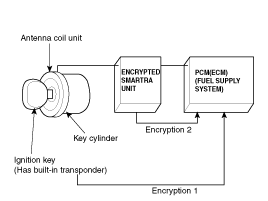
Components and Operation
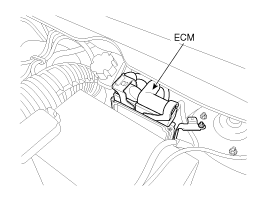
PCM (Powertrain Control Module)- The PCM (ECM) (A) verifies the ignition key using a special encryption algorithm that is programmed into the transponder and the PCM (ECM) simultaneously. The engine can be started only if the results match. Data for all transponders valid for the vehicle is stored in the PCM (ECM). The ERN (encrypted random number) value is exchanged between the EMS and the SMARTRA encoded unit, and the EMS determines the validity of the encoded key.
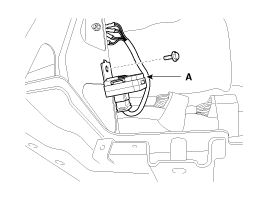
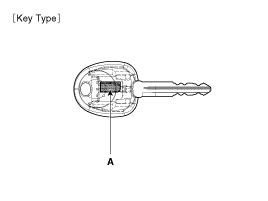
- The antenna coil supplies power to the transponder.
- The antenna coil receives the signal from the transponder.
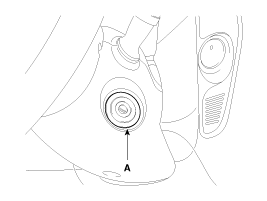
- The antenna coil sends the transponder signal to SMARTRA. It is located directly in front of the steering column lock.
Test yourself
A quick Hyundai Tucson LM quiz: every answer comes with an explanation and a link to the manual page.
Was this page helpful?