Emission Control System
Schematic Diagrams
In this manual: Emission Control System
~2min read
Schematic Diagram
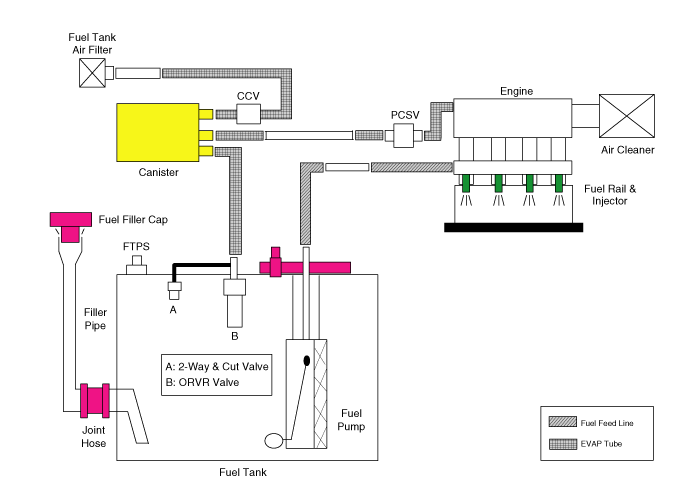
Fuel Tank Cap
The ratchet tightening mechanism in the threaded fuel tank cap reduces the possibility of incorrect installation when sealing the fuel filler neck. After the gasket on the fuel tank cap and the filler neck flange make contact, the ratchet makes a loud clicking sound, indicating that the seal is installed.
Fuel Tank Pressure Sensor (FTPS)
The Fuel Tank Pressure Sensor (FTPS) is an integral part of the monitoring system. The FTPS monitors the Purge Control Solenoid Valve (PCSV) and leaks in the evaporative emission control system by monitoring fuel tank pressure and vacuum level during PCSV operating cycles.
Canister Close Valve (CCV)
The Canister Close Valve (CCV) is located between the canister and the fuel tank air filter. It closes the air inlet to the canister for the evaporative emission control system and prevents fuel vapor from escaping from the canister when the vehicle is not operating.
Evaporative System Monitoring
The evaporative emission control system monitor checks for fuel vapor generation, vacuum, and leak check phases. First, the OBD-II system checks whether vapor generation due to fuel temperature is small enough to start monitoring. Then it evacuates the evaporative system through the PCSV with a ramp to maintain a specified vacuum level. The last step is to check that there is no loss of vacuum due to any leak in the system.
Vapor Generation Check
During the stabilization period, the PCSV and CCV are closed. The system pressure is measured as the initial pressure (DP_A). After a specified period of time (T1), the system pressure (DP_B) is measured again, and the difference from the initial pressure is calculated. If this difference (DP_B - DP_A) is greater than the threshold value, the vapor pressure must be excessive and the monitor is aborted for the next check. Conversely, if the difference is less than the negative threshold, the PCSV is judged faulty, for example stuck open.
Large Leak Detection (EVAP)
The PCSV opens with a specified ramp to reduce pressure to a specified level. If the pressure cannot be reduced below the threshold value, the system is considered to have an open fuel tank cap or a large leak.
Leak Check
The PCSV closes, and the system waits for some time to obtain stabilized pressure. During the test period (T2), the system measures the start and end pressure in the system (DP_C, DP_D). The diagnostic value is the pressure difference, corrected for natural vapor generation level (DP_B - DP_A) from the vapor generation check step.
Test yourself
A quick Hyundai Tucson LM quiz: every answer comes with an explanation and a link to the manual page.
Was this page helpful?