How does the airbag system work?
- The airbags are armed (ready to deploy if necessary) only when the ignition switch or the Engine Start/Stop button is turned to the ON position or the engine is running.
- The appropriate airbags inflate instantly in the event of a severe frontal or side collision to help protect occupants from serious bodily injury.
- There is no single speed at which the airbags will deploy. In general, airbags are designed to inflate depending on the severity and direction of the collision. These two factors determine whether the sensors produce an electronic deployment/inflation signal.
- Airbag deployment depends on a number of factors, including vehicle speed, angle of impact, and the density and rigidity of vehicles or objects that your vehicle strikes in a collision. The determining factors are not limited to those mentioned above.
- Front airbags fully inflate and deflate in an instant. It is virtually impossible to see the airbags inflate during an accident. It is much more likely that you will only see deflated airbags hanging out of their storage compartments after a collision.
- In addition to inflating in severe side collisions, side and/or curtain airbags will deploy if the sensor system detects a rollover.
- When a rollover is detected, the side and/or curtain airbags will remain inflated longer to help provide protection against ejection, especially when used together with seat belts.
- To help provide protection, airbags must inflate very quickly. The inflation speed of the airbag results in an extremely short time to inflate the airbag cushion between the occupant and the vehicle structures the occupant would otherwise strike. This inflation speed reduces the risk of serious or fatal injury and is therefore an essential part of the airbag design. However, airbag deployment can also cause injuries, which may include facial abrasions, bruises and bone fractures, because the airbag inflates with great force.
- There are even circumstances in which contact with the steering wheel or passenger airbag may result in fatal injuries, especially if the occupant is positioned too close to the steering wheel or passenger airbag.
WARNING – Airbag Deployment
Sit as far back from the steering wheel as possible while still maintaining comfortable control of your vehicle. A distance of at least 25 cm (10 in.) between your chest and the steering wheel is recommended. Failure to do so may result in injury from the driver airbag deployment.
Noise and Smoke
When the airbag deploys, it makes a loud noise and leaves smoke and powder in the air inside the vehicle. This is normal and is the result of ignition of the airbag inflator. After the airbag inflates, you may feel considerable discomfort in breathing due to chest contact with both the seat belt and the airbag, as well as from inhaling smoke and powder. Open the doors and/or windows as soon as possible after exposure to reduce discomfort and prevent prolonged exposure to smoke and powder.
Although the smoke and powder are non-toxic, they may cause irritation to the skin, eyes, nose and throat, etc. In this case, wash and rinse immediately with cold water and consult a doctor if symptoms persist.
WARNING - Hot Components
Do not touch the airbag module area components immediately after the airbag has deployed. Parts related to the airbag in the steering wheel, instrument panel, and roof rails above the front and rear doors are very hot. Hot components may cause burns.
WARNING
Do not install or place accessories near airbag deployment areas, such as the instrument panel, windows, pillars, and roof rails.
Do not install a child restraint on the front passenger seat.
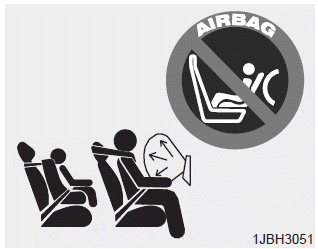
Never place a rear-facing child restraint in the front passenger seat. If the airbag deploys, it will strike the rear-facing child restraint, causing serious or fatal injury.
In addition, do not install a forward-facing child restraint in the front passenger seat. If the front passenger airbag inflates, it may cause serious or fatal injury to the child.
CAUTION - Airbag Deployment
- When children are seated in the rear side seats of the vehicle with side and/or curtain airbags, install the child restraint system as far from the door as possible. Inflation of the side and/or curtain airbags may strike the child.
- Do not install or place accessories near airbag deployment areas, such as the instrument panel, windows, pillars, and roof rails.
Test yourself
A quick Kia Forte BD quiz: every answer comes with an explanation and a link to the manual page.