Driving in Special Conditions. Driving in Winter Weather
Driving in winter weather requires special preparation: the chapter recommends a winter check, antifreeze protection, suitable battery care and correct tire selection. It also covers preventing the parking brake from freezing. Detailed instructions on the safe use of snow chains, including fitting, speed limits and legal notes, complete the winter tips. If you are prepared, the Kia Opirus keeps you mobile and safe even in cold weather.
We recommend carrying the following aids: snow chains, ice scraper, windshield de-icer, possibly a bag of sand, a small shovel and jumper cables.
Your KIA dealer will gladly carry out a winter check on request, in which the winter readiness of your vehicle is inspected. If you do not have a winter check carried out, check the following points before winter begins:
- Make sure that the engine coolant contains sufficient antifreeze.
- Check the condition of the battery and the battery cables. Cold reduces the capacity of a car battery. A battery in good condition is therefore important so that enough power is available to start the engine, even at low temperatures.
- Make sure the viscosity of the engine oil is suitable for low outside temperatures.
- Check the ignition system for loose cable and connector connections and for proper general condition.
- Add sufficient antifreeze to the windshield washer fluid (never use engine coolant antifreeze in the washer system).
- Do not apply the parking brake in freezing conditions. Instead, park in a low gear or, for automatic transmissions, in P (Park). If necessary, additionally block the wheels with wheel chocks.
Winter Tires
If you fit your Kia with winter tires, make sure the tire size and load rating match the data of the original tires.
Fit winter tires on all four wheels to maintain balanced handling in all weather conditions. Please also note that the traction of winter tires on dry roads may be lower than the traction of the standard summer tires.
Therefore, drive carefully even on roads that are free of snow.
Obtain information from your dealer regarding the maximum permitted speed for the respective winter tires.
CAUTION - Winter Tire SizesWinter tires must match the standard tires in their dimensions and construction.
Otherwise, the safety and handling of your vehicle may be permanently impaired. For more information on wheel/tire combinations, see Chapter 8.
Do not use studded tires until you have checked the local regulations on the use of such tires. The use of studded tires is not permitted in many countries.
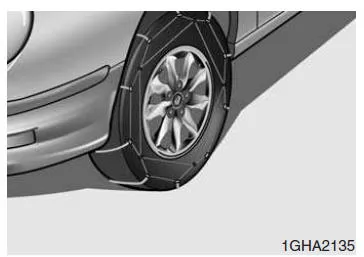
Snow chains
The tire sidewalls can be damaged by some types of snow chains. We therefore recommend using winter tires instead of snow chains. Do not fit snow chains to wheels with alloy rims, as alloy rims can be damaged by snow chains. If snow chains must be fitted, use fine-link chains with a diameter of less than 15 mm. Vehicle damage caused by improper installation of snow chains is not covered by the manufacturer's vehicle warranty.
Fit snow chains to the front wheels only.
CAUTION- Make sure the snow chains match your vehicle in size and specification. Snow chains that do not fit correctly may cause damage to the body and chassis. Damage of this kind is not covered by the vehicle manufacturer's warranty. The attachment hooks of the snow chains may be damaged if they come into contact with vehicle parts, so that the chains could come loose from the tire. Use only snow chains that comply with the DIN standard. Snow chains based on steel cables or plastic elements may also be used.
- After fitting snow chains, check that they are secure after driving approx. 50 - 100 m. Retighten the chains if they are not taut and secure.
Fitting the snow chains
When fitting the chains, follow the instructions of the chain manufacturer and secure the chains as tightly as possible. Drive slowly with the chains fitted.
If you hear the chains touching the body or chassis of your vehicle, stop and retighten the chains.
If the chains continue to touch the vehicle, reduce your speed until the chains no longer touch the vehicle. Remove the snow chains from the wheels as soon as you reach a road free of snow.
WARNINGTo fit the snow chains, park your vehicle on level ground and away from traffic. Switch on the hazard warning lights and, if necessary, place a warning triangle behind the vehicle. Apply the parking brake and engage a low gear or, for automatic transmissions, P (Park).
Switch off the engine before starting to fit the chains.
CAUTION - Snow Chains- Driving with snow chains fitted may permanently affect the handling of the vehicle.
- Do not drive faster than 30 km/h, or observe the speed limit specified by the chain manufacturer if it is lower.
- Drive carefully and avoid hitting the chains against other objects (e.g. curbs), driving through potholes, sharp cornering and other dangerous situations that could cause the vehicle to move unevenly.
- Avoid sharp steering movements and full braking.
- Snow chains of the wrong size, as well as chains that are not secured properly, can damage the brake lines, chassis, body and wheels of your vehicle.
- Stop and retighten the chains as soon as you hear them touching the vehicle.
The Kia Opirus 2003–2011 is well prepared for winter conditions if the recommended measures are observed. From fitting winter tires to carrying jumper cables, the Kia Opirus offers solutions for safe winter driving.
Using suitable snow chains and adapting your driving style help you stay in control on snowy and icy roads. This keeps the Kia Opirus a safe companion in all weather conditions.
FAQWhy should snow chains be fitted only to the rear wheels of the Kia Opirus 2003–2011?
Because that is where the drive force acts, which ensures the best traction.
What is the maximum speed when driving with snow chains?
Maximum 30 km/h, or the speed limit recommended by the chain manufacturer.
Test yourself
A quick Kia Opirus quiz: every answer comes with an explanation and a link to the manual page.