In this manual: Kia Sorento XM 2011-2023 Repair Manual
19steps
~114min
4/5difficulty
Done 0 of 19
Passive Functions. The system allows the user to access the vehicle without performing any action (for example, pressing the RKE button) on the SMART KEY FOB. It is sufficient that a valid SMART KEY FOB is located within a specified and limited range relative to the vehicle. Thus, the system is able to detect and authenticate the SMART KEY FOB within the ranges specified below.
Operating Range
The SMART KEY FOB receives and interprets the challenge sent by the vehicle through the external antennas in free space within a minimum radius of 0.7 m, measured around the external antennas built into the door handles; refer to the illustration below. The SMART KEY FOB receives and interprets the challenge sent by the vehicle through the external antennas in free space within a minimum radius of 0.7 m, measured around the external antennas built into the door handles; refer to the illustration below. Passive Access (Passive Entry): Pressing one of the buttons on the door handles when all doors are locked indicates the operator's intention to access the vehicle and therefore causes the system to unlock.
At least one door is open, and the two-step timer is not running. or
The two-step timer is running and one of the buttons other than the front left side is activated.
Passive Lock (Exit): Pressing one of the buttons on the door handles when one of the following conditions is met indicates the operator's intention to lock the vehicle and therefore causes the system to lock. Passive Tailgate Opening: Pressing the tailgate switch when the tailgate is closed indicates the operator's intention to open the tailgate, which causes the system to activate. Subsequently, the SMK ECU sends an LF challenge to the SMART KEY FOB through the external bumper antenna. The SMART KEY FOB responds with an RF response. If the received response matches the expected response, the SMK ECU sends a "tailgate open" message via the CAN network. SMART KEY Reminder 1
Preconditions: All terminals are OFF, at least one door is open, and the lock status is not locked. Checked by the SMK periodically every 100 ms while CAN/LIN is active.
Event: Status of at least 1 door handle changed from unlocked to locked.
SMK Actions:
A.
IF the FOB is not active, the SMK searches for FOBs inside the vehicle. The same LF strategy must be used as defined for the no-ID warning (registration only, without authentication).
B.
IF fob is ACTIVE, SMK sends a PDM request to search for a valid TP
If no fob or TP is found, no action is required. If any valid fob or valid TP is detected, the SMK unlocks the vehicle by sending a CAN key unlock message with the fob number reminder. If any valid fob is found, the SMK unlocks the vehicle by sending a CAN/LIN key unlock reminder message with the fob number.
Preconditions: All terminals are OFF, any door (including tailgate) is open, no FOB-IN, and no lock (checked by the SMK periodically every 100 ms while CAN/LIN is active).
Vehicle action: Closing the last door or tailgate when the handles are in locked state or while locking is in progress.
SMK actions: Before 500 ms have elapsed after closing, if all doors are locked, then:
A.
IF the FOB is not active, the SMK searches for FOBs inside the vehicle. The same LF strategy must be used as for the no-ID warning (registration only, without authentication).
B.
IF fob is ACTIVE, SMK sends a PDM request to search for a valid TP
If the FOB is not found, no action is required. If any valid FOB or valid TP is found, the SMK sends an unlock command via CAN and activates the additional buzzer warning. If any valid FOB is found, the SMK sends an unlock command via CAN/LIN and activates the additional buzzer warning.
Preconditions: While (at least one door handle is unlocked) and (ACC ON or IGN ON) and (no FOB):
A.
(All doors closed) and (trunk closed)
Event:
A.
User presses the button on the door handle or trunk
SMK actions: The SMK searches for key fobs outside the vehicle using the same LF strategy as for "Scenario Access", with the difference in input/output.
Preconditions: Same as the passive locking precondition, but with at least one door open.
Event: User presses the button on the door handle.
SMK actions: The SMK searches for key fobs outside the vehicle using the same LF strategy as for "Scenario Access", with the difference in input/output. If no key fob is found, no action is required. If the preconditions cease to be valid while the time buzzer is active (3 seconds), the SMK ECU immediately turns off the buzzer.
Preconditions: Same as the passive lock precondition
User action:
A.
User presses the door handle button
SMK ECU actions:
A.
If the ATWS (Anti-Theft Warning System) is in the DISARM state, the SMK ECU searches for a key fob inside the vehicle (use scenario "Door Lock Warning 3").
SMK actions: While the preconditions are met, the SMK ECU periodically searches for key fobs inside the vehicle. The same LF strategy must be used, since it is defined for the no-ID warning (registration only, no authentication). Periodic search is performed every 3 seconds. If no key fob is found, the SMK ECU activates the key-out warning lamp, since all preconditions are valid, and another search will be performed after 3 seconds.
SMART KEY Reminder 2. Door Lock Warning by SMART KEY. Door Lock Warning 1. Door Lock Warning 2. Door Lock Warning 3. If the FOB is not found, passive locking is performed. If any valid FOB is detected, the SMK ECU activates the exterior buzzer. If the activity timer has expired, or ACC is ON, or IGN1 is ON, or NO DOOR is closed, or FOB-IN, the SMK ECU immediately turns off the buzzer. After searching for the interior FOB, the SMK ECU also searches for FOBs outside the vehicle. SMART KEY Indicator Warning: If any valid FOB is detected, the SMK ECU turns off the key-off indicator lamp and (if one door is open) performs another search after 3 seconds; if no door is open, the search resumes only the next time the preconditions are still valid, by opening one door. User Information Functions
ID OUT Warning
Preconditions:
A.
(ACC or IGN1) & (any door open or trunk open)
Event: Last open door closed
SMK action: SMK searches for the SMART KEY FOB inside the cabin.
A.
If a valid SMART KEY FOB is not found, the SMK activates the external buzzer and also sends the ID OUT WNG message via CAN (external warning buzzer and internal warning buzzer).
B.
If a door is opened and closed again while the terminals are on a valid key fob and inside the vehicle, the SMK re-enables authentication and stops the warning. If the terminal is in ACC, the SMK must turn on the immobilizer lamp.
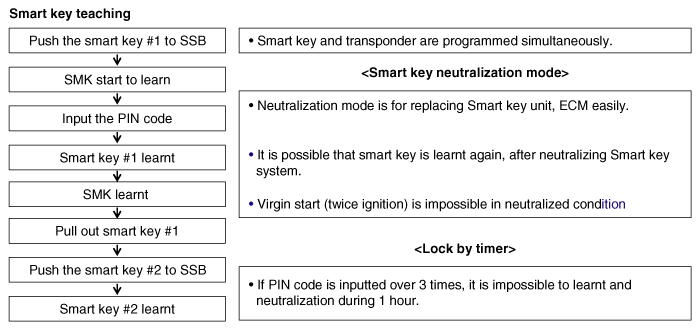
Immobilizer Lamp: Removing the PIF from the MSL and reinstalling the PIF and pressing the MSL handle will turn the lamp on again. FOB Low Battery Voltage Detection: To detect a low FOB battery condition, a specific battery voltage measurement and low voltage detection strategy are implemented in the FOB. The battery voltage measurement is performed if the FOB button is pressed or if an LF measurement command is received. If the FOB detects a low battery voltage, the LED will not light up when the button is pressed. Learning Procedure Description: This chapter describes the learning procedure for the SMK and FOB. Communication with the diagnostic tool is required to learn the SMK and FOB. LEARNING MODE: In any mode, the learning process is controlled by the SMK. Before starting learning, the Fob-In signal must be active and the vehicle secret code (called the PIN code) must be known. LEARNING MODE: This mode is used by dealers to replace the SMK and/or key set or to register additional keys for an existing system. This means the system is already learned to a specific PIN code. The PIN code is fixed for the entire service life of the vehicle, so in this mode. Otherwise, learning will fail. LEARNING MODE: Procedure Description (Step by Step). Purpose: Key learning procedure at a service station. Initial condition:
SMK replacement: SMK is not registered, while the SMART FOB is already registered with the same PIN code.
Learning additional or new keys: The SMK has already learned with the same PIN code.
Starting After Replacement (Initial Start): Starting is possible in the following order after replacing the new SMART KEY ECU and key FOB.
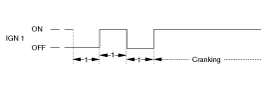
This is for starting from the virgin state
All related parts must be in original condition (Smart Key, IPM, ECM).
Depress the brake pedal in P or N range
Press the start button once with the virgin smart key.
?
Test yourself
A quick Kia Sorento Owner's Manual quiz: every answer comes with an explanation and a link to the manual page.