Emergency Starting
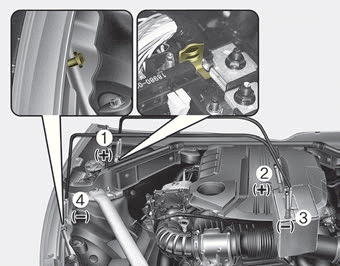
Connect the cables in numerical order and disconnect them in the reverse order.
Quick Start
Jump starting can be dangerous if it is not done correctly. To avoid injury to yourself or damage to your vehicle or battery, follow these jump starting procedures. If you are unsure, we strongly recommend that you have a qualified technician or towing service jump start your vehicle.
WARNING - Jump Starting the 12-Volt Battery
Use only a 12-volt jump starting system. Using a 24-volt power source (either two 12-volt batteries connected in series or a 24-volt motor-generator) may damage the 12-volt starter motor, ignition system, and other non-repairable electrical components.
WARNING - Battery
Never attempt to check the electrolyte level in the battery, as the battery may burst or explode.
WARNING! Frozen Battery
Do not attempt to jump start the vehicle if the discharged battery is frozen or if the electrolyte level is low, as the battery may burst or explode.
WARNING - Battery
Keep all sources of flame or sparks away from the battery. The battery generates hydrogen gas, which can explode when exposed to flame or sparks.
WARNING. Sulfuric Acid Hazard
Use caution when jump starting the vehicle to prevent battery acid from contacting your skin, clothing, or the vehicle. Automotive batteries contain sulfuric acid. It is poisonous and very corrosive.
Jump Starting Procedure
1. Make sure the booster battery has 12 V and that its negative terminal is grounded.
2. If the booster battery is in another vehicle, do not allow the vehicles to touch.
3. Turn off all unnecessary electrical loads.
4. Connect the jumper cables in the exact sequence shown in the illustration. First, connect one end of the jumper cable to the positive terminal of the discharged battery (1), then connect the other end to the positive terminal of the booster battery (2).
Continue by connecting the other end of the jumper cable to the negative (-) terminal of the booster battery (3), then connect the other end to a solid, stationary metal ground point (such as the engine lifting bracket) away from the battery (4). Do not connect it to any part that moves when the engine is started, or near such a part. Do not allow the jumper cables to contact anything other than the correct battery terminals or correct ground. Do not lean over the battery when making connections.
WARNING. Battery Cables
Do not connect the jumper cable to the negative (-) terminal of the discharged battery. This may cause the battery to overheat and crack, releasing battery acid. Be sure to connect one end of the jumper cable to the negative (-) terminal of the booster battery and the other end to a metal point away from the battery.
5. Start the engine of the vehicle with the booster battery and let it run at 2000 rpm, then start the engine of the vehicle with the discharged battery.
If the cause of the battery discharge is not obvious, have the vehicle inspected by an authorized Kia dealer.
Push Start
Vehicles equipped with an automatic transmission shift lock system cannot be started using the push-button start.
Follow the instructions in this section for jump starting.
WARNING - Towing to Start the Vehicle
Never tow the vehicle to start it. When the engine starts, the vehicle may suddenly lurch forward and may collide with the towing vehicle.
Test yourself
A quick Kia Stinger CK quiz: every answer comes with an explanation and a link to the manual page.