Seat belts
Important safety notes
WARNINGA seat belt that is incorrectly positioned or not properly fastened cannot provide the intended protection. Under certain circumstances, you could be seriously or even fatally injured in an accident.
Therefore, make sure that all occupants, including pregnant women, are always properly restrained.
- The seat belt must lie snugly against the body and must not be twisted. Avoid wearing thick clothing (such as a winter coat). The seat belt must cross the shoulder, never the neck or under the arm, and lie flat against the body. The lap portion must always be taut and run as low as possible across the hips, i.e. in the groin area, not over the stomach or lower abdomen. If necessary, pull the belt slightly downward and feed the excess webbing back toward the retractor.
- Do not route the belt over sharp or fragile objects. This applies in particular to objects on your clothing or in your pockets (glasses, pens, keys, etc.). Otherwise, the belt could be damaged and tear in an accident. You or other vehicle occupants could then be injured.
- A seat belt must only be used by one person at a time. A child must never be carried on an occupant's lap while the vehicle is moving. The occupant could not hold the child in an accident, during hard braking or a sudden change of direction. The child and other occupants could then be seriously or even fatally injured.
- Seat belts cannot be positioned correctly for persons under 1.50 m. Therefore, protect persons under 1.50 m with suitable restraint systems.
- Children under 1.50 m or under 12 years of age cannot be properly restrained with seat belts. Therefore, always protect them with a suitable child restraint system installed on an appropriate vehicle seat. For more information, see the “Transporting children” section of the “Safety” chapter. Follow the installation instructions of the child restraint system manufacturer.
- Never fasten both objects and a person with the same seat belt.
If the seatback is not upright or nearly upright, the seat belt cannot provide the intended protection. In certain circumstances, you could be seriously or even fatally injured in an accident.
Before driving, make sure the seat is correctly adjusted and the seatback is almost upright.
WARNINGIf the seat belt is dirty or damaged, or if it has been loaded or deformed in an accident, it cannot provide the intended protection. In certain circumstances, you could be seriously or even fatally injured in an accident.
Therefore, regularly check that the seat belts are not damaged or dirty.
Always have seat belts that are damaged or have been loaded in an accident replaced by a qualified workshop.
For safety reasons, Mercedes-Benz recommends using only seat belts specifically approved by Mercedes-Benz for your vehicle.
In a collision, the seat belts are the most effective means of reducing occupant movement. As a result, the risk of contact with parts of the interior is reduced.
Fastening the seat belts
- Adjust the seat and move the seatback to almost upright.
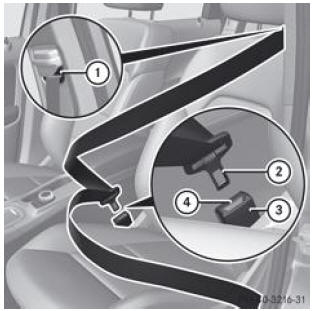
- Pull the belt smoothly out of the guide loop 1.
- Route the upper part of the belt across the middle of the shoulder and the lower part of the belt across the hips, without twisting the seat belt.
- Engage the tongue 2 in the buckle 3.
Seat belt fitting: the seat belts automatically adapt to the chest of the driver and front passenger.
- If necessary, adjust the height of the seat belt according to your height.
- If necessary, pull the seat belt up at chest level so that it fits snugly against the body.
For more information on unbuckling the seat belts with release button 4, see "Unfastening the seat belts"
Seat belt fitting
The seat belt fitting function adapts the seat belts to the chest of the driver and front passenger.
The belt then tightens slightly when
- you engage the tongue in the buckle and turn the key to position 2 in the ignition switch
- the key is in position 2 in the ignition switch and you engage the tongue in the buckle
When the seat belt is being fitted, a certain retraction force is applied if the system detects slack between the occupant and the belt. In this case, do not hold the seat belt back. You can activate and deactivate seat belt fitting via the on-board computer.
Seat belt fitting is a comfort function integrated into the PRE-SAFE® system. You will find more information on the PRE-SAFE® system in the section "PRE-SAFE® (anticipatory occupant protection)".
Seat belt height adjustment
Seat belt height adjustment is possible for the driver's seat and the front passenger's seat.
Adjust the seat belt height so that the upper part of the belt crosses the shoulder.
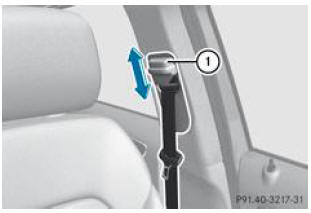
- Higher: push the upper belt guide upward.
The belt guide can lock in several positions.
- Lower: press and hold the release button of the belt guide 1.
- Move the belt guide downward.
- Release the release button of the belt guide 1 and make sure the belt guide locks into a detent.
Unfastening the seat belts
Make sure the seat belt retracts fully. Otherwise, the seat belt or buckle tongue may become trapped in the door or seat mechanism. The door, door trim and seat belt may then be damaged. Damaged seat belts can no longer perform their protective function and must be replaced. Have them replaced at a qualified workshop.- Press release button 4 and guide tongue 2 back toward the belt guide 1 of the seat belt.
Seat belt warning for driver and front passenger
The seat belt warning light located in the instrument cluster
is intended to remind you that all occupants must fasten their seat belts. It may light up continuously or flash. In addition, a warning signal may sound.
The seat belt warning light goes out and the warning signal stops
as soon as the driver and front passenger have fastened their seat belts.
For certain countries only: each time the engine is started, the seat belt warning light lights up
for 6 seconds, even if the driver and front passenger have already fastened their seat belts. It then goes out if the driver and front passenger have fastened their seat belts.
, see “Indicator and warning lamps in the instrument cluster, Seat belts”.Rear seat belt status indicator
The rear seat belt status indicator lets you see whether the rear passengers have fastened their seat belts.
The rear seat belt status indicator shows which seat belts are fastened in the rear.
When a seat belt is fastened, the symbol is shown on the display. When a
seat belt is not fastened or a rear seat is not occupied, the symbol is shown.
The rear seat belt status indicator appears on the multifunction display for approximately 30 seconds when
- you drive faster than 10 km/h after starting
- the rear passengers fasten or unfasten their seat belts while driving
- people get into or out of the vehicle and the vehicle then moves off again
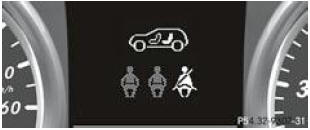
Example: the passenger seated in the rear left seat has fastened the seat belt. You can also hide the rear seat belt status indicator immediately:
- Press the button
 or the
button on the steering wheel.
Belt retractors and belt force limiters
WARNINGIf the belt tensioners have triggered, they can no longer provide their protective function in a subsequent accident. Therefore, have the triggered belt tensioners replaced by a qualified workshop.
For disposal of the belt tensioners, observe the safety instructions. You can have them disposed of at any Mercedes-Benz Service Center.
If the front passenger seat is not occupied, do not insert the buckle tongue into the front passenger seat belt buckle. Otherwise, the belt retractor could trigger in an accident.The front seat belts are equipped with a belt tensioner and a force limiter. The seat belts of the outer rear seats are equipped with belt tensioners.
The purpose of the belt tensioners is to tighten the seat belts so that they fit snugly against the body.
The belt tensioners cannot correct an incorrect seating position or an incorrect position of the seat belt.
The belt tensioners do not pull vehicle occupants back against the seat backrest.
When triggered, the force limiter reduces the pressure exerted by the belt on the occupant.
The force limiters of the front seat belts are matched to the front airbags, which absorb part of the deceleration forces. The load is then distributed over a larger area.
The belt tensioners can only be activated
- if the ignition is switched on
- if the restraint systems are operational, see "SRS warning lamp"
- at each of the front 3-point seat belts when they are fastened
The belt tensioners of the outer rear seats trigger independently of the locking status of the seat belts.
Depending on the type and severity of the accident, the belt tensioners are activated
- in a frontal or rear collision, if the vehicle undergoes significant deceleration or acceleration in the longitudinal direction at the moment of impact
- in a side collision, if the vehicle undergoes significant deceleration or acceleration in the transverse direction
When the belt tensioners trigger, a loud bang and possibly a release of dust occur. With rare exceptions, this bang is not harmful to hearing. The dust released is generally not harmful. The SRS warning lamp lights up.
Test yourself
A quick Mercedes-Benz B-Class quiz: every answer comes with an explanation and a link to the manual page.