Suitable positioning of the child restraint system
Correct positioning of the child restraint system in the Mercedes E-Class (4th generation W212, 2009–2016) is essential for safety. This article provides clear instructions on optimal placement and the appropriate settings. This way you can protect your child as well as possible and increase driving comfort. Rely on Mercedes-Benz safety recommendations.
Introduction
Only child restraint systems approved to ECE regulation ECE-R44 may be used in the vehicle.
With certain child restraint systems of weight group II or III, the range of use may be restricted. Contact with the roof may prevent the maximum size setting of the child restraint system from being possible.
Child restraint systems of the "Universal" category are marked with an orange approval label and the text "Universal".
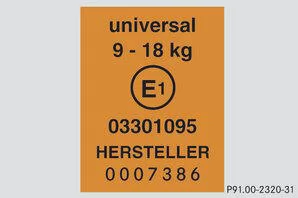
Approval label on the child restraint system (example)
"Universal" child restraint systems may be used on the seating positions marked U or IUF, in accordance with the tables "Suitability of seating positions for installing belted child restraint systems" or "Suitability of seating positions for installing an ISOFIX child restraint system".
Semi-universal child restraint systems are marked on the approval label with the text "semi-universal". If the vehicle and the seating position are listed in the vehicle type list of the child restraint system manufacturer, they may be used. For further information, contact the child restraint system manufacturer or visit its website.
Child restraint system on the front passenger seat – if circumstances require you to secure a child in a child restraint system on the front passenger seat: Always observe the notes under "Child restraint system on the front passenger seat".
There you will also find information on the correct routing of the shoulder belt from the belt outlet on the vehicle to the shoulder belt guide of the child restraint system.
Move the front passenger seat as far back as possible and additionally to the lowest position.
Set the seat belt height adjuster to the lowest position.Adjust the seatback to an almost upright position.
The base of the child restraint system must rest fully on the front passenger seat cushion. The back of a forward-facing child restraint system must lie as flat as possible against the front passenger seatback. The child restraint system must not touch the roof or be loaded by the head restraint. Adjust the seatback angle and the head restraint setting accordingly. Also observe the installation instructions of the child restraint system manufacturer.
Suitability of seating positions for installing belted child restraint systems
If you use a group 0 or 0+ infant carrier or a group I rearward-facing child restraint system on a rear seat, you must adjust the driver's or front passenger seat so that it does not touch the child restraint system.
If you use a group I forward-facing child restraint system, you must remove the head restraint of the corresponding seating position if possible. The back of the child restraint system must lie as flat as possible against the seatback of the vehicle seat.
Always also observe the notes under "Child restraint system" and the installation instructions of the child restraint system manufacturer.
When you remove the child restraint system, you must reinstall the head restraint immediately. All vehicle occupants must correctly adjust the head restraint before driving.
| Table legend: | |
|---|---|
| X | Seating position not suitable for children in this weight group. |
| U | Suitable for "Universal" category child restraint systems approved for use in this weight group. |
| L | Suitable for child restraint systems as recommended, see table "Recommended child restraint systems". Suitable for semi-universal child restraint systems if the vehicle and the seating position are listed in the vehicle type list of the child restraint system manufacturer. |
| Weight group | Front passenger seat | Rear seat | |||
|---|---|---|---|---|---|
| Front passenger airbag on | Front passenger airbag off | left, right | center |
||
| 0 | up to 10 kg | X | X | U | U |
| 0+ | up to 13 kg | X | L |
U | U |
| I | 9 kg to 18 kg | L | L | U | U |
| II | 15 kg to 25 kg | U, L | L | U | U |
| III | 22 kg to 36 kg | U, L | L | U | U |
Info
Vehicles with a fold-down rear bench in the cargo area (estate model): Information on child restraint systems on the fold-down bench is available at any Mercedes-Benz Service Center.
Suitability of seating positions for installing ISOFIX child restraint systems
If you use a group 0 or 0+ infant carrier or a group I rearward-facing child restraint system on a rear seat, you must adjust the driver's or front passenger seat so that it does not touch the child restraint system.
If you use a group I forward-facing child restraint system, you must remove the head restraint of the corresponding seating position if possible. The back of the child restraint system must lie as flat as possible against the seatback of the vehicle seat.
Always also observe the notes under "Child restraint system" and the installation instructions of the child restraint system manufacturer.
When you remove the child restraint system, you must reinstall the head restraint immediately. All vehicle occupants must correctly adjust the head restraint before driving.
| Table legend: | |
|---|---|
| X | ISOFIX position not suitable for ISOFIX child restraint systems in this weight group and/or size class. |
| IUF | Suitable for forward-facing ISOFIX child restraint systems of the "Universal" category approved for use in this weight group. |
| IL | Suitable for ISOFIX child restraint systems as recommended, see the following table "Recommended child restraint systems". A recommendation for a suitable ISOFIX child restraint system is also available from the manufacturer. Your vehicle and the seating position must be listed in the vehicle model list of the child restraint system manufacturer. For further information, contact the child restraint system manufacturer or visit its website. |
| Weight group | Size class | Device | Rear seat left/right | |
|---|---|---|---|---|
| Baby carrier | F | ISO/L1 | X | |
| G | ISO/L2 | X | ||
| 0 | up to 10 kg up to approx. 6 months |
E | ISO/R1 | IL |
| 0+ | up to 13 kg up to approx. 15 months |
E | ISO/R1 | IL |
| D | ISO/R2 | IL | ||
| C | ISO/R3 | IL | ||
| I | 9 to 18 kg approx. 9 months to 4 years |
D | ISO/R2 | IL |
| C | ISO/R3 | IL | ||
| B | ISO/F2 | IUF | ||
| B1 | ISO/F2X | IUF | ||
| A | ISO/F3 | IUF | ||
The child restraint system must not touch the roof or be loaded by the head restraint. Adjust the head restraint accordingly. Also observe the installation instructions of the child restraint system manufacturer.
The Mercedes E-Class W212 (model years 2009–2016) offers a wide range of options for safely positioning child restraint systems. Thanks to equipment that complies with ECE regulations and tested systems, children can be transported safely, whether in the front or the rear.
The clear marking of suitable seating positions and the recommendations for seat and seat belt height adjustment make correct use easier and give parents valuable guidance.
This ensures that children are optimally protected and that the safety of the E-Class remains at the highest level.
Test yourself
A quick Mercedes-Benz E-Class quiz: every answer comes with an explanation and a link to the manual page.