Seat belts
The seat belts of the Mercedes E-Class (4th generation W212, 2009–2016) are a central component of the protection concept. This article explains how the belts are best used and which safety functions are integrated. This helps ensure that all passengers are protected as well as possible. The E-Class combines comfort with the highest safety quality.
Introduction
A correctly worn seat belt is the most effective way to limit the movement of the occupant in a collision or rollover. This reduces the risk of occupants contacting parts of the vehicle interior or being thrown out of the vehicle. The seat belt also helps keep the occupant in a better position relative to the deploying airbag.
The seat belt system consists of
- seat belts
- belt tensioners for the front seat belts and the outer rear seat belts
- belt force limiters for the front seat belts and the outer rear seat belts
In a collision, the belt tensioner pulls the seat belt taut so that it fits closely against the body. However, it does not pull the occupant back toward the seat back.
The belt tensioner also does not correct an incorrect seating position or the belt routing of an incorrectly worn seat belt.If the seat belt is additionally equipped with a belt force limiter, it reduces the belt load on the occupant when activated.
The belt force limiters of the front seats are matched to the front airbags, which absorb part of the deceleration forces. This can reduce the load on the vehicle occupants during an accident. NoteIf the front passenger seat is not occupied, do not insert the seat belt buckle tongue into the front passenger seat buckle. Otherwise, the belt tensioner may trigger in an accident and must be replaced.
Important Safety Notes
WARNINGIf the seat belt is worn incorrectly, it cannot provide protection as intended. In addition, an incorrectly worn seat belt can cause additional injuries, for example in an accident, during braking maneuvers or with abrupt changes of direction. There is an increased risk of injury or even of death!
Always make sure that all vehicle occupants are correctly belted and seated properly.
WARNINGIf the seatback is not in an almost upright position, the seat belt does not provide the intended restraint protection. In this case, you may slide under the seat belt during a braking maneuver or in an accident and sustain injuries, for example to the abdomen or neck. There is an increased risk of injury or even of death!
Adjust the seat correctly before driving. Always make sure the seatback is in an almost upright position and the shoulder belt portion runs across the middle of the shoulder.
If you transport a child under twelve years old and under 1.50 m tall in the vehicle,
- always secure the child in a child restraint system suitable for this Mercedes-Benz vehicle. The child restraint system must be appropriate for the child's age, weight and size
- be sure to observe the instructions and safety notes on "Children in the vehicle" in this owner's manual, as well as the installation instructions from the manufacturer of the child restraint system.
Seat belts cannot provide protection as intended if
- they are damaged, altered, heavily soiled, bleached or discolored
- the buckle is damaged or heavily soiled
- modifications have been made to the belt tensioners, belt anchorages or belt retractors.
Never modify the seat belts, belt tensioners, belt anchorages or belt retractors. Make sure the seat belts are undamaged, not worn and clean. After an accident, have the seat belts checked immediately at a qualified specialist workshop.
Mercedes-Benz recommends that you use seat belts approved by Mercedes-Benz for your vehicle. Otherwise, the vehicle's operating permit may become void.
Correct Use of the Seat Belts
Observe the safety notes for the seat belt.
All vehicle occupants must correctly fasten their seat belts before driving. Also make sure during the journey that all vehicle occupants are always correctly wearing their seat belts.
When fastening the seat belt, be sure to ensure that- the seat belt tongue is only inserted into the buckle belonging to the seat position.
- the seat belt fits snugly against the body.
Avoid bulky clothing, e.g. a winter coat.
- the seat belt is not twisted.
Only then can the forces that occur be distributed over the width of the belt.
- the shoulder belt always runs across the middle of the shoulder.
The shoulder belt should not touch the neck and must not be routed under the arm. If possible, adjust the seat belt to the height suited to your body size.
- the lap belt fits closely and as low as possible across the hips.
The lap belt must always run across the hip joint and never over the abdomen or lower stomach. Pregnant women in particular must pay attention to this. If necessary, press the lap belt down into the hip joint and pull it taut with the shoulder belt.
- the seat belt does not run over sharp, pointed or fragile objects.
If such objects are on or in your clothing, e.g. a pen, keys or glasses, store them in a suitable place.
- only one person is ever belted in with one seat belt.
Never carry an infant or child on the lap of a vehicle occupant. In an accident, they may be crushed between the vehicle occupant and the seat belt.
- objects are never belted in together with a person.
Seat belts are intended exclusively for securing and restraining persons. To secure objects, luggage or cargo, always observe the "Loading Guidelines".
Fastening and Adjusting the Seat Belt
Observe the safety notes for the seat belt and the information on the correct use of the seat belt.
If a person is wearing the center rear seat belt, also observe the information on the seat belt for the center rear seat position.
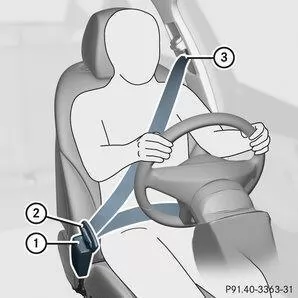
 Adjusting the Seat
Pull the seat belt smoothly out of the belt outlet and insert the buckle tongue
 into the buckle
 until it latches.
If necessary, pull the seat belt up in front of the chest so that it fits snugly against the body.
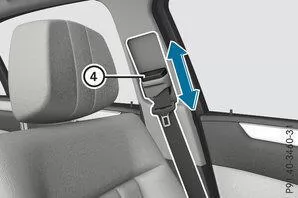
Estate models: You can also adjust the belt height on the outer rear seats.
The shoulder belt must always run across the middle of the shoulder. If necessary, adjust the belt outlet.Raise: Slide the belt outlet upward.
Lower: With the belt outlet release button pressed, slide the belt outlet downward.
In the desired position, release the belt outlet release buttonand make sure the belt outlet engages.
Seat Belt for the Center Rear Seat
If the left rear seatback is folded forward and back again, the center rear seat belt may be locked. The seat belt then cannot be pulled out.
Unlocking the center rear seat belt: Pull the seat belt out approx. 20 mm at the belt outlet on the seatback and release it.Releasing the Seat Belt
NoteMake sure the seat belt retracts completely. Otherwise, the seat belt or the buckle tongue may become trapped in the door or seat mechanism. This can damage the door, door trim and seat belt. Damaged seat belts cannot perform their protective function and must be replaced. Consult a qualified specialist workshop.
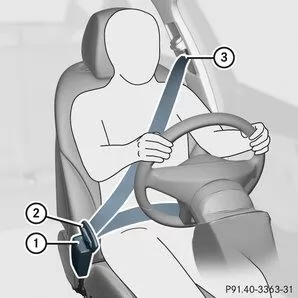 Release buttonPress the release button, hold the buckle tongueand guide it backto the belt outlet.
Belt Adjustment
Belt Adjustment is a comfort function integrated into PRE-SAFE. This function adjusts the seat belt of the driver and front passenger seats to the occupant's upper body.
To do this, the belt webbing is slightly tensioned when- the buckle tongue is latched in the buckle and
- the ignition is switched on.
If slack is detected between the vehicle occupant and the seat belt, the belt adjustment takes place with a certain retraction force. Do not hold the seat belt while this occurs.
You can switch Belt Adjustment on and off in the on-board computer.
Seat Belt Warning for Driver and Front Passenger
The seat belt warning lamp in the instrument cluster reminds you that all vehicle occupants must fasten their seat belts. It may light up continuously or flash. A warning tone may also sound.
The seat belt warning lampand the warning tone stop as soon as the driver and front passenger are belted in.
Further Information on the Seat Belt Warning Lamp, see "Warning and Indicator Lamps in the Instrument Cluster, Seat Belt"
Rear Seat Belt Status Indicator
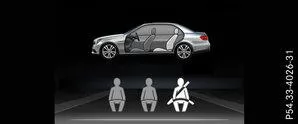
The rear seat belts on the driver's side and center rear seat are not fastened. (Example: sedan)
The rear seat belt status indicator is only available in certain countries.
The rear seat belt status indicator shows for approx. 30 seconds which rear seat belt is not fastened.
The rear seat belt status indicator appears when- You start driving and reach a speed of approx. 10 km/h
- rear passengers fasten or unfasten their seat belts while the vehicle is moving
- passengers get in or out of the vehicle and you drive off again.
You can also hide the rear seat belt status indicator immediately.
The seat belts of the Mercedes E-Class W212 (model years 2009–2016) are an essential part of the occupant protection concept. With functions such as belt tensioners, belt force limiters and automatic adjustment, they provide optimal restraint in accidents or sudden braking maneuvers.
Particular attention must be paid to correct use in order to achieve full protective effect. Mercedes-Benz has established clear guidelines to ensure occupant protection at the highest level.
Question: What safety functions do the seat belts in the E-Class W212 provide?
Answer: The seat belts are equipped with belt tensioners, belt force limiters and height adjustment, which improve restraint in an emergency.
Question: What must be observed when fastening the seat belt?
Answer: The belt should fit snugly, must not be twisted, and must run correctly over the shoulder and hip to ensure optimal protective function.
Test yourself
A quick Mercedes-Benz E-Class quiz: every answer comes with an explanation and a link to the manual page.