Jump Starting
Never start the engine using a fast charger.
When the battery is discharged, start the engine using jumper cables and the battery of another vehicle.
Caution
Jump starting with jumper cables must be carried out with the utmost care.
Failure to follow the instructions below may result in accidents or battery explosion, as well as damage to the electrical systems of both vehicles.
Caution
Avoid contact with eyes, skin, fabrics, and painted surfaces. Battery electrolyte contains sulfuric acid, which can cause injury and damage on direct contact.
- No open flames or sparks near the battery.
- A discharged battery can freeze at a temperature of 0 °C.
Thaw a frozen battery before connecting the jumper cables.
- When working near the battery, wear goggles and protective clothing.
- Use a booster battery with the same voltage (12 volts). Its capacity (Ah) must not be much lower than that of the discharged battery.
- Use jumper cables with insulated clamps and a cross-section of at least 16 mm2, or 25 mm2 for diesel engines.
- Do not disconnect the discharged battery from the vehicle electrical system.
- Switch off all non-essential electrical consumers.
- Do not lean over the battery during the entire procedure.
- Make sure the clamps of the jumper cables do not touch each other.
- The vehicles must not touch each other during jump starting.
- Apply the parking brake, and place the manual transmission in neutral or the automatic transmission in P.
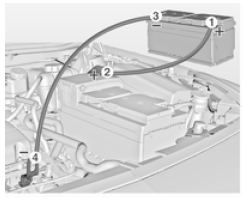
Jumper cable connection sequence:
- Connect the red cable to the positive terminal of the booster battery.
- Connect the other end of the red cable to the positive terminal of the discharged battery.
- Connect the black cable to the negative terminal of the booster battery.
- Connect the other end of the black cable to a ground point on the vehicle, such as the engine block or an engine mounting bolt.
Connect it as far away from the discharged battery as possible, at least 60 cm in any case.
Route the cables so that they cannot be caught by moving parts in the engine compartment.
Jump-starting the engine:
- Start the engine of the donor vehicle.
- After 5 minutes, start the other engine. Starting attempts must not exceed 15 seconds, with an interval of 1 minute between attempts.
- Run both engines at idle for about 3 minutes with the cables connected.
- Switch on electrical consumers (e.g. headlights, rear window heater) on the donor vehicle.
- Remove the cables in exactly the reverse order of installation.
Test yourself
A quick Opel Insignia quiz: every answer comes with an explanation and a link to the manual page.