Preliminaries
KEYLESS VEHICLE FUNCTION
1. APPLICABILITY OF THIS DOCUMENT
This document describes the diagnosis applicable to all electronic control units with the following characteristics:
| Vehicle(s): Mégane II Function concerned: Keyless vehicle |
ECU name: Programme no.: VDIAG no.: 04 |
2. ESSENTIAL ITEMS FOR DIAGNOSIS
Documentation type
Diagnostic methods (this document and the technical notes for the injection system fitted to the vehicle, the Passenger Compartment Central Unit and the Protection and Switching Unit):
- Assisted diagnosis (built into the diagnostic tool), paper (Repair Manual or Technical Note), Dialogys.
Wiring diagrams:
- Visu-Schéma (CD-ROM), paper.
Diagnostic tool type
- CLIP
Essential tool type
Essential special tools |
| Multimeter |
| Elé 1681 universal breakout box |
3. REMINDERS
Procedure
To diagnose the vehicle control units, switch the ignition to diagnostic mode (+ after forced ignition).
Proceed as follows:
- Place the vehicle key on the key holder (vehicles without key scenario 1, entry level, without hands-free and scenario 2, high end, with hands-free),
- long press (more than 5 seconds) on the "start" button outside starting conditions,
- connect the diagnostic tool and carry out the required operations.
Diagnosis is therefore only possible after switching the ignition to diagnostic mode (+ after forced ignition) and switching on the dipped headlights.
To cut the + after ignition, proceed as follows:
- disconnect the diagnostic tool,
- briefly press the "start" button twice (less than 3 seconds each time),
- check that the + after ignition supply is cut by the ECU warning lights going out on the instrument panel.
Faults
There are declared present faults and declared stored faults (which appeared under certain conditions and have since cleared, or are still present but were not diagnosed under the current conditions).
The present or stored state of faults must be considered when the diagnostic tool is connected after switching on the + after ignition (without operating any components of the system).
For a present fault, apply the procedure given in the Fault Interpretation chapter.
For a stored fault, note the displayed faults and apply the instructions section.
If the fault is confirmed by applying the instruction, the fault is present. Repair the fault.
If the fault is not confirmed, check:
- the electrical circuits corresponding to the fault,
- the connectors of these lines (corrosion, bent pins, etc.),
- the resistance of the component detected as faulty,
- the condition of the wiring (melted or cut insulation, chafing).
Conformity check
The conformity check aims to verify states and parameters that do not show a fault on the diagnostic tool when they are inconsistent. This step therefore allows:
- diagnose faults with no fault display that may correspond to a customer complaint,
- verify correct operation of the system and make sure a fault will not reappear after repair.
This chapter therefore contains a diagnosis of states and parameters, under the conditions required for their check.
If a state does not operate normally or a parameter is out of tolerance, refer to the corresponding diagnostic page.
Particularities of compliance checks for the keyless vehicle function
The compliance check of the keyless vehicle function is divided into three parts. These parts cover the three sub-functions of the keyless vehicle function: access management, protection and starting.
The states and parameters concerned by these sub-functions are classified with their respective control unit.
Customer symptoms - Fault location tree
If the diagnostic tool check is correct but the customer complaint is still present, deal with the problem using symptom-based diagnosis.
A summary of the overall procedure is available as a flowchart on the next page4. DIAGNOSTIC PROCEDURE
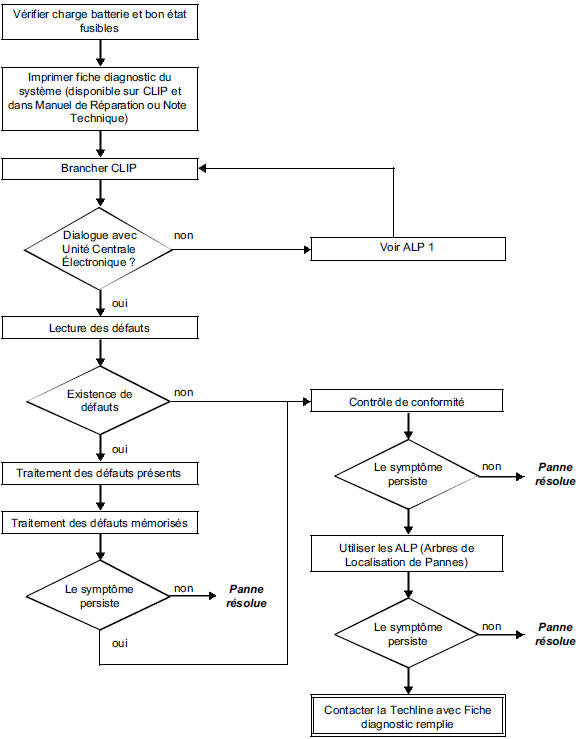
5. DIAGNOSTIC SHEET
WARNINGAll incidents on a complex system must be subject to a full diagnosis using suitable tools. The DIAGNOSTIC SHEET, to be completed during diagnosis, provides and keeps a record of the diagnosis carried out. It is an essential element of communication with the manufacturer.
A DIAGNOSTIC SHEET MUST BE COMPLETED EVERY TIME A DIAGNOSIS IS PERFORMED.This sheet will always be required:
- When requesting technical assistance from the techline.
- For approval requests, when replacing parts that require mandatory approval.
- To be attached to the "monitored" parts returned. It is then required for warranty reimbursement and helps with a better analysis of the removed parts.
6. SAFETY INSTRUCTIONS
Any work on a component requires safety rules to avoid any material damage or personal injury:
- Check that the battery is correctly charged to avoid damage to the ECUs in case of low charge.
- Avoid using a booster battery (prohibited on 24 V).
- Check that the clutch switch is not faulty, as there is a risk of unintended starting.
- No smoking.
- Use the appropriate tools.
GENERAL OPERATION
The keyless vehicle function is divided into three sub-functions: access management, protection and starting. Diagnosis of the keyless vehicle function, using the diagnostic tool, can be carried out in two ways.
- The first way is ECU diagnosis, which communicates with a single control unit (select the relevant control unit).
- The second way is function diagnosis, which communicates with the three (or four) control units of the keyless vehicle function.
DESCRIPTION OF SUB-FUNCTIONS
Access management sub-function
This sub-function includes everything used to lock and unlock the vehicle.
The Passenger Compartment Central Unit alone performs this sub-function.
Note:- Locking is impossible when the ignition is on or the card is in the reader.
- The ABS provides the vehicle speed information for the Automatic Locking When Driving function.
- A fault in the airbag system prevents the Automatic Locking When Driving function, and the "Airbag deployed" information unlocks the vehicle.
Protection sub-function
This sub-function includes everything used to protect the vehicle against theft.
The control units concerned are the Passenger Compartment Central Unit, the injection system for immobiliser, and the steering column lock.
Note:- A fault in the airbag and/or ABS system (speed information) prevents locking of the steering column.
- A fault in the Protection and Switching Unit may cause the steering column lock to not operate.
Starting sub-function
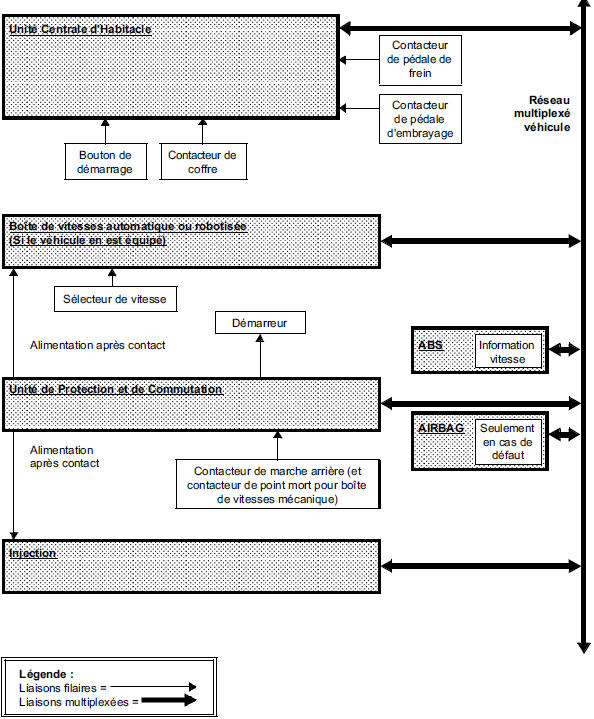
This sub-function includes everything used to start the vehicle.
The control units concerned are the Passenger Compartment Central Unit, the injection system, the Protection and Switching Unit and, if the vehicle is so equipped, the automatic or automated gearbox control unit.
Note:- A speed signal greater than 0 km/h prevents the engine from being stopped.
- Airbag deployment stops the engine.
KEYLESS VEHICLE FUNCTION
EXCHANGES BETWEEN THE MAIN COMPONENTS OF THE KEYLESS VEHICLE FUNCTION
- lock or unlock request

- lock status information
- request to switch on ignition
- starting conditions met
- starter activation request

- ignition on information
- lock exchange immobiliser software

- starting conditions met information
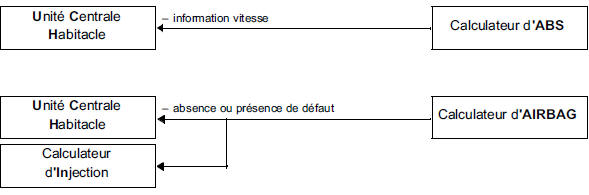
- card response

- query card presence and association with the vehicle
KEYLESS VEHICLE FUNCTION
SUMMARY OF ELEMENTS CONTROLLED OR MANAGED BY THE KEYLESS VEHICLE FUNCTION FOR DOOR MANAGEMENT
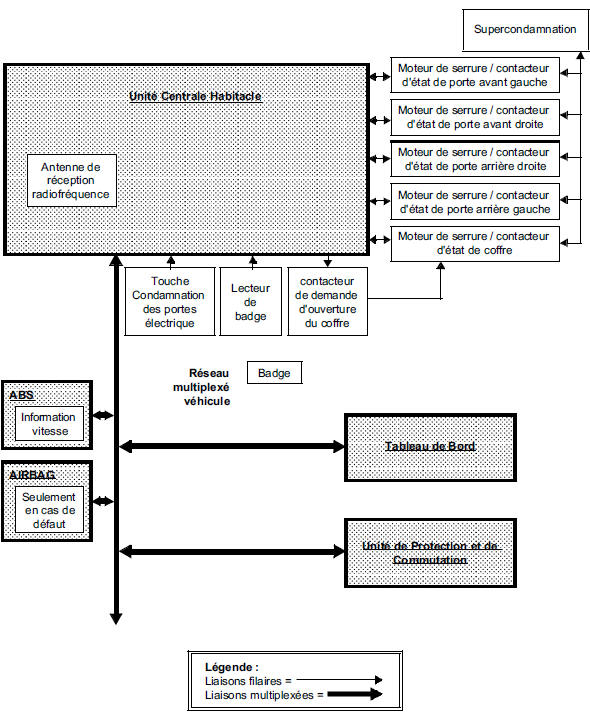
KEYLESS VEHICLE FUNCTION
SUMMARY OF ELEMENTS CONTROLLED OR MANAGED BY THE KEYLESS VEHICLE FUNCTION FOR DOOR MANAGEMENT (HANDS-FREE)
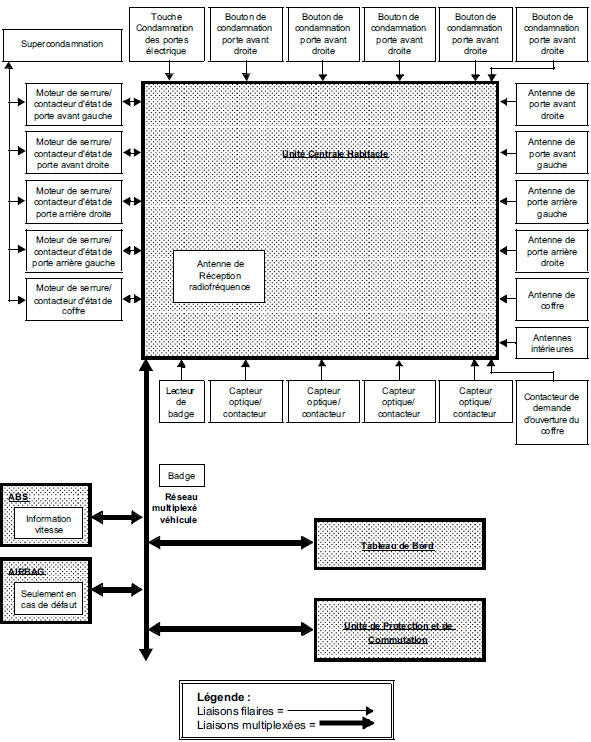
KEYLESS VEHICLE FUNCTION
SUMMARY OF ELEMENTS CONTROLLED OR MANAGED BY THE KEYLESS VEHICLE FUNCTION FOR SECURITY
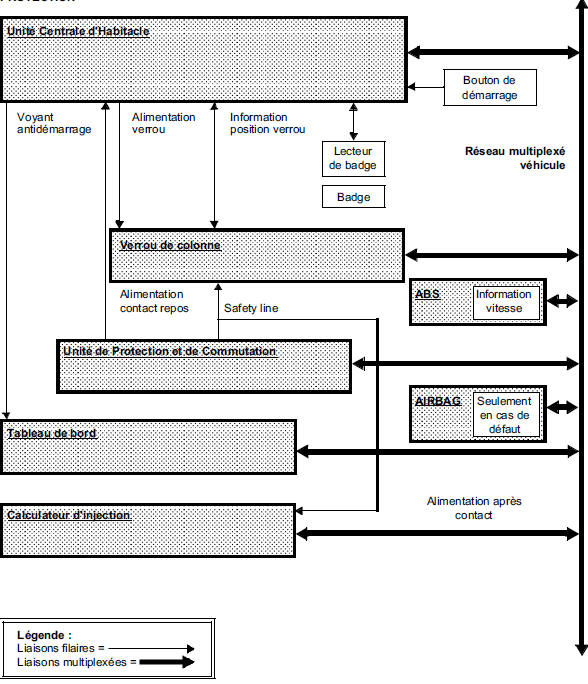
KEYLESS VEHICLE FUNCTION
SUMMARY OF ELEMENTS CONTROLLED OR MANAGED BY THE KEYLESS VEHICLE FUNCTION FOR SECURITY (HANDS-FREE)
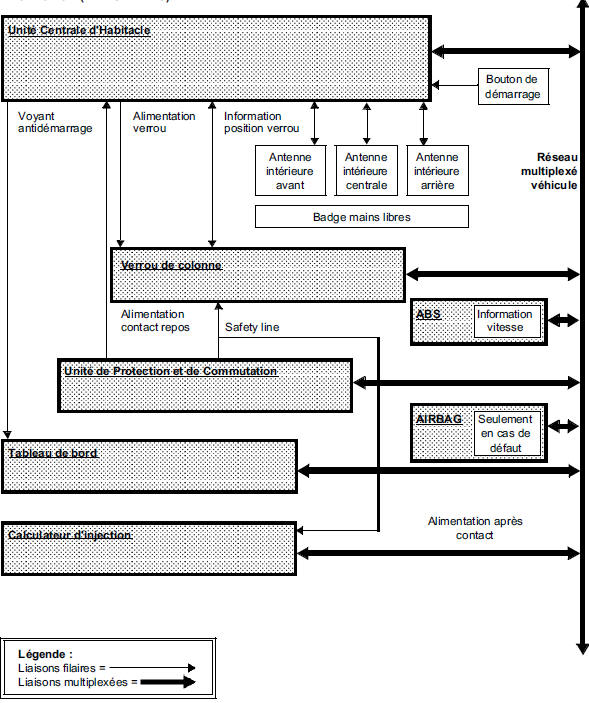
KEYLESS VEHICLE FUNCTION
SUMMARY OF ELEMENTS CONTROLLED OR MANAGED BY THE KEYLESS VEHICLE FUNCTION FOR STARTING
Test yourself
A quick Renault Megane quiz: every answer comes with an explanation and a link to the manual page.