Introduction
Basic inspection
In this manual: Introduction
15steps
~90min
4/5difficulty
Done 0 of 15
- When measuring resistance of electronic parts
- Unless otherwise stated, all resistance measurements should be made at an ambient temperature of 20°c (68°f). Resistance measurements may be inaccurate if measured at high temperatures, i.E. Immediately after the vehicle has been running. Measurements should be made after the engine has cooled down.
- Handling connectors
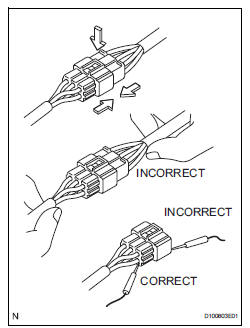
- When disconnecting a connector, first squeeze the mating halves tightly together to release the lock, and then press the lock claw and separate the connector.
- When disconnecting a connector, do not pull on the harnesses. Grasp the connector directly and separate it.
- Before connecting a connector, check that there are no deformed, damaged, loose or missing terminals.
- When connecting a connector, press firmly until it locks with a "click" sound.
- If checking a connector with a toyota electrical tester, check the connector from the backside (harness side) using a mini test lead.
- As a waterproof connector cannot be checked from the backside, check it by connecting a sub-harness.
- Do not damage the terminals by moving the inserted tester needle.
- Checking connectors
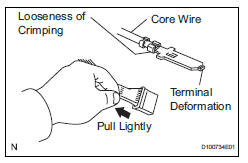
- Checking when a connector is connected: squeeze the connector together to confirm that they are fully connected and locked.
- Checking when a connector is disconnected: pull the wire harness lightly from the backside of the connector. Visually check for the following: 1) unlatched terminals, missing terminals, loose crimps and broken conductor wires; 2) corrosion, metallic matter, foreign matter and water; and 3) bent, rusted, overheated, contaminated and deformed terminals.
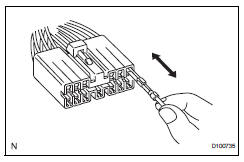
- Checking the contact pressure of the terminal: prepare a spare male terminal. Insert it into a female terminal, and check for ample tension when inserting and after full engagement.
When testing a gold-plated female terminal, always use a gold-plated male terminal.
- Repair method of connector terminal
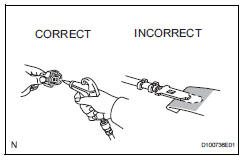
- If there is any foreign matter on the terminal, clean the contact point using an air gun or cloth.
- Handling of wire harness
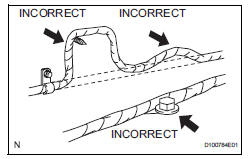
- If removing a wire harness, check the wiring and clamping before proceeding so that it can be restored in the same way.
- Never twist, pull or slacken the wire harness more than necessary.
- The wire harness should never come into contact with a high temperature part, or rotating, moving, vibrating or sharp-edged parts. Avoid contact with panel edges, screw tips and other sharp items.
- When installing parts, never pinch the wire harness.
- Never cut or break the cover of the wire harness.
If it is cut or broken, repair the cover with vinyl tape or replace the wire harness.
Test yourself
A quick Toyota RAV4 quiz: every answer comes with an explanation and a link to the manual page.
Was this page helpful?