Frontal collisions and the laws of physics
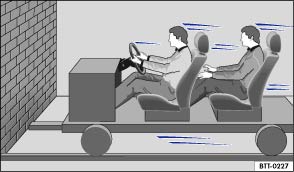 Fig. 40
A vehicle drives toward a wall with unbelted
occupants.
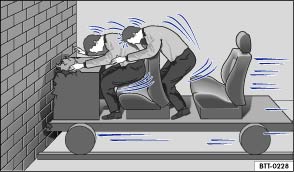 Fig. 41
A vehicle drives into the wall with unbelted
occupants.
 Read and observe the introductory information
and safety warnings first⇒
 Introduction
to the topic
The physical principle of a frontal collision is simple to explain. As soon as the vehicle is in motion ⇒ Fig. 40 , both the vehicle and its occupants have kinetic energy, the so-called kinetic energy of motion.
The higher the vehicle speed and the greater the weight, the more energy must be dissipated in the event of a collision.
However, vehicle speed is the more significant factor. For example, if the speed doubles from approximately 25 km/h to approximately 50 km/h, the kinetic energy quadruples!
The amount of kinetic energy depends largely on the vehicle speed and on the weight of the vehicle and its occupants. As speed and weight increase, more energy must be dissipated in the event of a collision.
Occupants who have not fastened their seat belts are therefore not connected to the vehicle. In a frontal collision, these occupants will therefore continue moving at the same speed the vehicle had before the impact until something stops them! Since the occupants in our example are not wearing seat belts, in the event of an impact all of their kinetic energy is dissipated only by the impact against the wall ⇒ Fig. 41 .
At a speed of approximately 30 km/h to approximately 50 km/h, forces acting on the body in an accident can easily exceed one metric ton (1,000 kg). The forces acting on the body increase further at higher speeds.
This example applies not only to frontal collisions but to all types of accidents and collisions.