Belt Routing
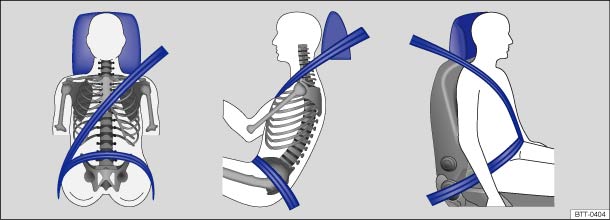 Fig. 47
Correct belt routing and correct
head restraint adjustment.
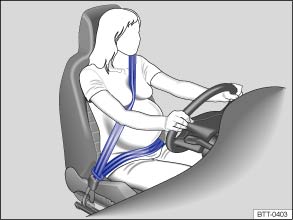 Fig. 48
Correct belt routing for
pregnant women.
 Read and observe the introductory information
and safety warnings first⇒
 Introduction
to the topic
Only with correct belt routing do fastened seat belts provide optimal protection in an accident and reduce the risk of serious or fatal injuries. Correct belt routing also keeps the occupant in a position where the deploying airbag can provide maximum protection. Therefore, always fasten the seat belt and make sure the belt routing is correct.
An incorrect seating position can cause serious or fatal injuries ⇒ Adjusting the seating position .
Correct belt routing- The shoulder belt portion of the seat belt must always run across the middle of the shoulder and never over the neck, over the arm, under the arm or behind the back.
- The lap belt portion of the seat belt must always run across the front of the hips and never over the abdomen.
- Always keep the seat belt flat and snug against the body. Tighten the belt webbing slightly if necessary.
For pregnant women, the seat belt must run evenly over the chest and as low as possible across the front of the hips, and lie flat so that no pressure is applied to the abdomen, throughout the entire pregnancy ⇒ Fig. 48 .
Adjusting belt routing to body sizeBelt routing can be adjusted with the following equipment:
- Height-adjustable front seats ⇒ Adjusting the seating position .

 Warning
Incorrect belt routing can cause serious injuries in an accident or in a sudden braking or driving maneuver.
- The seat belts only provide optimal protection when the backrest is in an upright position and the seat belt is correctly fitted.
- The seat belt itself, or a loose seat belt, can cause serious injuries if it slides from hard parts of the body onto soft tissue, e.g. the abdomen.
- The shoulder belt portion must run across the middle of the shoulder and never under the arm or over the neck.
- The seat belt must lie flat and snug against the upper body.
- The lap belt portion must run across the front of the hips and never over the abdomen. The seat belt must lie flat and snug against the hips. Tighten the belt webbing slightly if necessary.
- For pregnant women, the lap belt portion must run as low as possible across the front of the hips and lie flat around the rounded abdomen.
- Do not twist the belt webbing when wearing the seat belt.
- Never hold the seat belt away from the body with your hand.
- Do not route the belt webbing over hard or fragile objects, e.g. glasses, pens or keys.
- Never alter the belt routing using a belt guide clip, retaining loops or similar devices.

Persons who, due to their physical characteristics,
cannot achieve optimal belt routing should have an authorized workshop advise them on possible special installations in order to achieve optimal protection from the seat belt and airbags. Volkswagen recommends the Volkswagen Partner for this.