Windshield Wiper and Washer System
Hose couplings of the washer fluid lines
The following hose coupling types are used to connect the hoses to pumps and spray nozzles, and as separation points:
Front and rear window washer system
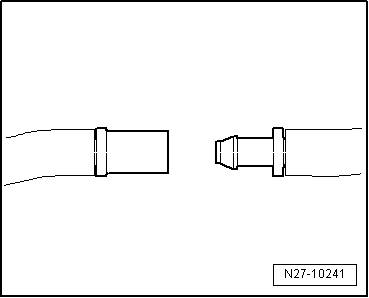
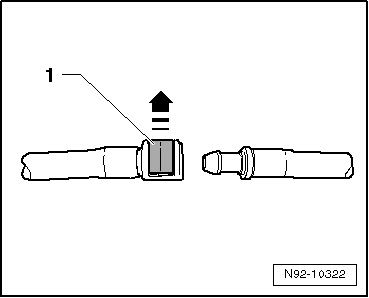
- To disconnect, pull both coupling parts apart (no locking device).
- To connect, press both coupling parts firmly together until they engage audibly and can be felt.
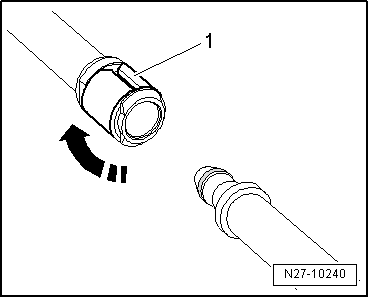
- To disconnect, turn the locking ring -1- by 90° in the direction of the arrow and pull off the hose connector.
- To connect, push on the hose connector and turn the locking ring -1- in the direction of the arrow until it engages.
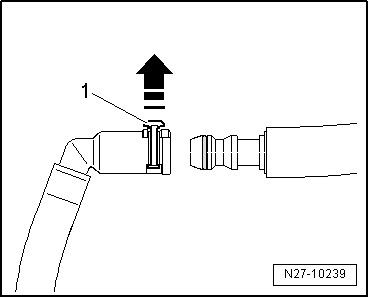
- To disconnect, pull the locking clip -1- up approx. 1 mm in the direction of the arrow and pull off the hose connector.
- To connect, push on the hose connector and press in the locking clip -1- until it engages.
- To connect, push on the hose connector and press in the locking clip -1- until it engages.
- To disconnect, pull the locking clip -1- up in the direction of the arrow and pull off the hose connector.
- To connect, push on the hose connector and press in the locking clip -1- until it engages.
Headlamp washer system
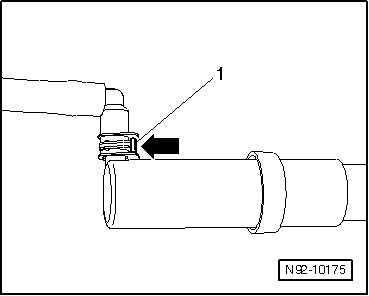
- To disconnect, press the locking clip -1- in the direction of the arrow and pull off the hose connector.
- To connect, hold the locking clip pressed in the direction of the arrow and push on the hose connector. Check that the locking clip has engaged by performing a pull test without pressing the clip.
Hose repair
A repair concept has been developed for repairing washer system hoses. The spare parts available include various connectors, special EPDM hoses (ethylene propylene diene monomer) and heat-shrink tubing.
General description
- The spare parts can be found in the Electronic Parts Catalogue (ETKA).
- The spare parts are available for repairing both smooth tubing and corrugated tubing.
Repair solution for smooth tubing
Smooth tubing with a diameter of 5x1 mm or 6x1 mm can be repaired using EPDM hose.
- Cut out the damaged section from the smooth tubing to be repaired, making a straight cut.
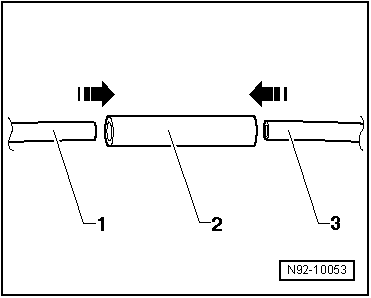
- Select the suitable EPDM hose -2- and cable ties from the Electronic Parts Catalogue (ETKA).
- Cut the EPDM hose -2- to length so that the smooth tubing ends -1- and -3- can each be pushed approx. 10 mm into the EPDM hose -2-.
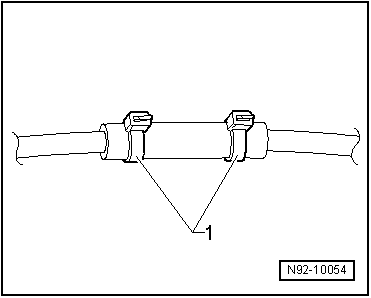
- Secure the repair point with cable ties -1-.
Repair solution for corrugated tubing
Required Special Tools, Test and Measuring Equipment and Auxiliary Items
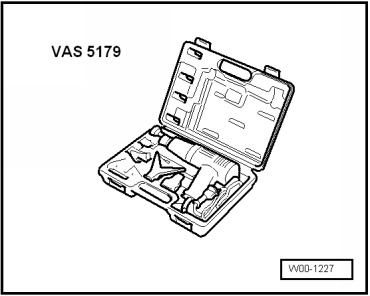
- Hot air blower -VAS 5179- or
- Hot air blower -V.A.G 1416/- or
- Hot air blower -VAS 1978/14-

Note
- The repair point must not be subjected to tension or bending.
- If the damaged area is longer than 20 mm, you must insert a new piece of corrugated tubing and carry out the following procedure twice.
- Cut out the damaged section from the corrugated tubing to be repaired, making a straight cut.
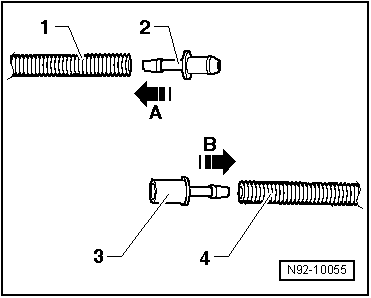
- Select the suitable connectors -2- and -3- and the matching heat-shrink tubing from the Electronic Parts Catalogue (ETKA).
- Heat the end of the corrugated tubing -1-.
- Press the connector -2- into the corrugated tubing -1- in the direction of arrow A.
- Heat the end of the corrugated tubing -4-.
- Press the connector -3- into the corrugated tubing -4- in the direction of arrow B.
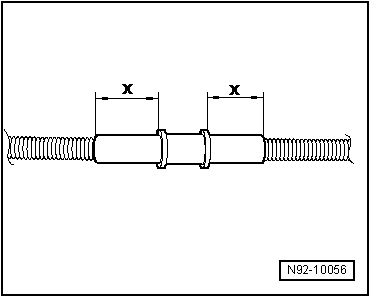
- Cut the heat-shrink tubing to length so that at least 20 mm -dimension x- of the corrugated tubing is covered on both sides.
- Slide the heat-shrink tubing over the corrugated tubing, join the connectors and secure the repair point with the heat-shrink tubing.
Identification features of flat (beamless) wiper blades
Identification features of Bosch and Federal Mogul.
When replacing the wiper inserts, pay attention to the manufacturer. The wiper blades must be replaced with blades from the same manufacturer.
The wiper blades can be identified by the attachment to the wiper arm.
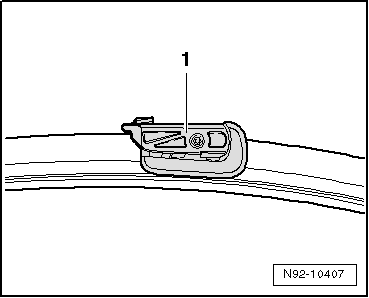
Bosch wiper blades -1 and 2-:
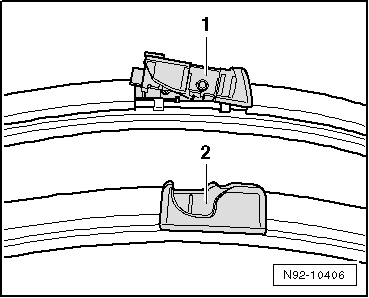
Federal Mogul wiper blade -1-: