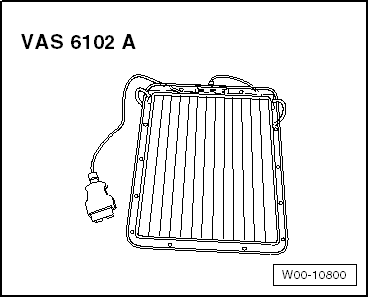
Solar Panel -VAS 6102A-
Maintenance charging with the Solar Panel -VAS 6102A-
Solar Panel VAS 6102A
General description:
The Solar Panel -VAS 6102A- supports the vehicle electrical system and prevents the battery from self-discharging.
The Solar Panel -VAS 6102A- reaches a maximum voltage of 14.3 V and a maximum charging current of 255 mA.
All rechargeable lead-acid or lead-gel batteries may be charged with the Solar Panel -VAS 6102A-.
The Solar Panel -VAS 6102A- is connected to the diagnostic connector in the vehicle.
A green LED is integrated in the frame to indicate the function. The brighter this LED lights up, the higher the charging current.
Overcharging the battery is not possible due to the integrated electronics.
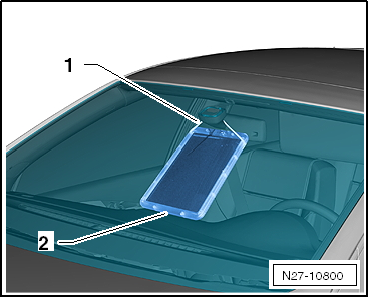
- Attach the Solar Panel -VAS 6102A- to the interior rear-view mirror -1-.
- Rest the lower edge on the dashboard -2-.

Note
The Solar Panel -VAS 6102A- must not lie completely flat on the dashboard. Only its lower edge may rest on the dashboard for support. Full contact may cause discoloration of the dashboard.
- Tighten the fastening cord so that the Solar Panel -VAS 6102A- is close to the windshield.
- Connect the Solar Panel -VAS 6102A- to the vehicle's diagnostic connector. Connect it as you would the vehicle diagnostic tester,
- Check the Solar Panel -VAS 6102A- for function. The green LED indicates that the Solar Panel -VAS 6102A- is functioning.
Deeply discharged batteries

WARNING!
Risk of injury! Observe the warnings and safety regulations!
A battery is considered "deeply discharged" when its open-circuit voltage is less than or equal to 11.6 V.

WARNING!
Batteries where the magic eye shows light yellow must not be tested or charged. Do not give jump-start!
Risk of explosion when testing, charging or jump starting.
These batteries must be replaced.

Caution!
- Deeply discharged batteries freeze at an early stage.
- Frozen batteries must no longer be used.

Note
- Deeply discharged batteries in vehicles before registration must be replaced before delivery. Prior damage cannot be ruled out.
- Batteries that have not been driven for a long time, e.g. in vehicles in storage, self-discharge.
- In deeply discharged batteries, the battery acid consists almost entirely of water, because the acid content is greatly reduced.
- Deeply discharged batteries sulfate, i.e. the entire plate surfaces of the battery harden.
- If deeply discharged batteries are recharged immediately after deep discharge, the sulfation largely reverses.
- If these batteries are not recharged, the plates continue to harden and the ability to accept charge is reduced. This results in reduced battery performance.
- Check the open-circuit voltage of the battery.

WARNING!
Risk of injury! Observe the warnings and safety regulations!

Caution!
To avoid damage to the battery or vehicle, observe the information on battery types.

WARNING!
Batteries where the magic eye shows light yellow must not be tested or charged. Do not give jump-start!
Risk of explosion when testing, charging or jump starting.
These batteries must be replaced.
Cruise control system (CCS)
General description:
The cruise control functions are controlled by the engine control module.
- You can activate/deactivate the cruise control system.
Fault detection and fault indication:
Faults relating to the cruise control system are output via the engine control module.
For fault finding, use the vehicle diagnostic tester in the "Guided Fault Finding" mode.
Activate/deactivate cruise control system
- Connect the vehicle diagnostic tester.
- Select the "Guided Fault Finding" mode on the vehicle diagnostic tester.
- Use the "Jump" button to select "Function/component selection", and then select the following menu items in turn:
- Drive
- Engine code letters
- 01 - Self-diagnosis-capable systems
- Engine management or diesel direct injection and glow plug system
- Functions
- Activate/deactivate cruise control system