Technical Data
Safety Information
Safety precautions when working on air conditioning systems
Risk of frostbite from refrigerant
When working on the air conditioning system, refrigerant under pressure may escape. Frostbite of the skin and other parts of the body is possible.
- Wear protective gloves.
- Wear safety goggles.
- Extract the refrigerant and open the refrigerant circuit immediately.
- If more than 10 min have passed since the refrigerant was extracted and the refrigerant circuit has not been opened, extract the refrigerant again. Post-evaporation has built up pressure in the refrigerant circuit.
Risk of damage to refrigerant lines
The inner film of the refrigerant lines can tear and be damaged.
- Never bend refrigerant lines to a radius smaller than r = 100 mm.
Safety precautions when working on the cooling system
Scalding risk from hot coolant
When the engine is warm, the cooling system is under overpressure. Risk of scalding from hot steam and hot coolant.
- Wear protective gloves.
- Wear safety goggles.
- Relieve overpressure: cover the cap of the coolant expansion tank with a cloth and open carefully.
General Information
Notes on odours in air-conditioned vehicles
- If unpleasant odours come from the evaporator, clean the evaporator.
- Volkswagen has tested and approved the ultrasonic air conditioning cleaning device -VAS 6189A- and the pressure cup gun -V.A.G 1538- with the corresponding spray lance for cleaning the evaporator.
- Instructions for cleaning the evaporator are supplied with the devices.
- As soon as Volkswagen releases new procedures, corresponding information will be found in the repair manual → Air conditioning with refrigerant R134a.
Type plates
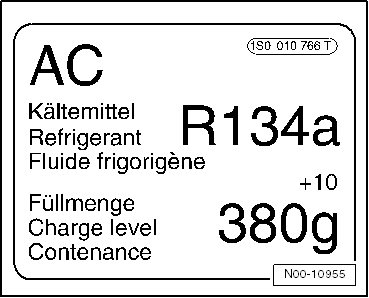
The type plate for refrigerant and refrigerant quantity is located on the lock carrier.
Repair notes
Working on the refrigerant circuit
In some countries, special qualifications are required for work that involves opening the refrigerant circuit.
Further information
- Notes on repair work on air-conditioned vehicles and handling refrigerant → Air conditioning with refrigerant R134a.
- Notes on test equipment and tools for repairs on air-conditioned vehicles → Air conditioning with refrigerant R134a.
- Notes on working with the A/C service station on air-conditioned vehicles → Air conditioning with refrigerant R134a.
- Conditions and procedure for flushing with refrigerant R134a → Air conditioning with refrigerant R134a.
Seals for refrigerant circuit
- Replace O-rings after removal.
- Lubricate O-rings with refrigerant oil before installation.
- Make sure the O-rings are seated correctly on the pipe or in the groove.
- Work in a clean environment. Even the smallest contaminants, such as a hair, can cause leaks.
- Only install O-rings that are resistant to refrigerant R134a and the associated refrigerant oil. These O-rings are color-coded to prevent mix-ups → Electronic parts catalog.
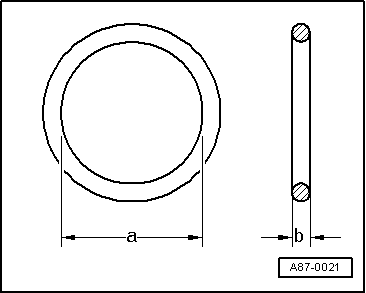
Dimensions -a- and -b- depend on the installation location of the O-ring → Electronic parts catalog.
Technical Data
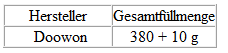
Refrigerant R134a fill quantities
Refrigerant oil
Refrigerant oil absorbs water very readily. For this reason, refrigerant oil from containers that have been left open for a long time is unusable.
- Immediately seal opened containers airtight to protect them from moisture.


1) This quantity of refrigerant oil is included in the replacement part A/C compressor; it corresponds to the total fill quantity.
Oil distribution
In the refrigerant circuit, the oil that was in the oil sump of the A/C compressor before the air conditioning was first switched on is distributed as follows:
- A/C compressor approx. 50 %
- Condenser approx. 10 %
- Suction hose approx. 10 %
- Evaporator approx. 20 %
- Receiver/drier approx. 10 %