Sistema de retención de cinturones de seguridad
- For maximum protection, the restraint system must always be used whenever the vehicle is moving. The shoulder belt should be positioned halfway across the shoulder, over the collarbone.
- Never allow children to ride in the front passenger seat. See the Child Restraint System section for further information.
WARNING - Twisted seat belt
Make sure your seat belt is not twisted when worn. A twisted seat belt may not protect you properly in a crash and may even cut your body.
¡ADVERTENCIA! Banda del hombro
- Never wear the shoulder belt under your arm or behind your back. An improperly worn shoulder belt cannot protect the occupant in a crash.
- Utilice siempre tanto la banda diagonal como la banda sub-abdominal (de cadera) del cinturón.
WARNING - Damaged seat belt
Replace the entire seat belt assembly if any part of the webbing or hardware is damaged, as you can no longer be sure the damaged seat belt will provide protection in a crash.
Seat belts are designed to fit the bony structure of the body and should be worn low across the front of the pelvis, chest and shoulders, as applicable; the lap portion of the belt should not be worn across the abdomen.
Seat belts should be adjusted as tightly as is comfortable to provide the protection for which they were designed.
A loose belt significantly reduces the level of protection for the occupant.
Care should be taken to avoid contaminating the webbing with polishes, oils and chemicals, especially battery acid. Cleaning can be safely performed using mild soap and water. The belt should be replaced if the webbing is worn, contaminated or damaged.
- The user must not make any changes or additions that either prevent the seat belt adjustment devices from removing slack or prevent the seat belt assembly from being adjusted to remove slack.
- When fastening the seat belt, make sure the belt does not latch into the buckles of other seats. This is very dangerous, and you may not be protected by the seat belt properly.
- Do not unbuckle the seat belt or repeatedly fasten and unfasten the seat belt while driving. This may result in loss of control and an accident, leading to death, serious injury or property damage.
- When fastening the seat belt, make sure the belt does not pass over hard or easily broken objects.
WARNING - Seat belt buckle
Do not allow foreign materials (gum, crumbs, coins, etc.) to enter the seat belt buckle. This may prevent the seat belt from latching securely.
Aviso de cinturón de seguridad no abrochado
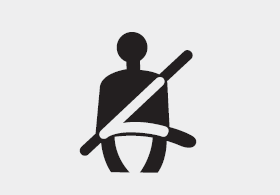
As a reminder to the driver, the unfastened seat belt warning light illuminates for approximately 6 seconds each time the engine start/stop button is in the ON position, regardless of whether the belt is fastened, and the warning chime will sound for approximately 6 seconds each time the engine start/stop button is in the ON position while the belt is not fastened.
If the driver continues not to fasten the seat belt and drives at a speed of 9 km/h or more but less than 20 km/h, the warning light will continue to illuminate.
If the driver continues not to fasten the seat belt while driving at a speed above 20 km/h, the unfastened seat belt warning chime will sound for approximately 100 seconds and the corresponding warning light will flash.
If the driver unfastens the seat belt while driving at a speed below 20 km/h, the warning light will remain illuminated.
If the driver unfastens the seat belt while driving at a speed above 20 km/h, the unfastened seat belt warning chime will sound for approximately 100 seconds and the corresponding warning light will flash.
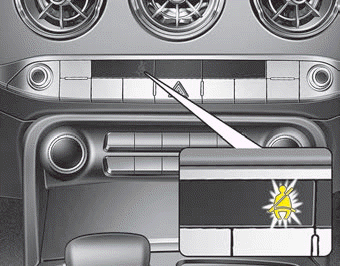
As a reminder to the front passenger, the unfastened front passenger seat belt warning light illuminates for approximately 6 seconds each time the engine start/stop button is in the ON position, regardless of whether the belt is fastened.
If the front passenger continues not to fasten the seat belt and the vehicle moves at a speed of 9 km/h or more but less than 20 km/h, the warning light will remain illuminated.
If the front passenger continues not to fasten the seat belt when the vehicle is moving at a speed above 20 km/h, the unfastened seat belt warning chime will sound for approximately 100 seconds and the corresponding indicator will start to flash.
If the front passenger unfastens the seat belt while the vehicle is moving below 20 km/h, the warning light will continue to illuminate.
If the front passenger unfastens the seat belt while the vehicle is moving above 20 km/h, the unfastened seat belt warning chime will sound for approximately 100 seconds and the corresponding indicator will flash.
Cinturón de regazo/hombro
Ajuste de altura
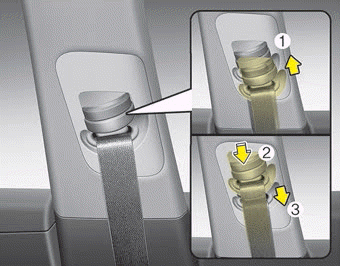
Puede ajustar la altura del anclaje del cinturón de hombro en una de 4 posiciones para lograr el máximo confort y seguridad.
La altura ajustable del cinturón de seguridad no debe quedar demasiado cerca del cuello. No obtendrá la protección más eficaz. La parte del hombro debe ajustarse de modo que quede sobre el pecho y en el centro del hombro, junto a la puerta, y no sobre el cuello.
Para ajustar la altura del anclaje del cinturón de seguridad, baje o suba el ajustador de altura a la posición adecuada.
Para subir el ajustador de altura, tire de él hacia arriba (1). Para bajarlo, empújelo hacia abajo (3) mientras presiona el botón de liberación del ajustador de altura (2).
Suelte el botón para fijar el anclaje en la posición deseada. Intente mover el regulador de altura para asegurarse de que está bloqueado en esa posición.
Improperly fastened seat belts may cause serious injury in a crash.
WARNING. Shoulder belt position.
Nunca coloque la correa del hombro sobre el cuello o la cara.
WARNING - Seat belt replacement
Replace seat belts after a crash. Failure to replace the seat belts after a crash may leave you with damaged belts that will not provide protection in a subsequent collision.
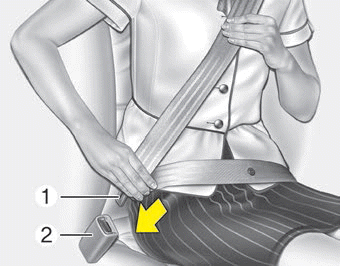
Para abrochar el cinturón de seguridad:
Para abrochar el cinturón de seguridad, extraiga la cinta del retractor e inserte la lengüeta metálica (1) en la hebilla (2). Se oirá un clic cuando la lengüeta quede bloqueada en la hebilla.
El cinturón de seguridad solo se ajusta automáticamente a la longitud correcta después de que la parte de regazo se ajuste manualmente para que quede bien ajustada a las caderas. Si se inclina hacia delante lentamente y con suavidad, el cinturón se extenderá y le permitirá moverse. Sin embargo, en una parada brusca o un impacto, el cinturón se bloqueará en su posición. También se bloqueará si intenta inclinarse hacia delante demasiado rápido.
✽ NOTA
Si no puede extraer el cinturón de seguridad del retractor, tire con fuerza de la cinta y suéltela. Después podrá extraer la cinta con suavidad.
ADVERTENCIA
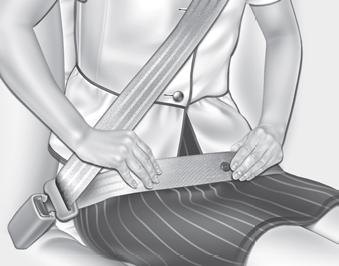
Debe colocar la parte de regazo del cinturón lo más bajo posible y bien ajustada sobre las caderas, no sobre la cintura. Si la parte de regazo queda demasiado alta sobre la cintura, puede aumentar el riesgo de lesiones en caso de colisión. Ambas manos no deben estar debajo ni encima del cinturón. Una debe estar encima y la otra debajo, como se muestra en la ilustración.
Nunca abroche el cinturón de seguridad por debajo del brazo, junto a la puerta.
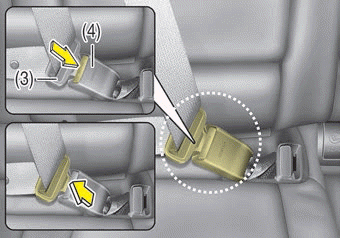
Para abrochar los cinturones de seguridad de los asientos traseros:
Tire de la lengüeta metálica (3) e insértela en la hebilla (4). Se oirá un «clic» cuando la lengüeta quede bloqueada en la hebilla. Asegúrese de que el cinturón no esté torcido.
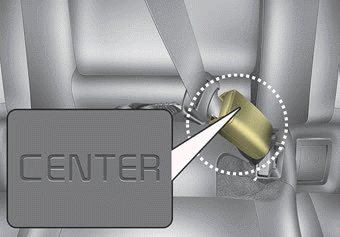
Al usar el cinturón de seguridad central trasero, debe utilizarse la hebilla marcada con «CENTER».
ADVERTENCIA
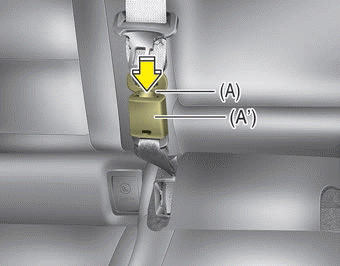
Inserte siempre la lengüeta metálica (A) en la hebilla (A’).
✽ NOTA
Si no puede extraer el cinturón de seguridad del retractor, tire del cinturón con firmeza y suéltelo. Una vez liberado, podrá extraer el cinturón con suavidad.
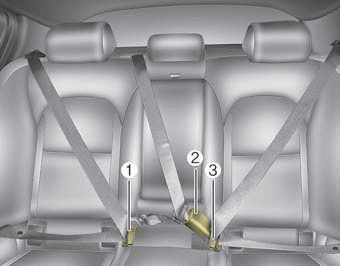
El cinturón de seguridad debe estar bloqueado en la hebilla de cada asiento para que quede correctamente abrochado.
➀ : Hebilla del cinturón de seguridad del asiento trasero derecho
➁ : Hebilla del cinturón de seguridad del asiento trasero central
➂ : Hebilla del cinturón de seguridad del asiento trasero izquierdo
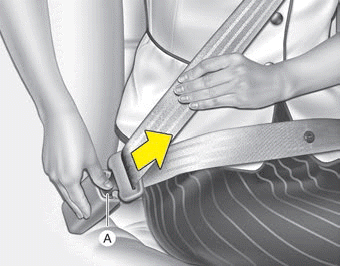
Para desabrochar el cinturón de seguridad:
Para desabrochar el cinturón de seguridad, pulse el botón de liberación (A) de la hebilla. Al soltarlo, el cinturón debe retraerse automáticamente en el retractor.
Si no ocurre, compruebe el cinturón para asegurarse de que no esté torcido y vuelva a intentarlo.
ADVERTENCIA
Antes de abrochar los cinturones de seguridad traseros, asegúrese de que la lengüeta coincida con la hebilla del asiento correspondiente. Abrochar por la fuerza el cinturón izquierdo o derecho en la hebilla central puede provocar una sujeción incorrecta que no le protegerá en caso de accidente.
Pon a prueba tus conocimientos
Un test rápido sobre el Kia Stinger CK: cada respuesta trae una explicación y un enlace a la página del manual.