EXHAUST EMISSION CONTROL SYSTEM
EXHAUST EMISSION CONTROL SYSTEM
Technical Description
The system is very effective in reducing the amount of harmful substances in the exhaust gas. The design of the system is such that it requires practically no additional care and maintenance. Under normal vehicle operating conditions, only one basic requirement must be observed: fill the vehicle with unleaded fuel only. There are practically no other recommendations.
The main components of the exhaust emission control system are:
- Fuel mixture formation system, which provides precisely calculated proportions of air and fuel depending on engine speed.
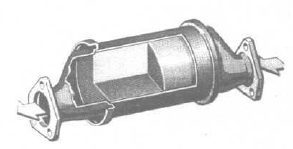
- Exhaust gas catalytic converter and sensor (monitoring the air-fuel ratio). The catalytic converter is built into the exhaust pipe and operates on the three-way principle. It consists of a ceramic substrate in a steel shell, with micro-channels running lengthwise inside, coated with a thin layer of platinum or rhodium.
The cleaning principle is as follows: exhaust gas passes through the dense network of micro-channels, reacts with the precious metal and is burned, and the three main harmful components are converted into harmless substances (three-way conversion), namely:
- carbon monoxide into carbon dioxide (CO2), - hydrocarbons into water, - nitrogen oxides into nitrogen (air, which we breathe, is 4/5 nitrogen).
The basic requirement for normal catalytic converter operation is that the exhaust gas must enter the converter at a minimum temperature and with a defined composition. This chemical composition is achieved by precisely controlling the fuel mixture proportions.
The exact air-fuel ratio is monitored by a special Lambda sensor.
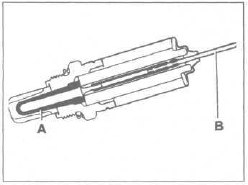
It consists of:
A — ceramic sensing element with precious metal coating.
B — connecting cable. See illustration.
Located upstream of the catalytic converter in the exhaust emission control system.
Continuously analyzes the chemical composition of the exhaust gases.
The analysis data is sent to the microprocessor of the electronic control unit, which automatically selects the required air-fuel ratio through the fuel mixture formation system.
Activated Charcoal Filter
A special system supplies air to the fuel tank and draws vapors out of it, reliably protecting the environment from their harmful effects. For this purpose, fuel vapors pass through a container filled with activated charcoal and are absorbed there.
When the engine is running, the charcoal canister is opened slightly and the vapors are routed to the engine, where they are burned. The system requires no care or maintenance.
Test yourself
A quick Audi 80 quiz: every answer comes with an explanation and a link to the manual page.