Vehicle Care
Jump Starting the Engine
In this manual: Vehicle Care
9steps
~54min
2/5difficulty
Done 0 of 9
Do not start the engine using emergency starting devices.
If the battery is discharged, the engine can be started using jumper cables and the battery of another vehicle.
Warning Exercise particular care when jump starting. Any deviation from the instructions below may result in personal injury and damage caused by battery explosion or damage to the electrical systems of both vehicles. Warning Avoid contact with eyes, skin, fabrics and painted surfaces. Battery electrolyte contains sulfuric acid, which can cause skin burns and corrosion of vehicle components on direct contact.- Do not bring open flames or sparks near the battery.
- At temperatures below 0 °C, a discharged battery may freeze. Thaw a frozen battery before connecting jumper cables.
- Wear eye protection and protective clothing when working with the battery.
- The booster battery must have the same supply voltage (12 V) as the battery in the vehicle. Its capacity (in Ah) must not be much lower than the capacity of the discharged battery.
- Use jumper cables with insulated clamps and a cross-section of at least 16 mm² (25 mm² for diesel engines).
- Do not disconnect the discharged battery from the vehicle's electrical system.
- Switch off all unnecessary electrical loads.
- Do not lean over the battery during starting.
- Do not allow the jumper cable clamps to touch each other.
- The vehicles must not touch each other while jump starting the engine.
- Apply the parking brake, place the manual transmission in neutral, or move the automatic transmission to P.
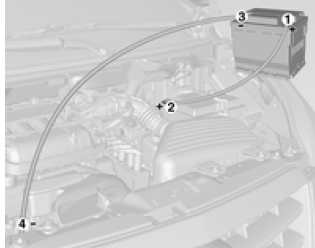
Connection sequence:
- Connect one end of the red cable to the positive (+) terminal of the booster battery.
- Connect the other end of this cable to the positive (+) terminal of the discharged battery.
- Connect one end of the black cable to the negative (−) terminal of the booster battery.
- Connect the other end of this cable to a grounding point on the vehicle, e.g. the engine block or a bolted connection of one of the engine mount components. The connection point should be as far as possible from the discharged battery, but no closer than 60 cm.
Route the cables so that they cannot accidentally catch on moving engine components.
Starting the engine:
- Start the engine of the vehicle with the booster battery.
- After 5 minutes, start the engine of the second vehicle. Starting attempts should be made at 1-minute intervals and last no longer than 15 seconds.
- After starting, let both engines run at idle for approx.
3 minutes. The cables should remain connected during this time.
- In the vehicle being jump-started, switch on an electrical consumer (e.g.
headlights or rear window defroster).
- Disconnect the cables in exactly the reverse order.
Test yourself
A quick Chevrolet Aveo quiz: every answer comes with an explanation and a link to the manual page.
Was this page helpful?