Driving and Operating
Driving Information
Distracted Driving
Distraction comes in many forms and can take your focus from the task of driving. Exercise good judgment and do not let other activities divert your attention away from the road. Many local governments have enacted laws regarding driver distraction. Become familiar with the local laws in your area.
click hereTo avoid distracted driving, always keep your eyes on the road, hands on the wheel, and mind on the drive.
• Do not use a phone in demanding driving situations.
Use a hands-free method to place or receive necessary phone calls.
• Watch the road. Do not read, take notes, or look up information on phones or other electronic devices.
• Designate a front seat passenger to handle potential distractions.
• Become familiar with vehicle features before driving, such as programming favorite radio stations and adjusting climate control and seat settings.
Program all trip information into any navigation device prior to driving.
• Wait until the vehicle is parked to retrieve items that have fallen to the floor.
• Stop or park the vehicle to tend to children.
• Keep pets in an appropriate carrier or restraint.
• Avoid stressful conversations while driving, whether with a passenger or on a cell phone.
Taking your eyes off the road too long or too often could cause a crash resulting in injury or death.
Focus your attention on driving.
Refer to the infotainment section for more information on using that system, including pairing and using a cell phone.
If equipped, refer to the navigation manual for information on that system, including pairing and using a cell phone.
Defensive Driving
Defensive driving means “always expect the unexpected.” The first step in driving defensively is to wear the safety belt.
• Assume that other road users (pedestrians, bicyclists, and other drivers) are going to be careless and make mistakes.
Anticipate what they might do and be ready.
• Allow enough following distance between you and the driver in front of you.
• Focus on the task of driving.
Drunk Driving
Death and injury associated with drinking and driving is a global tragedy.
Drinking and then driving is very dangerous. Your reflexes, perceptions, attentiveness, and judgment can be affected by even a small amount of alcohol. You can have a serious — or even fatal — collision if you drive after drinking.
Do not drink and drive or ride with a driver who has been drinking.
Ride home in a cab; or if you are with a group, designate a driver who will not drink.
Control of a Vehicle
Braking, steering, and accelerating are important factors in helping to control a vehicle while driving.
Braking
Braking action involves perception time and reaction time. Deciding to push the brake pedal is perception time. Actually doing it is reaction time.
Average driver reaction time is about three-quarters of a second. In that time, a vehicle moving at 100 km/h travels 20m (66 ft), which could be a lot of distance in an emergency.
Helpful braking tips to keep in mind include:
• Keep enough distance between you and the vehicle in front of you.
• Avoid needless heavy braking.
• Keep pace with traffic.
If the engine ever stops while the vehicle is being driven, brake normally but do not pump the brakes. Doing so could make the pedal harder to push down. If the engine stops, there will be some power brake assist but it will be used when the brake is applied.
Once the power assist is used up, it can take longer to stop and the brake pedal will be harder to push.
Steering
Electric Power Steering (2.4L L4 Engine)
If the vehicle has electric power steering, it does not have power steering fluid. Regular maintenance is not required.
If power steering assist is lost due to a system malfunction, the vehicle can be steered, but may require increased effort.
If the steering wheel is turned until it reaches the end of its travel and is held against that position for an extended period of time, power steering assist may be reduced.
Normal use of the power steering assist should return when the system cools down.
Hydraulic Power Steering (3.6L V6 Engine)
If your vehicle has hydraulic power steering, it may require maintenance.
If power steering is lost because the engine stops or a system malfunctions, the vehicle can be steered but may require increased effort. See your dealer if there is a problem.
Curve Tips
• Take curves at a reasonable speed.
• Reduce speed before entering a curve.
• Maintain a reasonable steady speed through the curve
. Wait until the vehicle is out of the curve before accelerating gently into the straightaway.
Steering in Emergencies
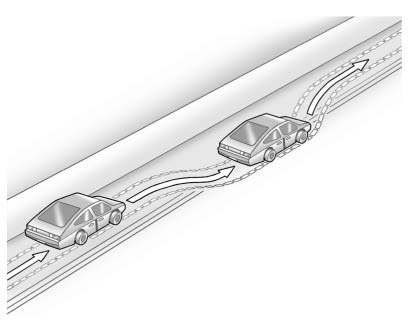
• There are some situations when steering around a problem may be more effective than braking.
• Holding both sides of the steering wheel allows you to turn 180 degrees without removing a hand.
• Anti-lock Brake System (ABS) allows steering while braking.
Off-Road Recovery
Test yourself
A quick Chevrolet Equinox quiz: every answer comes with an explanation and a link to the manual page.