Emergency towing
If a tow truck cannot be called, the vehicle can be towed using an emergency tow cable attached to the tow hooks under the bumper.

Front tow hooks The tow hooks are located under the bumper. To steer and brake the towed vehicle, a driver must be seated in it.
Towing in this manner may only be performed on paved roads, over short distances and at low speed.
The wheels, axles, transmission, steering and brake systems of the vehicle must be in good working order.
When towing the vehicle with a tow cable, some vehicle components may break.
To prevent damage:
• Towing by the front tow hooks may only be performed when no other towing equipment is available.
• It is recommended to tow the vehicle by its front end.
• The tow cable must not contact the bumper.
• Make sure both ends of the tow cable are securely attached to the tow hooks.
To do this, pull the tow cable taut.
• Towing with a tow rope may cause damage to the automatic transmission. To tow a vehicle with an automatic transmission, it is recommended to use a flatbed tow truck or a lift.
• The vehicle should move at a moderate speed and without sudden jerks.
Be careful, as control over the towed vehicle may be lost when towing with a rope.
• Do not tow a vehicle with damaged wheels, axles, transmission, steering system or brakes.
• Do not turn the ignition switch off while towing the vehicle, as this will lock the steering column and cause loss of control over the vehicle.
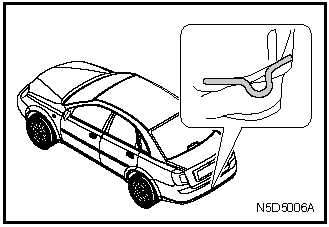
Rear Tow Hook
The tow hook at the rear of the vehicle is used for towing other vehicles. Use it only in emergencies (for example, to pull another vehicle out of a ditch, snowdrift or mud).
When towing, the pulling force must be applied strictly along the vehicle's longitudinal axis.
Do not apply force at an angle to the vehicle's axis. To avoid accidents, do not allow the tow rope to slacken suddenly.
Test yourself
A quick Chevrolet Lacetti quiz: every answer comes with an explanation and a link to the manual page.