Changing a Flat Tire
Before changing a flat tire, read the safety instructions below.
Safety Precautions When Changing a Wheel
1. Turn on the hazard warning lights.
2. Park the vehicle well away from the flow of traffic.
3. Park on level, firm ground. See “PARKING THE VEHICLE”.
4. Turn off the engine and remove the ignition key.
5. Apply the parking brake.
6. All passengers must leave the vehicle and move to a safe distance.
7. Place wheel chocks, wooden blocks or large stones on both sides of the wheel diagonally opposite the wheel being replaced.
Failure to observe these safety precautions may cause the vehicle to slip off the jack, which may result in serious personal injury.

Changing a Flat Tire
1. Remove the spare tire, jack and other tools from the luggage compartment.
2. Using the wheel wrench or a flat-blade screwdriver, remove the wheel cover (if equipped).
3. Using the wheel wrench, loosen each wheel bolt by one turn.
Do not remove the wheel nuts and bolts from the wheel until the wheel is raised.
4. Install the jack handle and the wheel wrench onto the jack.
5. To raise the wheel, turn the jack handle clockwise.
6. Position the jack as shown in the illustration below.
Reinforced jacking points are located under the front and rear doors of the vehicle.
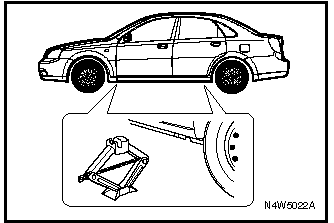
7. Position the jack vertically under the reinforced jacking point on the right or left side of the wheel to be replaced.
Do not attempt to raise the vehicle until the jack is installed and securely seated in the correct position.
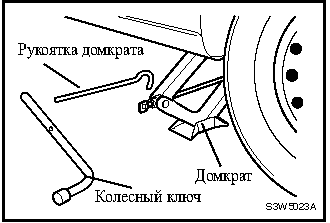
8. Turning the jack handle clockwise, carefully raise the vehicle until the jack is firmly seated at the correct point on the body and the wheel is raised at least 3 cm (1.2 in) off the ground.
• While raising the vehicle, make sure the jack is securely positioned; otherwise it may slip out from under the vehicle.
Raise the vehicle only to the height required to replace the wheel, and no higher.
• Do not get under a vehicle supported by the jack and do not start the engine.
The jack may slip, which may result in serious injury or death.
9. Turning the wheel wrench counterclockwise, fully loosen all wheel nuts and bolts, then remove them from the wheel.
10. Remove the wheel.
11. Install the spare wheel onto the hub.
• Never apply oil or grease to the wheel nuts or bolts.
• Always use only wheel nuts and bolts suitable for the wheel.
• Using the wheel wrench supplied in the tool kit, securely tighten the wheel nuts and bolts.
• At the first opportunity, have the wheel nuts and bolts tightened to Chevrolet specifications by an authorized Chevrolet dealer.
If the wheel nuts or bolts are not tightened correctly, they may loosen over time.
12. Install the wheel nuts and bolts and tighten them lightly by turning the wheel wrench clockwise.
13. To lower the vehicle to the ground, turn the jack handle counterclockwise.
14. Securely tighten the wheel nuts and bolts to 120 N·m torque, using a cross pattern in the sequence 1→2→3→4 (see the illustration below).
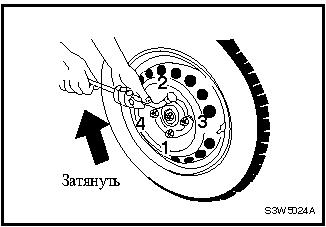
Make sure you use nuts and bolts of the correct size and tighten them to the specified torque.
Using non-recommended parts or insufficient bolt tightening may cause the bolts to loosen.
15. Secure the wheel cover in the luggage compartment. It will be needed when replacing the temporary spare tire with a regular wheel.
Do not install the wheel cover on the temporary spare tire (compact spare).
The cover or the wheel may be damaged.
16. Store the jack, tools and the flat tire in their designated places.
Do not leave the jack or tools in the passenger compartment.
Improperly secured tools may injure passengers in an emergency stop or collision.
The temporary spare tire (compact spare) is intended for short-term use only.
At the first opportunity, replace the temporary spare tire with a regular tire.
A vehicle raised on a jack is unstable, which may damage the vehicle and cause personal injury.
• Use only the supplied jack, positioned correctly.
• The jack must be positioned perpendicular to the ground.
• Do not get under a vehicle supported by the jack.
• Do not start the engine of a vehicle supported by the jack.
• Before raising the vehicle on the jack, all passengers must leave the vehicle and move to a safe distance (including away from other traffic).
• Use the jack only for changing wheels.
• It is unsafe to position the jack under a vehicle parked on a slope or slippery surface.
• Position the jack directly near the wheel to be replaced.
• Block the wheel diagonally opposite the wheel being replaced.
• Before raising the vehicle on the jack, apply the parking brake and engage first or reverse gear (manual transmission), or move the selector lever to the “P” position (automatic transmission).
• Do not change a wheel near moving traffic.
If conditions for changing the wheel are not suitable or you are not confident in your own abilities, contact a service workshop.
Test yourself
A quick Chevrolet Lacetti quiz: every answer comes with an explanation and a link to the manual page.