Starting the Engine Using Another Vehicle's Battery
• Do not attempt to start the engine by pushing or towing the vehicle.
This may damage the catalytic converter and automatic transmission, and may cause personal injury.
If the battery is discharged, the engine can be started using the battery of another vehicle.
Batteries are explosive.
Electrolyte burns or a short circuit may occur, which may result in serious injury or damage to vehicle components.
• Do not use batteries near open flames or sparks.
• When starting the engine using another vehicle's battery, do not tilt the battery.
• Do not allow the wires to short circuit.
• Wear protective goggles when working near the battery.
• Do not allow electrolyte to contact the eyes, skin, clothing or painted surfaces.
• Make sure both vehicles' batteries have the same nominal voltage.
• Do not disassemble a discharged battery.
Failure to observe these safety precautions or to follow the subsequent instructions when starting the engine from another vehicle's battery using jumper cables may result in battery explosion, electrolyte burns or a short circuit.
All of this may cause serious damage to the electrical systems of both vehicles and may also result in serious personal injury.
Before starting the engine from another vehicle's battery:
1. Apply the parking brake.
2. On vehicles with automatic transmission, place the selector lever in PARK. On vehicles with manual transmission, place the shift lever in neutral.
3. Turn off all electrical accessories.
• Before starting the engine from another vehicle's battery, turn off the audio system. Otherwise, it may be damaged.
Repairs for such malfunctions are not covered by the manufacturer's warranty.
• Make sure the jumper cables do not contact any moving parts in the engine compartment.
This may cause serious damage to these parts.
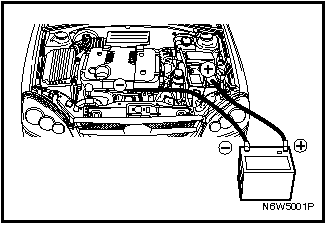
Connecting jumper cables Connect the jumper cables in the following order:
1. Connect one clamp of the first jumper cable to the positive (+) terminal of the charged battery (marked "+" on the battery case or on the terminal itself).
2. Connect the other end of this cable to the positive (+) terminal of the discharged battery. 3. Connect one end of the second jumper cable to the negative (-) terminal of the charged battery (marked "-" on the battery case or on the terminal itself).
Do not connect the remaining end of the second jumper cable to the negative (-) terminal of the discharged battery.
• Attach this clamp to a metal engine bracket.
• This bracket should be located as far as possible from the battery.
Connecting the last clamp to the negative (-) terminal of the discharged battery may cause an electrical arc or battery explosion.
This may result in personal injury and damage to vehicle components.
4. The second free end of the negative cable serves as a ground and is connected to a metal engine bracket.
5. While the discharged battery is charging, the engine of the vehicle whose battery is being used may be kept running.
The interval between attempts to start a vehicle with a discharged battery must be at least one minute, and each attempt must not exceed 15 seconds.
After the engine has started successfully:
1. Carefully disconnect the negative (-) jumper cable clamps. Start with the vehicle whose battery was discharged.
Do not turn off the engine of the vehicle.
2. Disconnect the negative jumper cable clamp from the negative (-) terminal of the other vehicle's battery.
3. Disconnect the positive jumper cable clamps from the positive (+) terminals of both batteries. Place the jumper cables in the luggage compartment next to the spare wheel.
4. After the engine has started, the vehicle should be driven for approximately 20 minutes.
This is necessary to charge the battery.
5. If the battery discharges again, contact an authorized Chevrolet dealer.
Test yourself
A quick Chevrolet Lacetti quiz: every answer comes with an explanation and a link to the manual page.