Automatic two-zone air conditioning
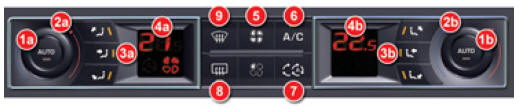
Automatic dual-zone air conditioning
The air conditioning system operates with the engine running.
Dual zone:It is the differentiated control of temperature and air distribution between the driver and the front passenger.
The driver and the front passenger can each adjust the temperature and air distribution as they wish.
The symbols and messages associated with the automatic air conditioning controls appear on the multifunction display.
1a. Automatic operation, driver side
1b. Automatic operation, passenger side
2a. Temperature adjustment, driver side
2b. Temperature adjustment, passenger side
3a. Air distribution adjustment, driver side
3b. Air distribution adjustment, passenger side
4a. Driver zone display
4b. Passenger zone display
- Airflow adjustment
- Air conditioning activation/deactivation
- Air recirculation – outside air intake
- Demisting – Rear defrost
- Demisting – Front defrost

This is the normal operating mode of the system.
Depending on the comfort level selected, pressing this control, confirmed by the illumination of indicator A, automatically and simultaneously manages all of the following functions:
- Airflow.
- Cabin temperature.
- Air distribution.
- Air conditioning.
- Automatic air recirculation.
It is recommended to keep all air vents open. A single press on any of the controls, except the temperature controls 1a and 1b, switches to manual mode. Indicator A goes off.
2a-2b. Temperature adjustment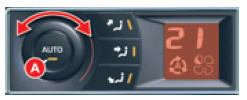
- Turn control 2a to adjust the driver-side temperature and control 2b to adjust the passenger-side temperature: to the right to increase the temperature or to the left to decrease it.
The desired setting is displayed.
The value shown on the display corresponds to a comfort level, not to a temperature in degrees Celsius or Fahrenheit, depending on the setting validated on the display.
Setting around the value 21 provides optimal comfort.
However, depending on your needs, a setting between 18 and 24 is common.
When you get into the vehicle, the interior temperature may be much colder (or hotter) than the comfort temperature. There is no need to change the displayed temperature to reach the desired comfort quickly.
Automatic air conditioning control will use its maximum capacity to compensate for the temperature difference as quickly as possible.
Manual control adjustments- Press any control except the temperature controls 2a and 2b. The A indicators on the “AUTO” controls go off.
It is possible to adjust one or more functions manually, while keeping the other functions in automatic mode.
Switching to manual mode may cause discomfort (temperature, humidity, odour, fogging) and is not optimal for comfort.
To return to “AUTO” mode, press controls 1a and 1b.
Indicators A come on.
3a-3b. Air distribution adjustment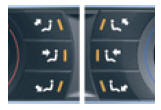
- Press control 3a to change the airflow distribution on the driver side.
- Press control 3b to change the airflow distribution on the passenger side.
The indicators corresponding to the selected distribution light up:
- Windscreen and front side windows.
- Front ventilation (centre and side vents, and soft-diffusion grille if open) and rear.
- Front and rear footwells.
Simultaneous display of air distribution to the windscreen, side windows, and front and rear ventilation is not possible.
- Air flow adjustment
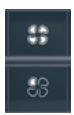
- Press control
- to increase the airflow,
- to decrease the airflow.
The airflow level is shown by the fan blade indicators lighting up progressively.
By reducing the air flow to the minimum, the air conditioning system switches off (OFF).To prevent fogging and a decline in cabin air quality, make sure a sufficient air flow is maintained.
- Air conditioning

Air conditioning operates only with the engine running. The blower control (air flow adjustment) must be active to obtain air conditioning.
- Press control 6. The indicator comes on.
For air conditioning to be effective, use it with the windows closed.
- Air recirculation – outside air intake

Air intake in automatic mode
It is activated by default in automatic comfort control.

Automatic mode is activated when reversing or when the windscreen washer is operated.
This function recirculates the air and isolates the passenger compartment from outside odours and smoke.
It is deactivated when the outside temperature is below +5 °C to prevent the risk of the vehicle fogging up.
Closing the air intake
- Press control 7 to close the outside air intake.
While the other settings are maintained, this position allows the driver to isolate themselves from unpleasant outside odours or smoke at any time.
It should be cancelled as soon as possible to allow fresh air into the passenger compartment and to demist the windows.
Outside air intake
- Press control 7 once to open the outside air intake.
- Demisting - Rear defrosting

The heated rear window operates independently of the air conditioning system.
- With the engine running, press control 8 to defrost the rear window and the mirrors. The indicator comes on.
It switches off automatically to avoid excessive power consumption, depending on the outside temperature.
It can be interrupted by pressing control 8 again or when the engine is switched off.
In the latter case, defrosting resumes at the next engine start if the stop lasted less than one minute.
Switch off rear window and exterior mirror defrosting as soon as you judge it unnecessary, as low power consumption reduces fuel consumption.
- Demisting - Front defrosting

In some cases, "AUTO" mode may be insufficient to demist or defrost the windows (humidity, many passengers, frost).
- Press control 9 to quickly clear the windows. The indicator comes on.
This system controls the temperature and airflow, manages the air intake and distributes the airflow to the windscreen and the front side windows.
A manual adjustment exits the “Demisting” mode. It should be cancelled as soon as possible to allow fresh air into the passenger compartment and to demist the windows.
Pressing one of the controls 1a or 1b returns to “AUTO”. With Stop & Start, the STOP mode is not available as long as demisting is activated. When starting from cold, the airflow only gradually reaches its optimum level to avoid blowing too much cold air. When you get into the vehicle after a more or less prolonged stop and the interior temperature is far from the comfort temperature, it is not necessary to change the displayed temperature to reach the desired comfort quickly. The system automatically uses its maximum capacity to compensate for the temperature difference as quickly as possible. Water from air conditioning condensation drains through a dedicated outlet; a puddle of water may therefore form under the vehicle when it is stationary. Whatever the season, in cool weather air conditioning is useful because it removes humidity and mist from the air. Avoid driving for too long with the air conditioning switched off.Test yourself
A quick Citroen C5 quiz: every answer comes with an explanation and a link to the manual page.