Electrical
Refrigerant System Tests. General Procedures
In this manual: Electrical
29steps
~174min
4/5difficulty
Done 0 of 29
Inspection
- Drive the vehicle or let the engine run until it reaches normal operating temperature.
- Set the air conditioning temperature to maximum cool with dual zone function off (if equipped). Manually set the blower fan to HI. If the vehicle has a fresh/recirculation air button, set it to recirculation. If the vehicle has an A/C switch or A/C compressor switch, set it to the OFF position.
- Close all vehicle windows and doors.
- Run the vehicle at idle for 5 minutes.
- Make sure the cabin temperature is above 24 °C. Set the A/C or compressor switch to MAX A/C ON.
- Run the vehicle at idle for 5 minutes.
- Turn the engine OFF and proceed to Procedure 2 — Ambient Temperature 21 °C to 38 °C.
Inspection
- Run the engine until it reaches normal operating temperature.
- Connect the A/C service manifold gauge set to the refrigerant system.
- Set the A/C system temperature to the lowest possible setting with the dual-zone function turned off (if equipped). Manually set the blower to HI. If the vehicle has a fresh air/recirculation button, set it to FRESH. If the vehicle has an A/C switch or A/C compressor switch, set it to the A/C on position.
- Open all vehicle windows and leave the hood open for inspection. Open the rear doors.
- Make sure the compressor is running and the cooling fans are operating or engaged. Run the vehicle at idle until the suction (low-pressure side) and discharge (high-pressure side) pressures are stable or fluctuate within a repeating range.
- Record the ambient (shop) temperature.
- Record the discharge pressure. If the pressure fluctuates, record the average value.
- Determine whether the discharge pressure is within normal operating range using the Normal Refrigerant Discharge Pressure 21–38 °C Ambient (30–60% relative humidity) chart below.

- Record the suction pressure. If the pressure fluctuates, record the average value.
- Determine whether the suction pressure is within the normal operating range using the Normal Refrigerant Suction Pressure 21–38 °C Ambient (30–60% relative humidity) chart below.

High (Discharge) Pressure Low (Suction) Pressure Component — Causes High Normal to High - Condenser – insufficient airflow
- Engine – overheating
Normal to High Normal - Overcharged refrigerant – air in the refrigerant
Normal to Low High - A/C compressor – low performance
Normal to Low Normal to High - A/C suction line partially blocked or restricted.
Normal to Low Low - Low refrigerant charge — leak in the system.
- A/C suction line partially blocked or restricted b
Erratic operation or compressor does not operate - Ambient air temperature (AAT) sensor - poor connection
- A/C pressure sensor – poor connection
- Evaporator temperature sensor – poor connection
- Low refrigerant charge – leak in the system
Additional possible components or causes related to improper compressor operation - Compressor drive belt — loose.
- Compressor clutch — slipping.
- Clutch coil open — short circuit or loose mounting.
- Control module switch — dirty contacts or stuck open.
- Clutch wiring circuit — high resistance, open circuit, or blown fuse.
- Compressor operation interrupted by engine computer.
Additional possible components or causes related to a damaged compressor - Incorrect clutch air gap.
- Suction accumulator — oil bleed hole clogged.
- Refrigerant leaks.
a Low-pressure reading will be normal or high if the restriction is located downstream of the service access valve.
b Low-pressure reading will be low if the restriction is located upstream of the service access valve.
Inspection
- Run the engine until it reaches normal operating temperature.
- Connect the A/C service manifold gauge set to the refrigerant system.
- Set the A/C system temperature to the lowest possible setting with the dual-zone function turned off (if equipped). Manually set the blower to HI. If the vehicle has a fresh air/recirculation button, set it to FRESH. If the vehicle has an A/C switch or A/C compressor switch, set it to the A/C on position.
- Open all vehicle windows and leave the hood open for testing. Open the rear hatch and/or rear doors (if equipped).
- Make sure the compressor is running and the cooling fans are operating or engaged. Run the vehicle at idle until the suction (low-pressure side) and discharge (high-pressure side) pressures are stable or fluctuate within a repeating range.
- Record the ambient (shop) temperature.
- Record the discharge pressure. If the pressure fluctuates, record the average value.
- Determine whether the discharge pressure is within normal operating limits using the Normal Refrigerant Discharge Pressure 38–49 °C Ambient (15–40% relative humidity) chart below.
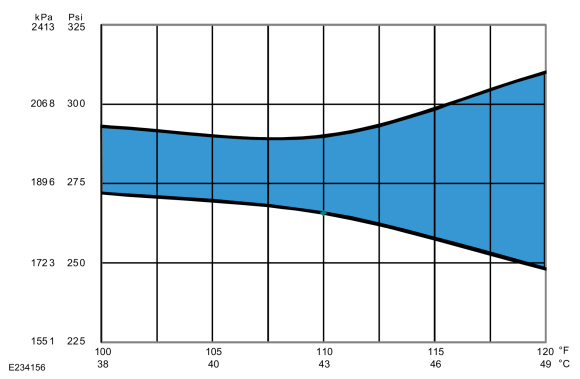
- Record the suction pressure. If the pressure fluctuates, record the average value.
- Determine whether the suction pressure is within normal operating limits using the Normal Refrigerant Suction Pressure 38–49 °C Ambient (15–40% relative humidity) chart below.

High (Discharge) Pressure Low (Suction) Pressure Component — Causes High Normal to High - Condenser – insufficient airflow
- Engine – overheating
Normal to High Normal - Overcharged refrigerant – air in the refrigerant
Normal to Low High - A/C compressor – low performance
Normal to Low Normal to High - A/C suction line partially blocked or restricted.
Normal to Low Low - Low refrigerant charge — leak in the system.
- A/C suction line partially blocked or restricted b
Erratic operation or compressor does not operate - Ambient air temperature (AAT) sensor - poor connection
- A/C pressure sensor – poor connection
- Evaporator temperature sensor – poor connection
- Low refrigerant charge – leak in the system
Additional possible components or causes related to improper compressor operation - Compressor drive belt — loose.
- Compressor clutch — slipping.
- Clutch coil open — short circuit or loose mounting.
- Control module switch — dirty contacts or stuck open.
- Clutch wiring circuit — high resistance, open circuit, or blown fuse.
- Compressor operation interrupted by engine computer.
Additional possible components or causes related to a damaged compressor - Incorrect clutch air gap.
- Suction accumulator — oil bleed hole clogged.
- Refrigerant leaks.
a Low-pressure reading will be normal or high if the restriction is located downstream of the service access valve.
b Low-pressure reading will be low if the restriction is located upstream of the service access valve.
Test yourself
A quick Ford Fusion quiz: every answer comes with an explanation and a link to the manual page.
Was this page helpful?