Towing Equipment
Hitches
The correct hitch equipment helps maintain combination control. Many trailers can be towed with a weight-carrying hitch which simply features a coupler latched to the hitch ball, or a tow eye latched to a pintle hook. Other trailers may require a weight-distributing hitch that uses spring bars to distribute the trailer tongue weight among the two vehicle and trailer axles.
Fifth-wheel and gooseneck hitches may also be used. See “Weight of the Trailer Tongue” under Trailer Towing on page 9‑84 for rating limits with various hitch types.
If a step-bumper hitch will be used, the bumper could be damaged in sharp turns. Make sure there is ample room when turning to avoid contact between the trailer and the bumper.
Consider using sway controls with any trailer. Ask a trailering professional about sway controls or refer to the trailer manufacturer's recommendations and instructions.
Weight-Distributing Hitch Adjustment
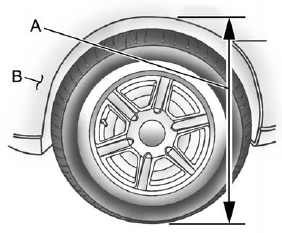
When using a weight-distributing hitch, the spring bars should be adjusted so the distance (A) is the same after coupling the trailer to the tow vehicle and adjusting the hitch.
Fifth-Wheel and Gooseneck Trailering
Fifth-wheel and gooseneck trailers can be used with many pickup models. These trailers place a larger percentage of the weight (kingpin weight) on the tow vehicle than conventional trailers. Make sure this weight does not cause the vehicle to exceed GAWR or GVWR.
Fifth-wheel or gooseneck kingpin weight should be 15 to 25 percent of the trailer weight up to the maximum amount specified in the trailering chart for the vehicle. See “Weight of the Trailer” under Trailer Towing on page 9‑84 for more information.
The hitch should be located in the pickup bed so that its centerline is over or slightly in front of the rear axle. Take care that it is not so far forward that it will contact the back of the cab in sharp turns. This is especially important for short box pickups. Trailer pin box extensions and sliding fifth-wheel hitch assemblies can help this condition.
There should be at least six inches of clearance between the top of the pickup box and the bottom of the trailer shelf that extends over the box.
Make sure the hitch is attached to the tow vehicle frame rails. Do not use the pickup box for support.
Safety Chains
Always attach chains between the vehicle and the trailer. Cross the safety chains under the tongue of the trailer to help prevent the tongue from contacting the road if it becomes separated from the hitch.
Instructions about safety chains may be provided by the hitch manufacturer or by the trailer manufacturer. If the trailer being towed weighs up to 2 271 kg (5,000 lbs) with a factory-installed step bumper, safety chains may be attached to the attaching points on the bumper; otherwise, safety chains should be attached to holes on the trailer hitch platform. Always leave just enough slack so the combination can turn. Never allow safety chains to drag on the ground.
Trailer Brakes
A loaded trailer that weighs more than 900 kg (2,000 lbs) needs to have its own brake system that is adequate for the weight of the trailer. Be sure to read and follow the instructions for the trailer brakes so they are installed, adjusted, and maintained properly.
Do not tap into the vehicle's hydraulic brake system.
Auxiliary Battery
The auxiliary battery provision can be used to supply electrical power to additional equipment that may be added, such as a slide-in camper.
If the vehicle has this provision, this relay will be located on the driver side of the vehicle, next to the underhood electrical center.
Be sure to follow the proper installation instructions included with any electrical equipment that is installed.
Notice: Leaving electrical equipment on for extended periods will drain the battery.
Always turn off electrical equipment when not in use and do not use equipment that exceeds the maximum amperage rating for the auxiliary battery provision.
Trailer Wiring Harness
The vehicle is equipped with one of the following wiring harnesses for towing a trailer or hauling a slide-in camper.
Basic Trailer Wiring
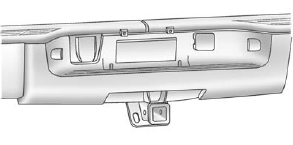
All regular, extended cab and crew cab pickups have a seven-wire trailer towing harness.
For vehicles not equipped with heavy duty trailering, the harness is secured to the vehicle's frame behind the spare tire mount. The harness requires the installation of a trailer connector, which is available through your dealer.
If towing a light-duty trailer with a standard four-way round pin connector, an adapter is available from your dealer.
Heavy-DutyTrailer Wiring Harness Package
Test yourself
A quick GMC Sierra quiz: every answer comes with an explanation and a link to the manual page.