Malfunction and Limitations of the Function
Malfunction of the Function
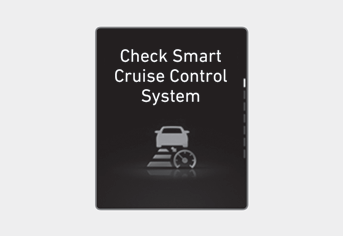
When Smart Cruise Control is not operating properly, the warning message "Check Smart Cruise Control" will appear and the warning light will illuminate on the cluster. We recommend having the system inspected by an authorized HYUNDAI dealer.
Function Disabled
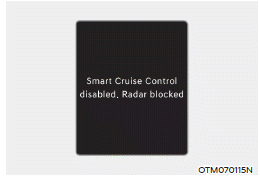
When the front radar cover or sensor is covered with snow, rain, or foreign material, it may reduce detection performance and temporarily limit or disable Smart Cruise Control.
In this case, the message "Smart Cruise Control Limited. Radar Blocked" will appear on the cluster for a certain period of time.
The system will operate normally once the snow, rain, or foreign material is removed.
WARNING
- Even if the warning message does not appear on the cluster, Smart Cruise Control may not operate properly.
- Smart Cruise Control may not operate properly in an area (for example, a hilly area) where there is nothing to detect after the engine is started.
Limitations of the Function
Smart Cruise Control may not operate normally, or the system may operate unexpectedly, under the following circumstances:
- The detection sensor or surrounding area is contaminated or damaged.
- Washer fluid is continuously sprayed or the wipers are operating.
- The camera lens is contaminated by tinted, film-coated, or coated windshield, damaged glass, or foreign matter (sticker, insect, etc.) stuck to the glass.
- Moisture is not removed or frozen from the windshield.
- The front view camera field of view is blocked by sun glare.
- Street lights or headlights of oncoming vehicles are reflected on a wet road surface, such as a puddle on the road.
- The temperature around the front view camera is high or low.
- An object is placed on the instrument panel.
- The surroundings are very bright.
- The surroundings are very dark, such as in a tunnel, etc.
- The brightness changes suddenly, for example when entering or exiting a tunnel.
- The outside brightness is low and the headlights are off or not bright.
- Driving in heavy rain or snow, or in dense fog.
- When driving through steam, smoke, or shadows.
- Only a part of the vehicle is detected
- The vehicle ahead has no taillights, or the taillights are located unusually, etc.
- The outside brightness is low and the taillights of the vehicle ahead are off or not bright.
- The rear of the vehicle ahead is small or appears abnormal (i.e., tilted, overturned, etc.)
- The ground clearance of the vehicle ahead is low or high.
- A vehicle suddenly cuts in ahead
- Your vehicle is being towed.
- Driving through a tunnel or under an iron bridge.
- Driving near objects containing metal, such as construction zones, railways, etc.
- Nearby material that reflects very well to the front radar, such as guardrails, a closely parked vehicle, etc.
- The bumper around the front radar is impacted or damaged, or the front radar is out of position.
- The temperature around the front radar is too high or too low.
- Driving in large open areas where there are few vehicles or structures (for example, desert, meadow, suburbs, etc.).
- The vehicle ahead is made of material that does not reflect the front radar
- Driving near a highway (or freeway) interchange or tollgate
- Driving on a slippery surface due to snow, puddles, ice, etc.
- Driving on a curved road
- The vehicle ahead is detected late.
- The vehicle ahead is suddenly blocked by an obstacle.
- The vehicle ahead suddenly changes lanes or decelerates sharply.
- The vehicle ahead is curved due to its shape.
- The speed of the vehicle ahead is high or low.
- When a vehicle is ahead, your vehicle changes lanes at low speed.
- The vehicle ahead is covered with snow.
- Unstable driving.
- You are at a roundabout and the vehicle ahead is not detected.
- You are continuously driving in a circle.
- Driving in a parking lot
- Driving through a construction site, unpaved road, partially paved road, uneven road, speed bumps, etc.
- Driving on a sloped road, curved road, etc.
- Driving past a roadside with trees or street lights
- Excessive vehicle vibration during driving due to adverse road conditions
- The height of your vehicle is lowered or raised due to heavy loads, incorrect tire pressure, etc.
- Driving on a narrow road where trees or grass overgrow.
- Interference from electromagnetic waves, such as driving in an area with strong radio waves or electrical interference
• Driving on curves
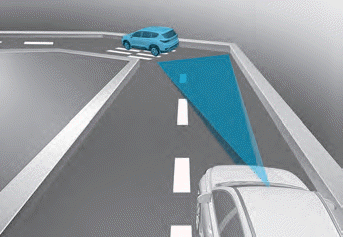
On curves, Smart Cruise Control may not detect a vehicle in the same lane and may accelerate to the set speed. In addition, your vehicle's speed may decrease rapidly when a vehicle ahead is suddenly detected.
Select an appropriate set speed on curves and depress the brake pedal or accelerator pedal according to the road and driving conditions ahead.
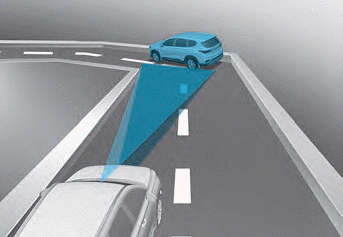
Your vehicle's speed may be reduced due to a vehicle in an adjacent lane.
Depress the accelerator pedal and select an appropriate set speed. Make sure that the road conditions allow safe operation of Smart Cruise Control.
• Driving on slopes
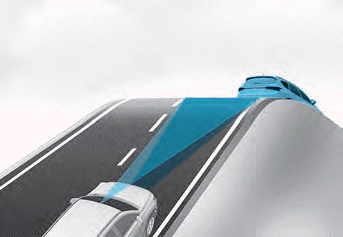
While driving uphill or downhill, Smart Cruise Control may not detect a moving vehicle in your lane and may cause your vehicle to accelerate to the set speed. In addition, your vehicle's speed will decrease rapidly when a vehicle ahead is suddenly detected.
Select an appropriate set speed on slopes and depress the brake pedal or accelerator pedal according to the road and driving conditions ahead.
• Lane changes
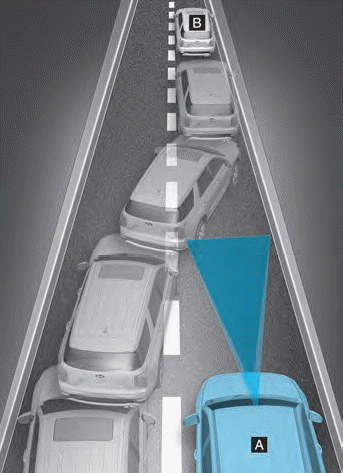
[A]: Your vehicle, [B]: Vehicle changing lanes
When a vehicle moves into your lane from an adjacent lane, it cannot be detected by the sensor until it enters the sensor's detection range. Smart Cruise Control may not immediately detect a vehicle that changes lanes abruptly. In this case, you must maintain a safe braking distance and depress the brake pedal as necessary to reduce speed and maintain a safe distance.
• Vehicle detection
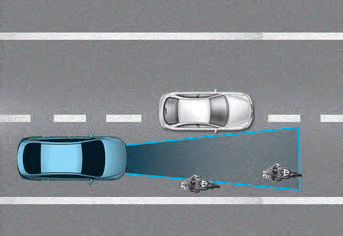
In the following cases, some vehicles in your lane may not be detected by the sensor:
-- Vehicles offset to one side
-- Slow-moving vehicles or vehicles that suddenly decelerate
-- Oncoming vehicles
-- Stopped vehicles
-- Vehicles with a small rear profile, such as trailers
-- Narrow vehicles, such as motorcycles or bicycles
-- Special vehicles
-- Animals and pedestrians
Adjust your vehicle's speed by depressing the brake pedal according to the road and traffic conditions ahead.
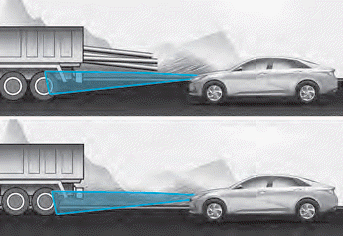
In the following cases, the vehicle ahead may not be detected by the sensor:
-- Vehicles with higher ground clearance, or vehicles with loads that protrude from the rear of the vehicle
-- Vehicles with the front raised due to heavy loads
-- You are driving your vehicle on narrow or sharply curved roads
Adjust your vehicle's speed by depressing the brake pedal according to the road and traffic conditions ahead.
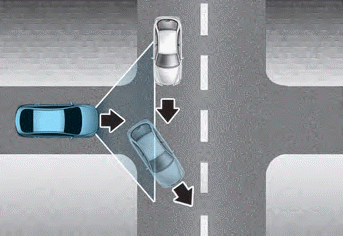
• When the vehicle ahead disappears at an intersection, your vehicle may accelerate.
Always pay attention to the road and driving conditions while driving.
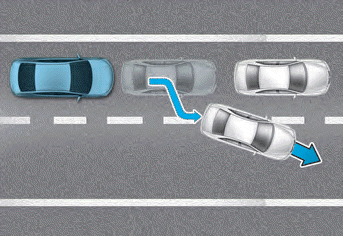
• When a vehicle in front of you merges out of the lane, Smart Cruise Control may not immediately detect a new vehicle now ahead of you.
Always pay attention to the road and driving conditions while driving.
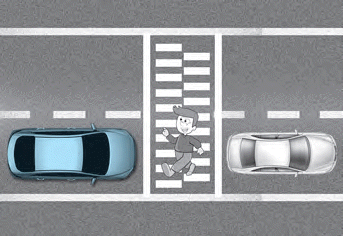
• Always watch for pedestrians when your vehicle is following a vehicle ahead.
Information
This device complies with Part 15 of the FCC Rules.
Operation is subject to the following two conditions:
1. This device may not cause harmful interference, and
2. This device must accept any interference received, including interference that may cause undesired operation.
3. Changes or modifications not expressly approved by the party responsible for compliance could void the user's authority to operate the equipment.
Information
Radio Frequency Radiation Exposure Information:
This equipment complies with FCC radiation exposure limits set forth for an uncontrolled environment.
This equipment must be installed and operated with a minimum distance of 8 inches (20 cm) between the radiator (antenna) and your body.
This transmitter must not be co-located or operated in conjunction with any other antenna or transmitter.
Test yourself
A quick Hyundai Elantra CN7 quiz: every answer comes with an explanation and a link to the manual page.