Body Electrical System
Description and Operation
In this manual: Body Electrical System
6steps
~36min
2/5difficulty
Done 0 of 6
Power Window Safety Function
When the driver door auto-up switch is pressed, the safety function is activated.- Safety Function Condition: When a force of 100 N (using a 10 N/mm spring) is detected while the window is rising, the window lowers.
- Window reverse distance (except when holding the auto-up switch)
A. When pinching is detected within 4 mm to 250 mm from the top of the center pillar, the window lowers to 300 mm from the top of the B-pillar. 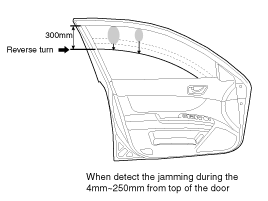
B. When pinching is detected at more than 250 mm from the top of the B-pillar, the window lowers to the lowest position if the total length of the trapped object plus 50 mm is below the lowest window position. 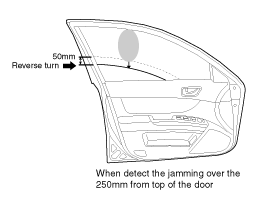
- Window Lowering Length
A. When pinching is detected while pressing the auto-up switch, the window moves down 25 mm from the locked position. B. The auto-up function is unavailable for 5 seconds after the above operation. > When the auto-up switch is pressed, the manual-up function is activated (without safety function). C. 5 seconds after the above condition, when the auto-up switch is held, the window reverses to 25 mm from the pinch position. 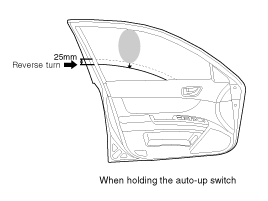
- Area Without Safety Function: The safety function is not available within 4 mm from the top of the window frame.
- Battery Connection Initialization: When battery power has been disconnected for more than 5 minutes, the power window switch must be initialized.
- Window Operation Before Initialization
A. Manual-Up/Safety function is available. B. Auto-Up/Down function is unavailable. (If the auto-up/down switch is pressed, the manual-up/down function is activated.) - Initialization: Close the window from the open position and hold the switch in the fully closed position for more than 0.2 seconds. (If closing starts from the fully closed position, initialization may fail.)
- When initializing the safety power window in the lock condition, the following conditions may occur.
A. Safety Function Not Available - Window Position Memory: A Hall sensor is used to detect the window position and motor operating direction. The ECU determines the highest window position and sets the position as "0".
- Deinitialization: The ECU is deinitialized when the following conditions occur. After deinitialization, the auto-up and safety functions do not operate. Deinitialization Conditions
A. The window moves down 15 times in succession. B. Power supply is interrupted while the engine is running. C. Driver's door open, ignition off, window at Hard Stop -> IGN On within 2 seconds -> within 5 seconds with ignition on, input a signal with the manual switch down 3 times -> Deinitialization complete (if power is not turned on within 2 seconds or the operation is not completed within 5 seconds, repeat the deinitialization process from the beginning.) - Engine Overheat Prevention. The software overheat prevention function is used to prevent the engine from overheating (but EEPROM data must be stored in the ECU). There are 2
- Window Operation Before Initialization
- Fail-Safe Mode Initialization
- If the window is forcibly moved and the motor is faulty, the window switch may enter fail-safe mode for user safety.
- Power Window Operation in Fail-Safe Mode
A. Auto/Manual-Down function is available. B. Auto/Manual-Up function is not available. (During auto/manual up, the window rises 20 mm and stops moving.)
Test yourself
A quick Hyundai Genesis DH quiz: every answer comes with an explanation and a link to the manual page.
Was this page helpful?