Body Electrical System
Tilt and Telescope Control (SCM) Description and Operation
In this manual: Body Electrical System
20steps
~120min
4/5difficulty
Done 0 of 20
Description
The tilt and telescope operation function in the SCM includes the following functions.- Manual control using direction switches (tilt up/down, telescope forward/backward).
- Recall with position switches (switches P1 and P2).
- Memory with position switches (switches P1 and P2).
- Easy Access operation according to IGN SW SCM = Key OFF > exception of key OFF, or IGN SW SCM = exception of key OFF > key OFF.
- Easy Entry position extension.
- Arbitration Control
- Fault Detection
- Notice (manual mode, memory recall, quick access mode)
- Manual Operation: Motor operation using the manual seat switch.
- The seat position is changed by a motor when a signal is input through the manual seat switch (slide, reclining, front tilt, cushion height-adjustable rear, cushion extension).
- Memory Function: Stores and recalls data for two drivers using the IMS switch.
- Memory position for optimal seal position, set by driver based on CAN data from the DDM > IMS module with the IMS switch.
- CAN playback of data received from DDM when operating the IMS switch.
- Linked Movement On/Off
- Linked movement on/off function depending on the engine ON/OFF status.
- Using MS IN data transmission
- Start condition: When the power is in ACC mode.
Operation
Behavior for normal state: manual control using direction switches.- Tilt and telescope control is performed by the SCM in accordance with the user's operation of the direction switches when the following conditions are met.
A. Only one of the direction switches is pressed (tilt up/down, telescope forward/backward). - Manual mode has priority even if a drive self-diagnosis command is received (drive operation ignored).
- LIMIT must be updated over the entire range by MANUAL operation during initial LIMIT setting.
- If a fault occurs during operation, after saving FAULT DATA to EEPROM, the quick access position is deleted and only the SOFT LIMIT of the direction of movement is deleted.
- LIMIT must be reset over the entire range and free access (exit) after the fault condition is restored.
- SOFT LIMIT is displayed at ±12 PULSES from the mechanical limit position.
- The SCM stores the position once when either Mem P1 CMD or Mem P2 CMD is changed to ON.
- Enable memory
A. CAN signal Mem ENB=Enable - Memory operation
A. When the CAN signal Mem P1 CMD=P1 or Mem P2 CMD=P2 is received, the SCM stores the current tilt and telescope position. - Memory notice
A. Memory must not be cleared even if the battery is disconnected. 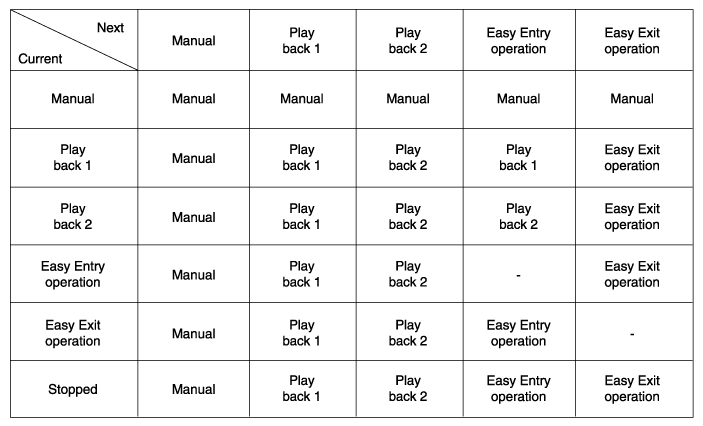
Test yourself
A quick Hyundai Genesis DH quiz: every answer comes with an explanation and a link to the manual page.
Was this page helpful?