Tow/Haul
Towing Services
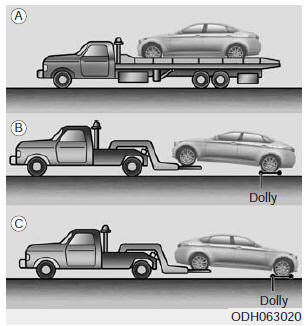
If emergency towing is required, we recommend that it be performed by an authorized HYUNDAI dealer or a commercial towing service. Proper lifting and towing procedures are necessary to prevent damage to the vehicle. Use of wheel dollies or a flatbed is recommended.
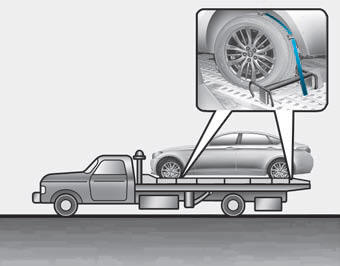
When towing the vehicle on a flatbed, secure the wheels with wheel chocks and tie-down straps (or soft straps).
Do not attach straps to body panels or over the wheels.
CAUTION
Do not lift the vehicle by the towing fitting or body and chassis parts. Otherwise, the vehicle may be damaged.
On all-wheel drive vehicles, the vehicle must be towed with a wheel lift and dolly or flatbed equipment with all wheels off the ground.
CAUTION
An all-wheel drive vehicle must never be towed with its wheels on the ground. This may cause serious damage to the transmission or the all-wheel drive system.
On two-wheel drive vehicles, it is permissible to tow the vehicle with the front wheels on the ground (without dollies) and the rear wheels off the ground.
If any of the loaded wheels or suspension components are damaged, or the vehicle is towed with the rear wheels on the ground, use a towing dolly under the rear wheels.
When towing with a commercial tow truck and wheel dollies is not used, the rear of the vehicle must always be lifted, not the front.
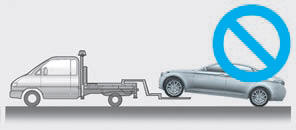
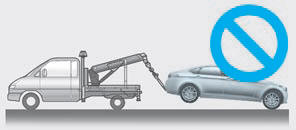
CAUTION
- Do not tow the vehicle with the rear wheels on the ground as this may cause damage to the vehicle.
- Do not tow the vehicle with a sling-type device. Use a wheel lift or flatbed equipment.
When towing the vehicle to an emergency location without wheel dollies:
1. Set the engine START/STOP button to the ACC position.
2. Shift the gear shift lever to the N (Neutral) position.
3. Release the parking brake.
CAUTION
Failure to place the shift lever in N (Neutral) may cause internal damage to the transmission.
Test yourself
A quick Hyundai Genesis DH quiz: every answer comes with an explanation and a link to the manual page.