Make sure the brake fluid in the reservoir is at the MAX (upper) line.
Have someone slowly depress the brake pedal several times, then apply pressure.
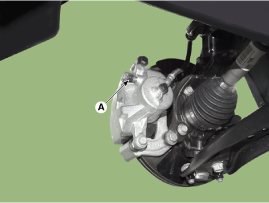
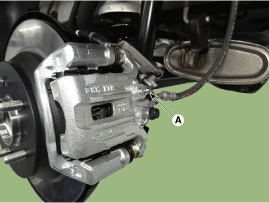
Loosen the bleeder screw on the right rear brake (A) to allow air to escape from the system. Then securely tighten the bleeder screw. [Front][Rear]
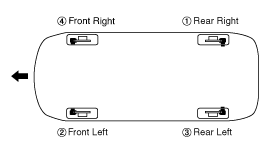
Repeat the procedure for each wheel in the sequence shown below until no more air bubbles appear in the fluid.
Fill the master cylinder reservoir to the MAX (upper) level mark.
Remove the reservoir cap and fill the brake fluid reservoir with brake fluid.
Connect the self-diagnosis connector (16-pin), located under the driver's side crash pad, to the self-diagnosis device, then turn on the self-diagnosis device after turning the key on.
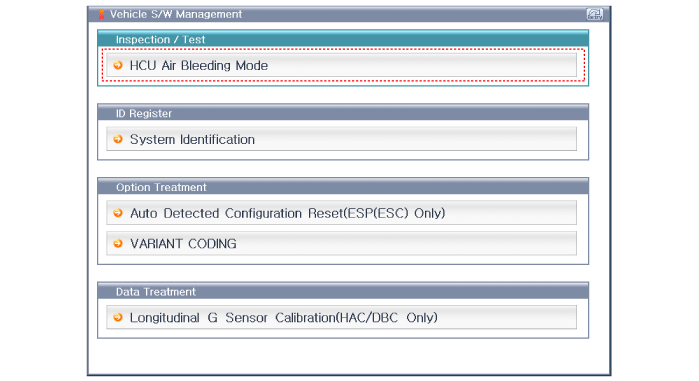
Select "Vehicle model" and "ABS/ESC" on the GDS vehicle selection screen, then select OK.
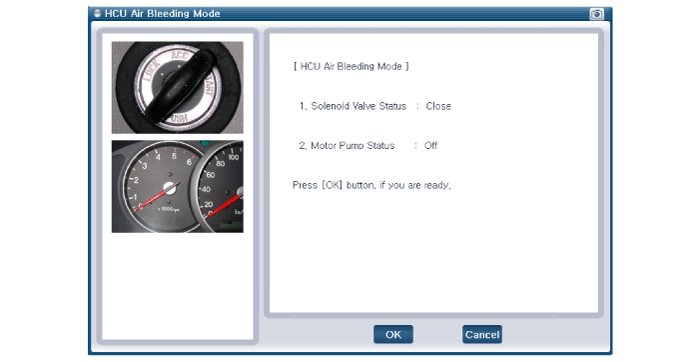
Select the HCU air bleeding mode.
Have an assistant depress the brake pedal several times to build up pressure, and hold it depressed.
Depress the brake pedal several times, then loosen the bleeder screw until fluid flows out without bubbles. Then close the bleeder screw (A).
Tightening torque: 6.8–12.7 N·m
[Front][Rear]
Repeat the procedure for each wheel in the sequence shown below until no more air bubbles appear in the fluid.
Perform the steps in the following order: rear right, front left, rear left and front right.
Fill the master cylinder reservoir to the MAX (upper) level mark.
ABS Bleeding This procedure must be performed to ensure proper air bleeding and filling of the ESC unit, brake lines and master cylinder with brake fluid.
?
Test yourself
A quick Hyundai Kona quiz: every answer comes with an explanation and a link to the manual page.