Suspension System (without ECS)
Troubleshooting
In this manual: Suspension System (without ECS)
~2min read
Troubleshooting
| Symptom | Possible Cause | Remedy |
| Hard Steering | Incorrect Front Wheel Alignment | Correct |
| Excessive resistance to lower arm ball joint rotation | Replace | |
| Low Tire Pressure | Adjust | |
| No power assistance | Repair or Replacement | |
| Poor Steering Return to Center | Incorrect Front Wheel Alignment | Correct |
| Poor or Harsh Ride | Incorrect Front Wheel Alignment | Correct |
| Faulty Shock Absorber | Repair or Replace | |
| Broken or Worn Stabilizer Bar | Replace | |
| Broken or Worn Coil Spring | Replace | |
| Worn lower arm bushing | Replace Lower Arm Assembly | |
| Abnormal Tire Wear | Incorrect Front Wheel Alignment | Correct |
| Incorrect tire pressure | Adjust | |
| Faulty Shock Absorber | Replace | |
| Wandering | Incorrect Front Wheel Alignment | Correct |
| Poor lower arm ball joint rotation resistance | Repair | |
| Loose or worn lower arm bushing | Tighten or replace | |
| Vehicle pulls to one side | Incorrect Front Wheel Alignment | Correct |
| Excessive resistance to lower arm ball joint rotation | Replace | |
| Broken or Worn Coil Spring | Replace | |
| Bent lower arm | Repair | |
| Steering Wheel Shimmy | Incorrect Front Wheel Alignment | Correct |
| Poor lower arm ball joint rotation resistance | Replace | |
| Broken or Worn Stabilizer Bar | Replace | |
| Worn lower arm bushing | Replace | |
| Faulty Shock Absorber | Replace | |
| Broken or Worn Coil Spring | Replace | |
| Bottom | Broken or Worn Coil Spring | Replace |
| Faulty Shock Absorber | Replace |
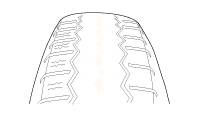
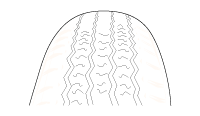
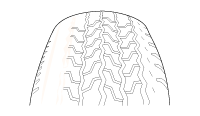
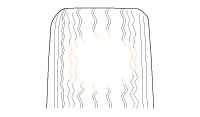
Noise, vibration and harshness problems related to the wheels/tires are directly related to vehicle speed and usually do not depend on acceleration, coasting or deceleration. In addition, an unbalanced wheel and tires may vibrate at more than one speed. Vibration that depends on engine speed or is eliminated by placing the transmission in neutral is not related to the tire and wheel. As a rule, tire and wheel vibrations felt through the steering wheel are related to the front wheel and wheel assemblies. Vibrations felt in the seat or floor are related to the rear tire and wheel assembly. This may help initially isolate the problem to the front or rear. Pay special attention to the tires and wheels. There are several symptoms that may be caused by damaged or worn tires and wheels. Perform a thorough visual inspection of the tires and wheel assemblies. Slowly rotate the tires and look for signs of lateral or radial runout. Refer to the tire wear chart to determine tire wear conditions and actions
| Wheel and Tire Diagnosis | ||
| Rapid Wear in Center | Rapid Wear on Both Shoulders | Wear on One Shoulder |
 |
 |
 |
|
|
|
| Partial Wear | Feathered Edge | Wear Pattern |
 |
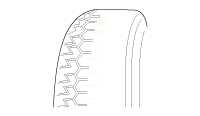 |
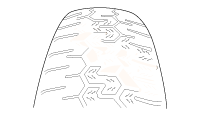 |
|
|
|
Test yourself
A quick Hyundai Kona quiz: every answer comes with an explanation and a link to the manual page.
Was this page helpful?