Blind-Spot Collision-Avoidance Assist Operation

Vehicle Detection
- To alert the driver that a vehicle has been detected, the side mirror indicator illuminates.
- The Blind-Spot Collision-Avoidance Assist operates when your vehicle speed is above 20 km/h and the vehicle speed in the blind-spot area is above 7 mph (10 km/h).
- The collision warning activates when the turn signal is activated in the direction of the detected vehicle.
- If "Warning Only" is selected in the Settings menu, the collision warning activates when your vehicle approaches a vehicle detected in the blind-spot area.
- To warn the driver of a possible collision, the side mirror indicator flashes. At the same time, a warning sound is heard.
- When the turn signal is turned off or you leave the lane, the collision warning is canceled and the Blind-Spot Collision-Avoidance Assist returns to vehicle detection status.
WARNING
- The rear corner radar detection range is determined by a standard road width. Therefore, on a narrow road, the Blind-Spot Collision-Avoidance Assist may detect other vehicles in two or more lanes and warn you. Conversely, on a wide road, the Blind-Spot Collision-Avoidance Assist may not be able to detect a vehicle traveling in the adjacent lane and may not warn you.
- When the hazard warning lights are on, the turn signal collision warning will not operate.
Information
If the driver's seat is on the left side, the collision warning may activate when you turn left. Keep a safe distance from vehicles in the left lane. If the driver's seat is on the right side, the collision warning may activate when you turn right. Keep a safe distance from vehicles in the right lane.
Collision-Avoidance Assist System (While Driving)
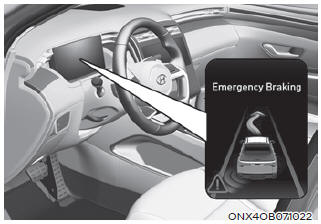
- To warn the driver of a possible collision, the side mirror indicator flashes and a warning message appears in the instrument cluster. At the same time, a warning sound is heard.
- The Blind-Spot Collision-Avoidance Assist operates when your vehicle speed is between 40-120 mph (60-200 km/h) and both lane markings are detected.
- Emergency braking helps to prevent a collision with a vehicle in the blind-spot area.
WARNING
• The Collision-Avoidance Assist is canceled under the following conditions:
- Your vehicle is moving into the adjacent lane for a certain distance
- Your vehicle is far from the risk of collision
- The steering wheel is being steered sharply
- The brake pedal is depressed
- Forward Collision-Avoidance Assist is operating
• After Blind-Spot Collision-Avoidance Assist steering or lane change assistance, you should drive toward the center of the lane. Blind-Spot Collision-Avoidance Assist will not operate if the vehicle is not driving near the center of the lane.
Collision-Avoidance Assist (During Evasive Steering)

- To warn the driver of a possible collision, the side mirror indicator flashes and a warning message appears in the instrument cluster. At the same time, a warning sound is heard.
- Blind-Spot Collision-Avoidance Assist operates when your vehicle speed is below 3 km/h and the speed of the vehicle in the blind spot is above 5 km/h.
- Emergency braking helps to prevent a collision with a vehicle in the blind-spot area.

- When the vehicle is stopped by emergency braking, the "Drive Carefully" warning message appears on the cluster. For your safety, the driver must immediately depress the brake pedal and check the surroundings.
- Braking control ends approximately 2 seconds after the vehicle is stopped by emergency braking.
WARNING
Observe the following precautions when using Blind-Spot Collision-Avoidance Assist:
- For safety, change the settings after parking the vehicle at a safe location.
- If another system warning message is displayed or a warning chime sounds, the Blind-Spot Collision-Avoidance Assist warning message may not be displayed and the warning chime may not sound.
- You may not hear the Blind-Spot Collision-Avoidance Assist warning chime if the surroundings are noisy.
- Blind-Spot Collision-Avoidance Assist may not operate if the driver depresses the brake pedal to avoid a collision.
- While Blind-Spot Collision-Avoidance Assist is operating, braking control is automatically cancelled when the driver excessively depresses the accelerator pedal or sharply steers the vehicle.
- During Blind-Spot Collision-Avoidance Assist operation, the vehicle may stop suddenly, causing injury to passengers and displacing loose objects. Always fasten your seat belt and secure loose items.
- Even if there is a problem with Blind-Spot Collision-Avoidance Assist, the basic braking function of the vehicle will operate normally.
- Blind-Spot Collision-Avoidance Assist does not operate in all situations and cannot avoid all collisions.
- Blind-Spot Collision-Avoidance Assist may warn the driver late or may not warn the driver, depending on the road and driving conditions.
- The driver must always keep control of the vehicle. Do not rely on Blind-Spot Collision-Avoidance Assist. Maintain a safe braking distance and, if necessary, depress the brake pedal to reduce speed or stop the vehicle.
- Never rely on Blind-Spot Collision-Avoidance Assist to avoid people, animals, objects, etc. This may cause serious injury or death.
WARNING
Braking control may not operate properly depending on the ESC (Electronic Stability Control) condition.
The warning will only be given when:
- The ESC (Electronic Stability Control) warning light is on
- The ESC (Electronic Stability Control) is operating for another function
Test yourself
A quick Hyundai Tucson quiz: every answer comes with an explanation and a link to the manual page.