Navigation-Based Smart Cruise Control Limitations
Navigation-based Smart Cruise Control may not operate properly under the following circumstances:
- Navigation does not operate properly
- Map information is not transmitted due to abnormal operation of the audio/video/navigation system
- Speed limit and road information in the navigation is not updated
- The map information and the actual road are different due to real-time GPS data errors or map information errors.
- Navigation searches for a route while driving
- GPS signals are blocked in areas such as tunnels
- A road that divides into two or more roads and rejoins
- Driver deviates from the route set in the navigation
- Destination route is changed or canceled by resetting the navigation
- The vehicle arrives at a service station or rest area.
- Android Auto or CarPlay is operating.
- Navigation cannot detect the current position of the vehicle (for example, overpasses, including an overpass near public roads, or when roads run parallel nearby)
- Navigation updates while driving
- Navigation restarts while driving
- The speed limit changes depending on road conditions in some sections
- Driving on a road under construction
- Driving on a controlled road
- Bad weather such as heavy rain, heavy snow, etc.
- Driving on a road with a sharp curve
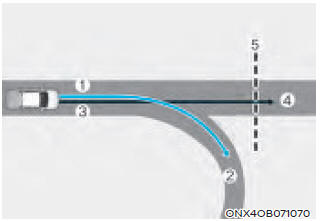
[1]: Set route, [2]: Branch road, [3]: Driving route, [4]: Main road, [5]: Curved road section.
- When there is a difference between the navigation set route (branch road) and the driving route (main road), the Highway Curve Deceleration function may not operate until the driving route is recognized as the main road.
- When the vehicle's driving route is recognized as the main road instead of the main road of the navigation set route, the Highway Curve Deceleration function will operate. Depending on the distance to the curve and the current vehicle speed, the vehicle may not decelerate sufficiently or may decelerate rapidly.
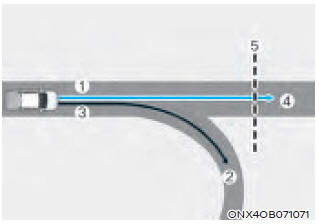
[1]: Set route, [2]: Branch road, [3]: Driving route, [4]: Main road, [5]: Curved road section.
- When there is a difference between the navigation route (main road) and the driving route (branch road), the Highway Curve Deceleration function will operate based on curve information on the main road.
- When it is determined that you are driving off the road by entering an interchange or intersection, the Highway Curve Deceleration function will not operate.
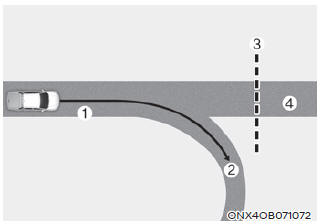
[1]: Driving route, [2]: Branch road, [3]: Curved road section, [4]: Main road
- If a destination is not set in the navigation, the Highway Curve Deceleration function will operate based on curve information on the main road.
- Even if you start on the main road, the Highway Curve Deceleration function may temporarily operate based on the navigation information of the highway curve section.
WARNING
- Navigation-based Smart Cruise Control does not replace safe driving practices but is a convenience feature. Always watch the road, and it is the driver's responsibility to avoid violating traffic laws.
- Speed limit information from navigation may differ from the actual speed limit on the road. It is the driver's responsibility to check the speed limit on the actual road or lane.
- Navigation-based Smart Cruise Control will be automatically canceled when you exit the main highway road. Always pay attention to the road and driving conditions while driving.
- Navigation-based Smart Cruise Control may not operate due to the presence of leading vehicles and traffic conditions. Always pay attention to the road and driving conditions while driving.
- When towing a trailer or another vehicle, it is recommended that Navigation-based Smart Cruise Control be turned off for safety reasons.
- After you pass through a toll gate on a highway, navigation-based Smart Cruise Control will operate based on the first lane. If you enter one of the other lanes, navigation-based Smart Cruise Control may not operate properly.
- The vehicle will accelerate if the driver presses the accelerator pedal while the navigation-based Smart Cruise Control is operating, and the function will not decelerate the vehicle. However, if the accelerator pedal is not pressed sufficiently, the vehicle may decelerate.
- If the driver accelerates and releases the accelerator pedal while Navigation-based Smart Cruise Control is operating, the vehicle may not brake sufficiently or may suddenly decelerate to a safe speed.
- If the curve is too large or too small, Navigation-based Smart Cruise Control may not operate.
Information
- A time lag may occur between the navigation guidance and when navigation-based Smart Cruise Control operation starts and ends.
- Speed information on the cluster and navigation may differ.
- Even if you are driving at a speed lower than the speed set by Smart Cruise Control, acceleration may be limited by curved sections ahead.
- If navigation-based Smart Cruise Control is operating when exiting the main road to an interchange, junction, rest area, etc., the function may operate for a certain period of time.
- Navigation-based Smart Cruise Control deceleration may not feel sufficient due to road conditions such as uneven road surfaces, narrow lanes, etc.
Information
This device complies with Part 15 of the FCC Rules.
Operation is subject to the following two conditions:
1. This device may not cause harmful interference, and
2. This device must accept any interference received, including interference that may cause undesired operation.
3. Changes or modifications not expressly approved by the party responsible for compliance could void the user's authority to operate the equipment.
Information
Radio Frequency Radiation Exposure Information:
This equipment complies with FCC radiation exposure limits set forth for an uncontrolled environment.
This equipment must be installed and operated with a minimum distance of 8 inches (20 cm) between the radiator (antenna) and your body.
This transmitter must not be located near or operated in conjunction with any other antenna or transmitter.
Test yourself
A quick Hyundai Tucson quiz: every answer comes with an explanation and a link to the manual page.