Certification Label
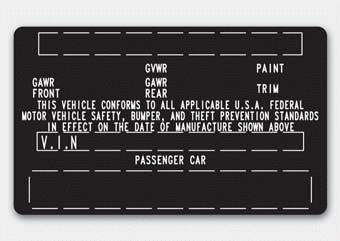
The certification label is located on the driver's door pillar (B-pillar) and shows the maximum permissible weight of the fully loaded vehicle. This is called the GVWR (Gross Vehicle Weight Rating). The GVWR includes the weight of the vehicle, all passengers, fuel, and cargo.
This label also shows the maximum weight that can be supported by the front and rear axles, called the Gross Axle Weight Rating (GAWR).
The total weight of the vehicle, including all passengers, accessories, cargo, and the tongue load of a trailer, must not exceed the Gross Vehicle Weight Rating (GVWR) or the Gross Axle Weight Rating (GAWR). To determine the actual loads on your front and rear axles, drive to a weigh station and weigh the vehicle. Be sure to distribute the load evenly on both sides of the centerline.
WARNING
- Never exceed the GVWR of your vehicle, the GAWR for the front or rear axle, and the vehicle's load capacity. Exceeding these values may affect the handling and braking ability of your vehicle and may lead to a collision.
- Do not overload your vehicle. Overloading may cause heat buildup in the vehicle's tires, possible tire failure, increased braking distance, and poor vehicle handling. All of these may lead to a collision.
WARNING
If you carry items in the vehicle (such as suitcases, tools, bags, or anything else), they will move as fast as the vehicle. If you need to stop or turn quickly, or in the event of a collision, items may cause injury if they strike the driver or a passenger.
- Place items in the luggage compartment of your vehicle. Try to distribute the weight evenly.
- Do not stack items such as suitcases inside the vehicle above the top of the seatbacks.
- Never leave a child unattended in your vehicle.
- When you carry cargo inside the vehicle, secure it.
Test yourself
A quick Hyundai Tucson LM quiz: every answer comes with an explanation and a link to the manual page.