Check the brake operation by applying the brakes during a road test. If the brakes do not operate properly, inspect the brake booster. Replace the brake booster assembly if it does not operate properly or if there are signs of leakage.
Piston Cup and Pressure Cup Inspection (B)
Check the brake operation by depressing the brake pedal. Look for damage or signs of brake fluid leakage. Replace the master cylinder as an assembly if the pedal does not operate properly or if there is damage or signs of brake fluid leakage.
Check the difference in brake pedal stroke between quick and slow braking. Replace the master cylinder if there is a difference in pedal stroke.
Brake Hoses (C)
Look for damage or signs of brake fluid leakage. Replace the brake hose with a new one if it is damaged or leaking.
Caliper Piston Seal and Piston Boots (D)
Check the brake operation by depressing the brake pedal. Look for damage or signs of brake fluid leakage. If the pedal does not operate properly, the brakes drag, or there is damage or signs of brake fluid leakage, disassemble and inspect the brake caliper. Replace the dust boots and seals with new ones whenever the brake caliper is disassembled.
Brake Bleeding
Make sure the brake fluid in the reservoir is at the MAX (upper) line.
Have someone slowly depress the brake pedal several times, then apply pressure.
Loosen the bleeder screw for the right rear brake (A) to allow air to escape from the system. Then tighten the bleeder screw securely. Front Disc BrakeRear Disc Brake
Repeat the procedure for each wheel in the sequence shown below until no more air bubbles appear in the fluid.
Fill the master cylinder reservoir to the MAX (upper) level mark.
Remove the reservoir cap and fill the reservoir with brake fluid.
Connect a clear plastic tube to the wheel cylinder bleeder screw and insert the other end of the tube into a clear plastic bottle half-filled with brake fluid.
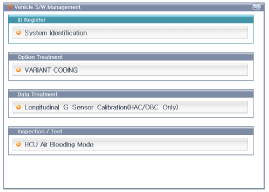
Connect the GDS to the data link connector located under the instrument panel.
Select and follow the instructions on the GDS screen.
Select the vehicle model name.
Select the Anti-lock Brake System.
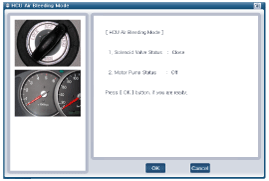
Select the HCU air bleeding mode.
Press "OK" to operate the motor pump and solenoid valve.
Wait 60 seconds before performing the air bleeding operation. (Otherwise, the engine may be damaged.)
Perform air bleeding.
Depress the brake pedal several times, then loosen the bleeder screw until fluid flows out without bubbles. Then close the bleeder screw (A). Front Disc BrakeRear Disc Brake
Repeat step 5 until there are no bubbles in the fluid for each wheel.
ABS/ESP Brake Bleeding: This procedure must be performed to ensure adequate air bleeding and filling of the ESP unit, brake lines and master cylinder with brake fluid.
?
Test yourself
A quick Kia Carens RP quiz: every answer comes with an explanation and a link to the manual page.