Brake System
Repair Procedures
In this manual: Brake System
58steps
~353min
5/5difficulty
1special tools
Done 0 of 58
Removal [Without EPB]
- Remove the rear wheel and tire.
Tightening torque: 88.3 ~ 108 N·m
- Release the parking brake lever. The parking brake cable is slack.
- Remove the parking brake cable (A) after removing the clip (B).

- Remove the brake hose banjo bolt (C). Tightening torque: Brake hose to caliper: 24.5 ~ 29 N·m
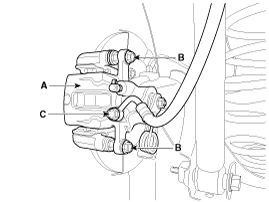
- Loosen the guide pin bolt (B) and remove the rear caliper body (A).
Tightening torque: 21.6 ~ 31 N·m
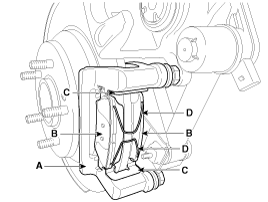
- Remove the pad return spring (D). Remove the pad retainers (C) and brake pads (B) from the caliper carrier (A).

- Loosen the caliper mounting bolts (B), then remove the rear caliper assembly (A). Tightening torque: Caliper assembly to carrier (B): 63.7 ~ 74 N·m

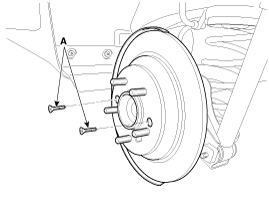
- Remove the rear brake disc by loosening the screws (A).
Tightening torque: 4.9 - 5.9 N·m
Removal [With EPB]
- Remove the rear wheel and tire.
Tightening torque: 88.3 ~ 108 N·m
- Release the parking brake.
- Disconnect the EPB actuator connector (A).

- Disconnect the brake hose from the brake caliper by loosening the bolt (C).
Tightening torque: 24.5 - 29 N·m
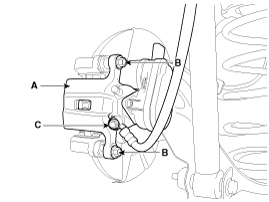
- Loosen the guide pin bolt (B) and remove the rear caliper body (A).
Tightening torque: 21.6 ~ 31 N·m
- Remove the pad return spring (D). Remove the pad retainers (C) and brake pads (B) from the caliper carrier (A).
- Loosen the caliper mounting bolts (A) and remove the rear caliper assembly (B).
Tightening torque: 63.7 ~ 74 N·m
- Remove the rear brake disc by loosening the screws (A).
Replacement [Without EPB]
Rear Brake Pads
- Remove the rear wheel and tire.
Tightening torque: 88.3 ~ 108 N·m
- Release the parking brake lever. The parking brake cable is slack.
- Loosen the guide pin bolt (B) and remove the rear caliper body (A).
Tightening torque: 21.6 ~ 31 N·m

- Remove the pad return spring (D). Replace the pad retainers (C) and brake pads (B) in the caliper carrier (A).
- Insert the piston into the cylinder using SST (09580-0U000).

- Place the caliper body (A) on the caliper carrier and tighten the guide pin bolts (B).
Tightening torque: 21.6 ~ 31 N·m
- Install the rear wheel and tire.
Tightening torque: 88.3 ~ 108 N·m
Replacement [With EPB]
Rear Brake Pads- Remove the rear wheel and tire.
- Connect the GDS to the data link connector located under the instrument panel.
- Ignition "ON" and engine "OFF".
- Release the electric parking brake.
- Select the vehicle model and the EPB system.
- Select "PAD Change Mode".
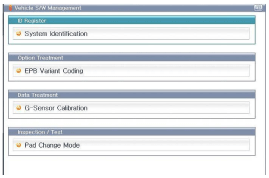
- Perform the "Pad Replacement Mode (Before Pad Replacement)" procedure using GDS.

- Ignition switch OFF.
- Disconnect the electric parking brake connector (A).
- Loosen the guide pin bolt (B) and the caliper body (A) so that they do not interfere.

- Remove the pad return spring (D). Replace the pad retainers (C) and brake pads (B) in the caliper carrier (A).
- Insert the piston into the cylinder using SST (09580-0U000).

- Place the caliper body (A) on the caliper carrier and tighten the guide pin bolts (B).
Tightening torque: 21.6 ~ 31 N·m
- Connect the electric parking brake connector (A).
- Ignition switch ON.
- Select "PAD Change Mode".
- Perform the "Pad Replacement Mode (Before Pad Replacement)" procedure using GDS.

- Turn the ignition switch "OFF" and disconnect the GDS.
- Install the rear wheel and tire.
Tightening torque: 88.3 ~ 108 N·m
Inspection
Rear brake disc thickness inspection
- Inspect the brake pads for wear and discoloration.
- Inspect the brake disc for damage and cracks.
- Remove all rust and contamination from the surface, and measure the disc thickness at 8 points at equal distances (5 mm) from the outer edge of the brake disc. Brake disc thickness Standard: 10 mm (0.394 in.) Maximum service limit: 8.4 mm (0.331 in.) Thickness variation: less than 0.01 mm (0.0004 in.)

- If wear exceeds the service limit, replace the discs and pads as a set, left and right of the vehicle.
Rear brake pad inspection
- Inspect the pad wear. Measure the pad thickness and replace the pad if it is less than the specified value. Pad thickness Standard: 10 mm (0.394 in.) Maximum operating limit: 2.0 mm (0.0787 in.)
- Check the pad and metal backing for damage and grease contamination.
Rear brake disc runout inspection
- Position the dial indicator approximately 5 mm (0.2 in) from the outer edge of the brake disc and measure the disc runout.
Brake disc runout Limit: 0.05 mm (0.0020 in.) or less (new)

- If brake disc runout exceeds the limit, replace the disc, then measure the runout again.
- If runout exceeds the specified limit, reposition the brake disc by turning it 180°, then re-check the brake disc runout.
- If runout cannot be corrected by changing the position of the brake disc, replace the brake disc.
Installation [Without EPB]
- Install in the reverse order of removal.
- Insert the piston into the cylinder using SST (09580-0U000).

- After installation, bleed the brake system. (Refer to Brake System Bleeding)
Installation [With EPB]
- Install in the reverse order of removal.
- Insert the piston into the cylinder using SST (09580-0U000).
- After installation, bleed the brake system. (Refer to Brake System Bleeding)
Test yourself
A quick Kia Carens RP quiz: every answer comes with an explanation and a link to the manual page.
Was this page helpful?