Kia Sorento: Using the Child Restraint System
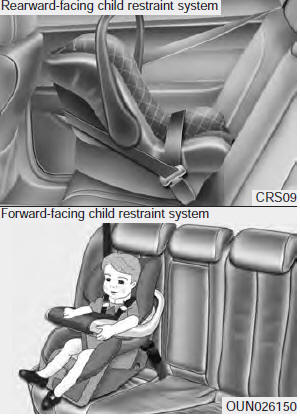
Small children and infants must use a child seat or infant seat. The child seat or infant seat must be the correct size for the child and must be installed in accordance with the manufacturer's instructions.
For safety reasons, we recommend using a child restraint system on the rear seats.
WARNING
Never install a rear-facing child restraint on the front passenger seat. The passenger airbag may deploy and strike the rear-facing child restraint, causing serious injury or death to the child.
Under normal conditions, all passenger seat belts retract freely and lock only in extreme or emergency conditions (emergency locking mode). To secure the child restraint, the seat belt retractor must be manually switched to automatic locking mode.
WARNING - Installing the Child Restraint
- The child may be seriously injured or killed in a collision if the child restraint is not properly secured to the vehicle, or if the child is not properly restrained in the child restraint. Read the child restraint manufacturer's instructions before installing the child restraint.
- If the seat belt does not operate as described in this section, have the system checked immediately by an authorized Kia dealer.
- Failure to follow the instructions in this manual regarding child restraint systems and the instructions supplied with the child restraint system may increase the likelihood and/or severity of injury in an accident.
Switching the Passenger Seat Belt to Automatic Locking Mode
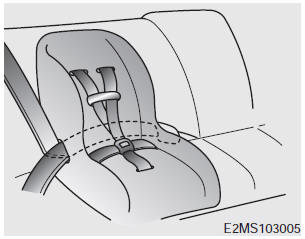
Automatic locking mode helps prevent the seat belt from loosening during normal child movement in the vehicle, which could compromise the child restraint system. To secure the child restraint, use the following procedure.

To install a child restraint on the side or center rear seats, proceed as follows:
1. Place the child restraint on the seat and route the lap/shoulder seat belt around or through the restraint, following the restraint manufacturer's instructions. Make sure the seat belt webbing is not twisted.
2. Fasten the lap/shoulder belt latch into the buckle. Listen for a distinct "click".
Position the release button so that it is easily accessible in an emergency.

3. Pull the shoulder portion of the seat belt all the way out. When the shoulder belt is fully extended, the retractor will switch to the "Auto Lock" position (child restraint).
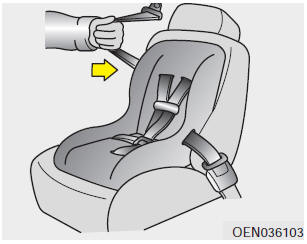
4. Slowly allow the shoulder belt to retract and listen for a clicking or ratcheting sound. This indicates that the retractor is in "Auto Lock" mode. If no distinct sound is heard, repeat steps 3 and 4.
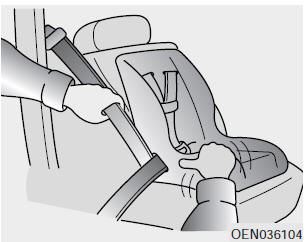
5. Remove as much slack from the belt as possible by pressing down on the child restraint system while guiding the shoulder belt back into the retractor.
6. Push and pull the child restraint to make sure the seat belt holds it securely in place. If it does not, unbuckle the seat belt and repeat steps 2 through 6.
7. Check twice that the retractor is in "Auto Lock" mode by trying to pull the belt out of the retractor. If you cannot, the retractor is in "Auto Lock" mode.
To remove the child restraint, press the release button on the buckle, then pull the lap/shoulder belt out of the restraint and allow the seat belt to retract fully.
WARNING! Automatic Locking Mode
The lap/shoulder belt automatically returns to "emergency locking mode" whenever the belt is allowed to retract fully. Therefore, the previous seven steps must be performed every time a child restraint is installed. If the retractor is not in Automatic Locking Mode, the child restraint may move when the vehicle turns or stops suddenly. The child may be seriously injured or killed if the child restraint is not properly secured to the vehicle, including failing to set the retractor to Automatic Locking Mode.
When the seat belt is fully retracted, the retractor automatically switches from "Auto Lock" mode back to emergency locking mode for normal adult use.
Securing the Child Seat Using the Tether Anchor System
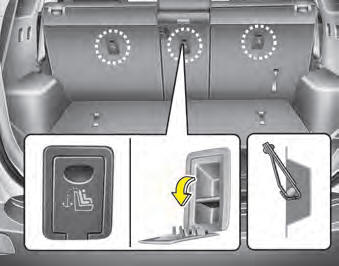
The tether anchor hooks for child restraints are located on the back of the rear seatbacks.
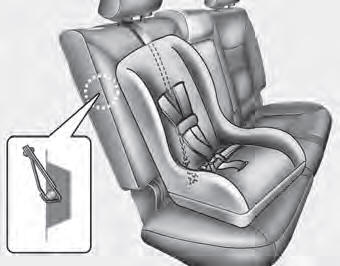
1. Route the child restraint tether strap over the seatback.
In vehicles with adjustable head restraints, route the tether strap under the head restraint and between the head restraint posts; otherwise, route the tether strap over the top of the seatback.
2. Attach the tether strap hook to the corresponding child restraint tether anchor hook and tighten to secure the child seat.
WARNING
The child may be seriously injured or killed in a collision if the child restraint is not properly secured to the vehicle, and the child is not properly restrained in the child restraint. Always follow the child seat manufacturer's instructions for installation and use.
WARNING! Seat Belt
Never install more than one child restraint on one tether anchor or on one lower anchor point. The increased load caused by multiple seats may cause the tethers or anchor points to fail, which may result in serious injury or death.
WARNING - Checking the Child Restraint
Make sure the child restraint is secure by pushing and pulling it in different directions. Improperly installed child restraints may swing, twist, or tip over, which may result in serious injury or death.
WARNING - Securing the Child Restraint
- Child restraint anchorages are designed only for the loads generated by properly installed child restraints. Under no circumstances should they be used for adult seat belts or shoulder belts, or for attaching other items or equipment to the vehicle.
- The shoulder belt may not function properly if it is attached anywhere other than the correct anchor.
Child Seat Installation Using the Lower Anchors and Tethers for Children (LATCH) System
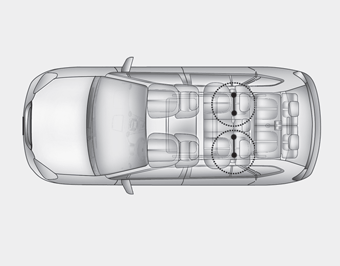
Some child seat manufacturers produce child restraints marked LATCH or LATCH-compatible. LATCH stands for "Lower Anchors and Tethers for CHildren". These seats include two rigid or strap-type connectors that attach to two LATCH anchors at designated seating positions in your vehicle. This type of child restraint eliminates the need to use the seat belts to secure the child seat to the rear seat.
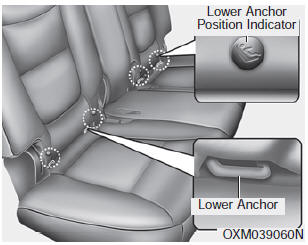
Child restraint symbols are located on the left and right rear seatbacks to indicate the positions of the child restraint lower anchors.
WARNING
- When using the vehicle's LATCH system to install a child restraint on the rear seat, all unused metal rear seat belt buckles or tongues must be securely latched into the seat belt buckles, and the seat belt webbing must be retracted behind the child restraint so that the child cannot reach and grasp unlatched seat belts. Unlatched metal buckles or tongues may allow the child to reach loose seat belts, which may result in strangulation and serious injury or death of the child in the child restraint.
- Do not place anything around the lower anchors. Also make sure the seat belt is not caught on the lower anchors.
WARNING
Install the child restraint fully rearward against the seatback, with the seatback reclined two positions from the most upright fixed position.
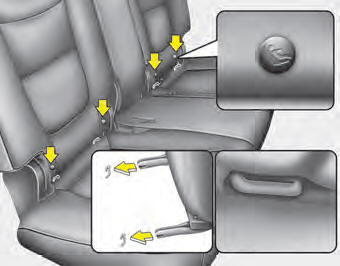
Your vehicle is equipped with LATCH anchors. The LATCH anchors are located at the left and right outboard rear seating positions. Their locations are shown in the illustration. No LATCH anchors are provided for the center rear seating position.
The LATCH anchors are located between the seatback and the seat cushion of the left and right outboard seating positions of the second row.
Follow the child seat manufacturer's instructions to properly install a LATCH or LATCH-compatible child seat.
After installing a LATCH child restraint, make sure the seat is securely attached to the LATCH lower anchors and the tether anchor.
In addition, check the child restraint before seating a child in it. Rock the seat from side to side. Also try to pull the seat forward. Check that the anchors are holding the seat in place.
CAUTION
Be careful that the rear seat belt webbing does not get scratched or pinched by the child seat buckle and LATCH anchor during installation.
WARNING
If the child restraint is not properly secured, there is a significantly increased risk that the child will be seriously injured or killed in a crash.
WARNING! LATCH the lower anchors.
LATCH lower anchors must be used only with the left and right outboard rear seating positions. Never attempt to attach a LATCH seat to the center seating position. You may damage the anchors, or the anchors may fail and break in a crash.
Test yourself
A quick Kia Sorento Owner's Manual quiz: every answer comes with an explanation and a link to the manual page.