Brake System
Electronic Parking Brake (EPB) Description and Operation
In this manual: Brake System
14steps
~84min
3/5difficulty
Done 0 of 14
Description
EPB is an electronic parking brake. EPB differs from existing parking systems that operate with a foot-pedal or lever-type brake. The EPB system sends a signal to the ECU when the driver operates the EPB switch. The ECU controls the EPB actuator, which consists of a motor and gear. EPB function- Static switch applied
- Manual application of the EPB switch at rest.
- Clamping Force Control; When parking on a slope less than 8% with the engine running, it is applied with Reduced Clamping Force (RCF); Except for the RCF condition, it is applied with full clamping force.
- Reduced Clamping Force on Flat Surface (RCF)
- If the EPB is applied on a slope less than 8%, it is applied with reduced clamping force.
- When the switch is held for more than 3 seconds, it is locked at full clamping force.
- Static (Switch) Release
- Manual EPB Release by Switch
- To prevent a hazardous situation, it can be released only when the ARC is satisfied.
- To prevent unintended release of the EPB, a condition must be satisfied before release; Example: IGN ON + [brake pedal depressed]
- With the ignition OFF, the EPB cannot be released.
- Hill Start Assist (HSA): The parking brake may be released automatically by gently depressing the accelerator pedal when all of the following conditions are met. (A/T only)
- Start the engine.
- Fasten the driver seat belt.
- Close the driver's door, hood and tailgate.
- Depress the accelerator pedal when the shift lever is in R (Reverse), D (Drive) or Sport mode.
- Start the engine.
- Fasten the driver seat belt.
- Close the driver's door, hood and tailgate.
- Depress the clutch pedal with a gear engaged.
- Dynamic Parking
- When the EPB switch is pulled in the dynamic state, dynamic deceleration is generated by the EPB actuator.
- The clamping force will be controlled to avoid rear wheel lock-up and ensure vehicle stability.
- Roll-Away Re-Clamp (RAR)
- If the vehicle rolls away, the EPB is re-applied; Vehicle movement is monitored by wheel rotational speed; It may remain active until a CAN signal is available (3 min.)
- High Temperature Re-Clamp (HTR)
- After hot brakes are detected, the EPB re-applies from the closed brake state to compensate for the loss of clamping force during brake cooling.
- Activation conditions: above 350 °C
- Pad Change Mode
- Fully return the spindle nut to replace the pads; This mode can be entered using a hand tool connected to the vehicle's OBD2 connector; The piston can be pushed in after entering pad change mode.
- Dynamic Stop Detection (DSD): This is how the parking brake operates when there is no wheel speed signal due to a malfunction. Braking force can be applied while the vehicle is moving to decelerate slowly. If the EPB switch is held pulled continuously, the parking brake can be applied with maximum force.
- From P to any position: EPB is automatically released when the shift lever is moved from the P position; Engine ON + brake pedal depressed condition required.
- From N to any position: EPB is automatically released when the shift lever is moved from the N position to a driving position (D or R); It is not released if the shift lever is moved to P or passes through N quickly; Engine ON + brake pedal depressed condition required.
- The following procedure is used to release the parking brake when the EPB malfunctions.
- This is the last resort for releasing the EPB with the parking brake applied. It cannot be released electrically or with a diagnostic scanner due to damage to the motor or EPB, or disconnection of the power line.
- This task must be performed on a level surface in a safe environment. When releasing the parking brake, make sure the vehicle remains stationary. (Perform this task only after confirming that precautions are in place in case the vehicle moves with the parking brake released.)
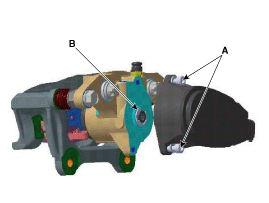
- Using a standard hex key, loosen the screw (A) on the rear caliper (2 pcs).
- Using the same hex key, turn the hex portion inside the spindle (B) clockwise by 0.5–1 full turn.
- The parking brake is released.
Test yourself
A quick Kia Cee'd quiz: every answer comes with an explanation and a link to the manual page.
Was this page helpful?