How the SRS Airbags Work
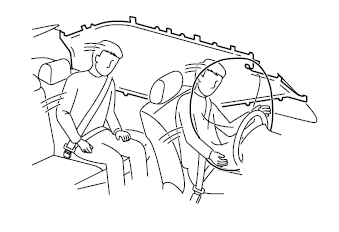
This Mazda vehicle is equipped with the following types of SRS airbags. The SRS airbags are designed to work together with the seat belts to reduce injuries in an accident.
The SRS airbags are designed to provide additional protection to occupants, in addition to the function of the seat belts. Be sure to wear your seat belts properly.
Front seat belt pretensioner
The front seat belt pretensioners are designed to activate in a frontal or near-frontal collision of moderate or severe intensity. In addition, in a side collision, the pretensioner operates on the side of the collision.
Driver airbag
The driver airbag is mounted in the steering wheel.
When the impact sensors detect a severe frontal impact, the driver airbag inflates rapidly to reduce injuries, especially injuries to the driver's head or chest caused by direct contact with the steering wheel.
Refer to "SRS Airbag Deployment Criteria" (page 2-59) for more information on airbag deployment.
(With front passenger seat occupant classification system) The two-stage driver front airbag controls airbag inflation at two force levels. In a moderate collision, the driver airbag deploys with less force, while in a more severe collision, it deploys with more force.
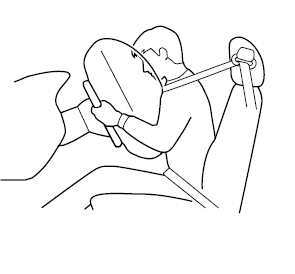
Front passenger airbag
The front passenger airbag is mounted in the dashboard on the front passenger side.
The front passenger airbag inflator is identical to the driver airbag, as described above.
Refer to "SRS Airbag Deployment Criteria" (page 2-59) for more information on airbag deployment.
(With front passenger seat occupant classification system) In addition, the front passenger airbag is designed to deploy only depending on the total weight seated on the front passenger seat. For more details, refer to the front passenger seat occupant classification system (page 2-62).
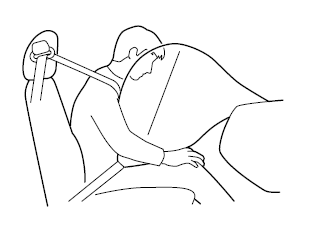
Side airbags
The side airbags are mounted on the outer sides of the front seatbacks.
When the airbag impact sensors detect a severe side impact, the system inflates the side airbag only on the side of the vehicle that was impacted. The side airbag inflates rapidly to reduce injuries to the driver's or front passenger's chest, especially injuries caused by direct contact with vehicle interior components such as a door or window.
Refer to "SRS Airbag Deployment Criteria" (page 2-59) for more information on airbag deployment.
(With front passenger seat occupant classification system) In addition, the front passenger side airbag is designed to deploy only depending on the total weight seated on the front passenger seat. For more details, refer to the front passenger seat occupant classification system (page 2-62).
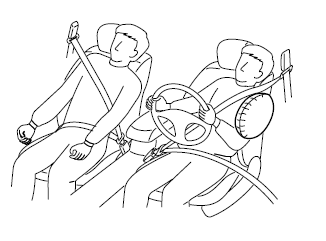
Curtain airbags
The curtain airbags are mounted on the front and rear window pillars and along the roof edge on both sides.
When the airbag impact sensors detect a severe side impact, the curtain airbag inflates rapidly to reduce injuries, especially injuries to the head of the outboard rear passenger caused by direct contact with vehicle interior components such as a door or window.
Refer to "SRS Airbag Deployment Criteria" (page 2-59) for more information on airbag deployment.
In a side impact: A severe collision on one side of the vehicle will cause the curtain airbag on that side only to deploy.
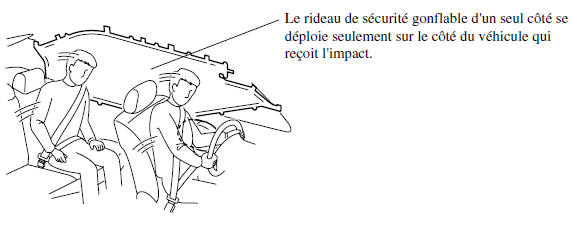
(With front passenger seat occupant classification system) In an oblique collision:
In a collision, the driver and front passenger airbags will deploy.
Depending on the nature of the impact, the side airbag and the inflatable curtain airbag may deploy.
Warning chime/indicator light
A malfunction in the system or operating conditions is indicated by a warning.
Refer to Indicator and Warning Lights on page 4-24.
Refer to Front Seat Belt Pretensioner/Airbag Warning Chime on page 7-40.
Test yourself
A quick Mazda 6 quiz: every answer comes with an explanation and a link to the manual page.