Child restraint systems
Important safety notes
WARNINGTo reduce the risk of serious or fatal injury to the child in an accident, hard braking or sudden change of direction, observe the following notes:
- Always protect children under 1.50 m tall or under 12 years of age with child restraint systems specially designed for children, which must be installed on suitable vehicle seats.
This is necessary because the seat belts are not designed for their size.
- Do not seat a child under 1.50 m tall or under 12 years of age in the front passenger seat.
Exception: the vehicle is equipped with automatic child seat detection at the front passenger seat and the child is secured by a child restraint system with transponders for automatic child seat detection.
- If you want to install a forward-facing child restraint system on the front passenger seat, you must move the front passenger seat fully to the rear.
- A child must never be carried on the lap of an occupant while the vehicle is moving. Due to the forces generated in an accident, hard braking or sudden change of direction, the occupant would not be able to hold the child. The child could strike parts of the interior and be seriously or fatally injured.
If the child restraint system is not correctly installed on a suitable vehicle seat, it cannot provide its intended protective function. In an accident, hard braking or sudden change of direction, the child cannot be restrained and may be seriously or fatally injured. Therefore, when installing a child restraint system, strictly follow the manufacturer's installation instructions and also observe the application range of the child restraint system.
Preferably install the child restraint system on a rear seat. The child is generally better protected there.
The entire support surface of the restraint system used must rest on the seat on which it is installed. Therefore, never place objects (such as cushions) under the child restraint system.
Do not use a child restraint system without the intended original cover. Replace worn covers only with original covers.
We recommend using the child restraint systems recommended for Mercedes-Benz.
WARNINGNever leave children unattended in the vehicle, even if they are secured in a child restraint system. Children may injure themselves on parts of the vehicle. They may also be seriously or even fatally injured if they are exposed to intense heat or cold for too long.
Do not expose the child restraint system to direct sunlight. Parts of the child restraint system may become very hot, and the child could burn themselves on contact with them.
Children may injure themselves or others when opening a door. They may get out of the vehicle and be injured by or injure other road users.
Also observe the notes on the HOLD function. For more information, refer to the alphabetical index.
WARNINGAn unsecured or improperly positioned load increases the risk of injury to the child and to all other occupants in the event of
- an accident
- sudden braking
- sudden change of direction
Do not carry heavy or hard objects in the passenger compartment unless they are secured. For more information, refer to the section "Loading guidelines" in the alphabetical index.
When a child is riding in the vehicle, make sure they are protected by a child restraint system recommended for Mercedes-Benz vehicles that suits their height, weight and age. Preferably install the restraint system on an appropriate rear seat. You can also seat the child on an integrated child seat. Make sure the child is always buckled up while the vehicle is in motion.
Mercedes-Benz recommends using only the child restraint systems presented at the.
For more information on suitable child restraint systems, contact a Mercedes-Benz service center.
For cleaning child restraint systems, preferably use Mercedes-Benz care products. For further information, contact a Mercedes-Benz Service Center.Child seat installed on the front passenger seat
WARNINGIf the front passenger airbag is not deactivated:
- A child secured in a child restraint system installed on the front passenger seat can be seriously or even fatally injured by this airbag if it deploys. This applies in particular if the child is in the immediate vicinity of the airbag when it deploys.
- Never install a rearward-facing child restraint system on the front passenger seat. Install the rearward-facing child restraint system only on an appropriate rear seat.
- Always move the front passenger seat fully to the rear if you are protecting a child with a forward-facing child restraint system installed on the front passenger seat.
The front passenger airbag is not deactivated
- in vehicles not equipped with automatic child seat detection on the front passenger seat
- in vehicles equipped with automatic child seat detection on the front passenger seat, if the child restraint system installed on the front passenger seat is not of a special type with transponders for automatic child seat detection
- in vehicles equipped with automatic child seat detection on the front passenger seat, if the PASSENGER AIRBAG OFF indicator lamp
 does not light up
To remind you of this, a corresponding warning label is affixed to the dashboard and to both sides of the front passenger sun visor.
For information on recommended child restraint systems, contact a Mercedes-Benz service center.
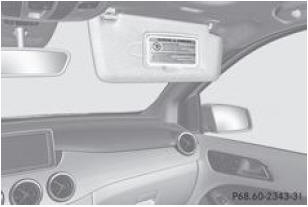
Warning on the front passenger sun visor
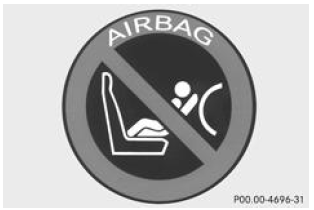
Warning symbol for rearward-facing child restraint system. Do not install a rearward-facing child restraint system on a seat protected by a front airbag.
Automatic child seat detection on the front passenger seat
WARNINGIf the PASSENGER AIRBAG OFF indicator lamp does not light up even though a
child restraint system is installed, the front passenger airbag is not deactivated. The child may then be seriously or even fatally injured if the front passenger airbag deploys.
Proceed as follows:
- Do not install the rearward-facing child restraint system on the front passenger seat.
- Install the rearward-facing child restraint system on an appropriate rear seat.
or
- Install a forward-facing child restraint system on the front passenger seat and move the front passenger seat fully to the rear.
- Have the automatic child seat detection checked by a qualified workshop.
For the automatic child seat detection on the front passenger seat to work and communicate correctly, never place objects (such as cushions) under the child restraint system. The entire support surface of the restraint system used must rest on the seat on which it is installed. An improperly installed child restraint system cannot provide the intended protection in an accident and may cause injury.
WARNINGDo not place electronic devices on the front passenger seat, for example
- a switched-on laptop
- a mobile phone
- a card with a transponder (such as a ski pass or access badge)
Signals from electronic devices may interfere with the sensor system of the automatic child seat detection. This may cause a malfunction of the system. The PASSENGER AIRBAG OFF indicator lamp may then light up even though no
child seat with transponders for automatic child seat detection is installed. In this case, the front passenger airbag will not deploy in an accident. The SRS warning lamp may also light up and/or the
PASSENGER AIRBAG OFF indicator lamp does not briefly light up
when you turn the key to position 2 in the ignition switch.
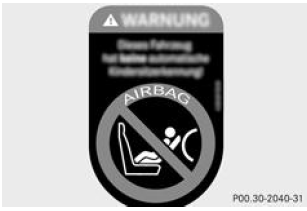
If your vehicle is not equipped with automatic child seat detection [1] on the front passenger seat, this is indicated by a special label. This label is affixed to the end of the dashboard on the passenger side. It is visible when you open the front passenger door.
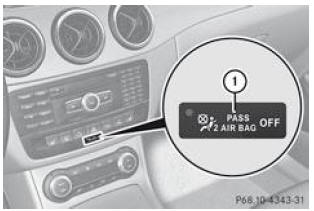
The sensor system for automatic child seat detection on the front passenger seat detects the presence of a special Mercedes-Benz child seat fitted with transponders for automatic child seat detection. In this case, the PASSENGER AIRBAG OFF 1 lights up.
The front passenger airbag is deactivated.
- Side airbag
- Curtain airbag
- Belt retractor
ISOFIX child seat anchorage system, rear
WARNINGA child restraint system secured with the ISOFIX system does not provide sufficient protection for children weighing more than 22 kg. Therefore, only protect children weighing less than 22 kg with a child restraint system secured with the ISOFIX system. If the child weighs more than 22 kg, secure the child restraint system with the 3-point seat belt.
WARNINGIf the child restraint system is not correctly installed on a suitable vehicle seat, it cannot provide its intended protective function. In an accident, hard braking or sudden change of direction, the child cannot be restrained and may be seriously or fatally injured. Therefore, when installing a child restraint system, strictly follow the manufacturer's installation instructions and also observe the application range of the child restraint system.
For safety reasons, only install child restraint systems equipped with the ISOFIX anchorage system on the rear seats.
We recommend using ISOFIX child restraint systems recommended for Mercedes-Benz.
An improperly installed child restraint system may come loose, and the child or other vehicle occupants may then be seriously or even fatally injured. Therefore, after installing the child restraint system on the seat, be sure to check that it is properly locked on the left and right in the anchorage brackets.
WARNINGIf damaged or subjected to loads in an accident, child restraint systems or their anchorages may no longer be able to perform their protective function. Therefore, the child they are meant to protect may be seriously or fatally injured in an accident, hard braking or a sudden change of direction.
If child restraint systems and their anchorages are damaged or have been subjected to loads in an accident, have them checked immediately by a qualified workshop.
When installing the child restraint system, make sure not to pinch the center seat belt.Otherwise, the seat belt could be damaged.
ISOFIX is a standardized anchorage system for installing special child restraint systems on the rear seats. ISOFIX anchorage brackets for 2 ISOFIX child restraint systems are installed on the left and right of the rear bench seat.
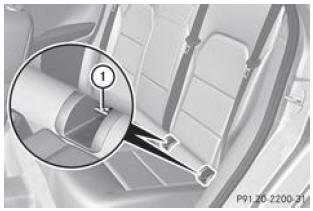
1 ISOFIX anchorage brackets
- Install the ISOFIX child restraint system. Be sure to follow the manufacturer's installation instructions when fitting the ISOFIX child restraint system.
TopTether
WARNINGMake sure the rear backrests are fully locked. The rear backrests are locked when the left and right red locking indicators are no longer visible. If the rear backrests are not locked, occupants may be injured in an accident, for example by objects carried in the luggage compartment that could be thrown forward.
The TopTether system creates an additional connection between the ISOFIX child restraint system and the rear seat. This further reduces the risk of injury.
The TopTether anchorage points are located on the back of the rear backrests.
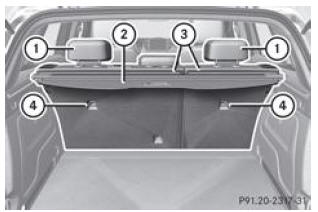
- Push the head restraint 1 upward.
- Unlock the rear backrest 3 and fold it forward.
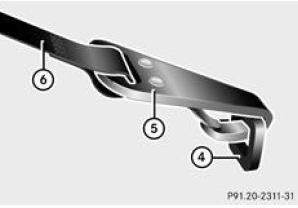
- Route the TopTether strap 6 under the head restraint 1 between the 2 guide rods.
- Hook the TopTether hook 5 of the TopTether strap 6 onto the TopTether anchorage point 4.
Make sure that
- the TopTether hook 5 is hooked onto the TopTether anchorage point 4 as shown in the illustration
- the TopTether strap 6 is not twisted
- the TopTether strap 6 runs between the rear backrest 3 and the luggage cover 2, if the luggage cover 2 is installed
- Fold the rear backrest 3 back until it locks.
The red locking indicator must no longer be visible.
- If necessary, adjust the head restraint 1 slightly lower. Make sure the TopTether strap 6 can slide freely.
- Install the ISOFIX child restraint system with the TopTether system. Be sure to follow the manufacturer's installation instructions. Make sure the TopTether strap 6 is taut.
Child seat detection problems
| Problem | Possible causes/consequences and solutions |
The PASSENGER AIRBAG OFF indicator lamp in the center console lights up |
A special Mercedes-Benz child seat fitted with transponders for automatic child seat detection is installed on the front passenger seat. Therefore, the front passenger airbag is deactivated.Risk of injuryNo child seat is installed on the front passenger seat. Automatic child seat detection is malfunctioning. The SRS warning lamp may also
If the PASSENGER AIRBAG OFF indicator lamp
|
 light up and/or the
Integrated child seat (IKS)
Important safety notes
WARNINGTo reduce the risk of serious or fatal injury to the child in an accident, hard braking or sudden change of direction, observe the following notes:
- When installing the integrated child seat retaining panels and the side head restraints, as well as when routing the seat belt, be sure to observe the manufacturer's instructions.
- Do not modify the integrated child seats, the integrated child seat retaining panels or the side head restraints. Do not use seat covers.
- Make sure that the built-in child seat backrest cushions and the side head restraints cannot become trapped or damaged. This can happen, for example, when
- you close the doors
- you adjust the seats
- you stow the built-in child seat cushions and the side head restraints in the vehicle
- you transport heavy objects
- Replace the built-in child seats, built-in child seat cushions and side head restraints if they have been damaged or heavily loaded in an accident.
- Note that children weighing less than 12.5 kg require a different type of restraint system. For information on other child restraint systems, contact a Mercedes-Benz Service Center.
- Make sure that the rear backrests are locked.
The built-in child seats are integrated into the left and right seats of the rear bench seat. In conjunction with the components listed in the following table, they meet the requirements of ECE R 44.04 .
| Weight classes | Built-in child seat | Built-in child seat cushion | Side head restraint |
| Class I: 12.5 to 18 kg | Unfolded position | Required | Required |
| Class II: 15 to 25 kg | Unfolded position | Not permitted | Required |
| Class III: 22 to 36 kg | Unfolded position | Not permitted | Recommended |
Mercedes-Benz recommends using the built-in child seats to transport children weighing between 12.5 and 36 kg.
For children weighing approximately 12.5 to 18 kg, you must also install an approved built-in child seat cushion and side head restraint.

- Side head restraint
- Belt guide
- Built-in child seat
- Release handle
Unfolding the built-in child seat
- Pull release handle 4 forward.
- Lift built-in child seat 3 and push it rearward until it locks.
Fastening the seat belt
WARNINGTo reduce the risk of serious or fatal injury to the child in an accident, hard braking or sudden change of direction, observe the following notes:
- The upper part of the seat belt must run across the shoulder (never across the neck) and lie flat against the chest. The lower part of the seat belt must run across the hips, not across the stomach, and must always be taut. Retighten it if necessary.
- Always use one restraint system for only one child at a time.
- Make sure that the seat belt is not trapped or twisted and does not rub against sharp edges.
- If you have not installed the side head restraint: when the child seat is occupied, drive only with the head restraint correctly adjusted. The head must be supported at eye level and rest in the center of the head restraint.
Observe the installation instructions for the built-in child seat cushion and the warnings and safety information they contain.
- Pull the seat belt smoothly out of the seat belt retractor.
- Engage the tongue in the buckle.
- If you use built-in child seat 3 without a child seat cushion, make sure that the seat belt
- runs as low as possible across the hips
- is taut across the pelvis (to do this, pull the seat belt upward at chest level)
- is not slack and runs across the shoulder
- is not twisted and does not run across the neck or under the arm
- Adjust the head restraint if necessary.
Folding the built-in child seat
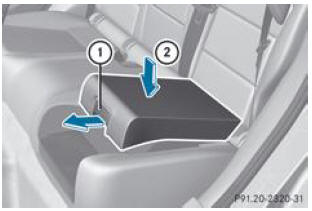
- Pull release handle 1 forward.
- Press 2 in the middle of the built-in child seat until it engages.
Built-in child seat cushions
Important safety notes
WARNINGIf the child seat cushion used is not correctly installed on the built-in child seat, it cannot provide the intended protection. The child would not be restrained and could be seriously or fatally injured in an accident, sudden braking or sharp change of direction. Therefore, you must observe the following description when installing built-in child seat cushions.
Built-in child seat cushions fit only built-in child seats in the unfolded position.
On the rear seats, install only built-in child seat cushions recommended by Mercedes-Benz.
A built-in child seat cushion that is not installed correctly can come loose, and the child or other vehicle occupants may then be seriously or fatally injured. Once the built-in child seat cushions are installed, make sure they are securely fastened.
WARNINGDo not modify the built-in child seat cushions, built-in child seats or seat belts. Built-in child seat cushions must not be used without their cover. The cover must not be removed from the built-in child seat cushion or replaced with one from another manufacturer. Otherwise, the official approval becomes void and the protective function may be limited.
Do not expose the built-in child seat cushions to excessive heat or direct sunlight. Some parts of the built-in child seat cushions can become very hot and children could be burned.
WARNINGTo reduce the risk of serious or fatal injury to the child in an accident, hard braking or sudden change of direction, observe the following notes:
- You must observe the following description when installing built-in child seat cushions.
- Do not modify the built-in child seat cushions.
- When the built-in child seats are occupied, drive only with the head restraints correctly adjusted: the head must be supported at eye level and rest in the center of the head restraint.
- Replace the built-in child seat cushions if they are damaged or have been heavily loaded in an accident.
- Remember that children under 2 years of age or weighing less than 12.5 kg require a different type of child restraint system. For information on other child restraint systems, contact a Mercedes-Benz Service Center.
- you close the doors
- you adjust the seats
- you store the integrated child seat restraint trays in the vehicle or transport heavy objects
Use the integrated child seat restraint trays in accordance with the requirements in the table in the chapter "Integrated child seats".
The integrated child seat with restraint tray must not be used directly after a baby capsule approved for weight class 0, up to 10 kg.

- Side head restraint
- Integrated child seat restraint tray
- Belt guide
- Left leg
- Built-in child seat
- Right leg
Installing the integrated child seat restraint trays
- Unfold the integrated child seat 5.
- Place the child on the integrated child seat 5.
- Fold the 2 legs 4 and 6 down.
- Place the restraint tray 2 above the integrated child seat 5.
Make sure that
- the seat belt is routed as described below
- the seat belt is not twisted
- the integrated child seat restraint tray is firmly against the child
- the seat belt is not trapped or twisted and does not rub against sharp edges
Otherwise, the child will not be restrained and could be seriously or fatally injured in an accident, hard braking or a sudden change of direction.
- Pull the seat belt smoothly out of the seat belt retractor.
- Insert the upper and lower parts of the belt into the belt guide on the door side 3.
- Bring both parts of the belt to the belt guide 3 located inside the vehicle and insert them into the belt guide.
- Engage the tongue in the buckle.
- Push the integrated child seat restraint tray 2 against the child.
- Tighten both parts of the belt. Make sure that the seat belt is not twisted.
Adjust the head restraint if necessary.
Side head restraints for integrated child seats
Use the side head restraints in accordance with the requirements in the table.
If you need an additional side head restraint for the 2nd integrated child seat, you can order it from any Mercedes-Benz Service Center.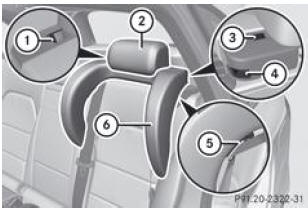
WARNING
If the side head restraints are not secured to the designated anchor points, they cannot provide the intended protection. The child would not be protected and could be seriously or fatally injured in an accident, hard braking or a sudden change of direction.
Only secure the side head restraints to the designated anchor points on the rear head restraints.
For safety reasons, Mercedes-Benz recommends using only side head restraints specifically approved by Mercedes-Benz for your vehicle.
Installing the side head restraint
- Push the head restraint 2 upward and set it upright.
- Center the side head restraint 6 and press it from the front onto the 2 head restraint guide rods until it engages.
The right locking indicator 1 and left locking indicator 3 must be retracted. The red surfaces are no longer visible.
- Make sure that the side head restraint 6 is engaged on its 2 guide rods.
- Lower the head restraint 2 until it rests on the upper edge of the side head restraint 6.
- Route the seat belt through the belt guide 5 on the door side, at the level of the side head restraint 6.
- Fasten the seat belt.
Removing the side head restraint
- Pull the seat belt out of the belt guide 5.
- Push the head restraint 2 upward.
- Press the left or right release button 4 and remove the side head restraint 6 from the front.
The right locking indicator 1 and left locking indicator 3 extend briefly.
- Adjust the head restraint 2.
Storing the restraint trays and side head restraints
WARNINGSecure the integrated child seat restraint trays and side head restraints properly in the vehicle.
Otherwise, they could come loose and injure occupants or damage the vehicle in an accident, hard braking or a sudden change of direction.
If you do not want to use the integrated child seat restraint trays or side head restraints, store them in a suitable location, for example in the luggage compartment.
In vehicles equipped with the TIREFIT tire sealing kit, for example, you can store the side head restraint in the storage compartment under the luggage compartment floor.
Suitable positions for child restraint systems
| Explanation of the letters in the table: | |
| X | This position is not suitable for children in this weight class. |
| U | Suitable for "Universal" category child restraint systems approved for this weight class. |
| UF | Suitable for "Universal" category ISOFIX forward-facing child restraint systems approved for this weight class. |
| L | Suitable for child restraint systems as recommended, see the table below "Recommended child restraint systems". |
| Weight classes | PositionsFront passenger seatThe front passenger airbag is not deactivated |
The front passenger airbag is deactivated [2] | Rear seatleft, right |
center |
| Group 0: up to 10 kg | X | U [3] , L [3] | U, L | U, L |
| Group 0+: up to 13 kg | X | U [3] , L [3] | U, L | U, L |
| Group I: 9 to 18 kg | U [3] , L [3] | U [3] , L [3] | U, L | U, L |
| Group II: 15 to 25 kg | U [3] , L [3] | U [3] , L [3] | U, L | U, L |
| Group III: 22 to 36 kg | U [3] , L [3] | U [3] , L [3] | U, L | U, L |
Child restraint systems in the "Universal" category carry an orange approval label.
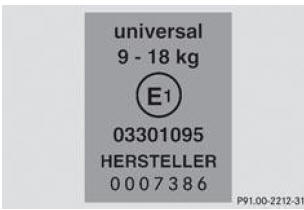
Child restraint system approval label (example)
| Explanation of the letters in the table: | |
| X | This ISOFIX position is not suitable for ISOFIX child restraint systems for this weight and/or size class. |
| IUF | Suitable for ISOFIX forward-facing child restraint systems in the "Universal" category approved for this weight class. |
| IL | Suitable for ISOFIX child restraint systems as recommended, see the table below "Recommended child restraint systems" |
Specifications for installing ISOFIX child restraint systems on the rear seats
| Weight classes | Size class | Device | Left or right rear seat |
| Baby cot | F | ISO/L1 | X |
| G | ISO/L2 | X | |
| 0: up to 10 kg, up to approx. 6 months | E | ISO/R1 | IL |
| 0+: up to 13 kg, up to approx. 15 months | E | ISO/R1 | IL |
| D | ISO/R2 | IL | |
| C | ISO/R3 | IL | |
| I: 9 to 18 kg, approx. 9 months to 4 years | D | ISO/R2 | IL |
| C | ISO/R3 | IL | |
| B | ISO/F2 | IUF | |
| B1 | ISO/F2X | IUF | |
| A | ISO/F3 | IUF |
Recommended child restraint systems
When installing a child restraint system that does not have transponders for automatic child seat detection on the front passenger seat:
- Move the front passenger seat fully rearward.
| Weight classes | Manufacturer | Type | Approval number (E1 xxx) | Order number (A 000 xxx) | Automatic child seat detection |
Group 0: up to 10 kgup to approx. 6 months |
Britax Römer |
BABY SAFE PLUS |
03 301146 04 301146 |
970 10 00 | Yes |
Group 0+: up to 13 kgup to approx. 15 months |
Britax Römer |
BABY SAFE PLUS |
03 301146 04 301146 |
970 10 00 | Yes |
Group I: 9 to 18 kgapprox. 9 months to 4 years |
Britax Römer |
DUO PLUS | 03 301133 04 301133 |
970 11 00 | Yes |
| 970 16 00 | No | ||||
Group II/III: 15 to 36 kgapprox. 4 to 12 years |
Britax Römer |
KIDFIX | 04 301198 | 970 18 00 | Yes |
| 970 19 00 | No |
Recommended ISOFIX child restraint systems of the 'Universal' category
| Weight classes | Weight classes | Manufacturer | Type | Approval number | Order number | Automatic child seat detection |
| Baby cot | F | - | - | - | - | - |
| G | - | - | - | - | - | |
Class 0:up to 10 kg |
E | - | - | - | - | - |
Class 0+:up to 13 kg |
E | Britax Römer |
BABY-SAFE ISOFIX plus |
04 301146 | B6 6 86 8224 | No |
| D | - | - | - | - | - | |
| C | - | - | - | - | - | |
Class I:9 to 18 kg |
D | – | – | – | – | – |
| C | – | – | – | – | – | |
| B | – | – | – | – | – | |
| B1 | Britax Römer |
DUO PLUS | 04 301133 | A 000 970 11 00 | Yes | |
| A 000 970 11 00 | Yes | |||||
| A | – | – | – | – | – |
Test yourself
A quick Mercedes-Benz B-Class quiz: every answer comes with an explanation and a link to the manual page.