Engine oil level: general
An engine consumes oil to lubricate and cool its moving parts, so topping up the oil between oil changes is normal.
However, if after the running-in period oil consumption exceeds 0.5 litre per 1,000 km, consult a brand representative.
Frequency: check the oil level regularly and in any case before each long journey, otherwise you risk damaging your engine.
Reading the oil level
The reading must be taken on level ground and after the engine has been stopped for an extended period.
To know the exact oil level and make sure the maximum level is not exceeded (risk of engine damage), it is essential to use the dipstick. Refer to the following pages.
The dashboard warning only comes on when the oil level is at minimum.
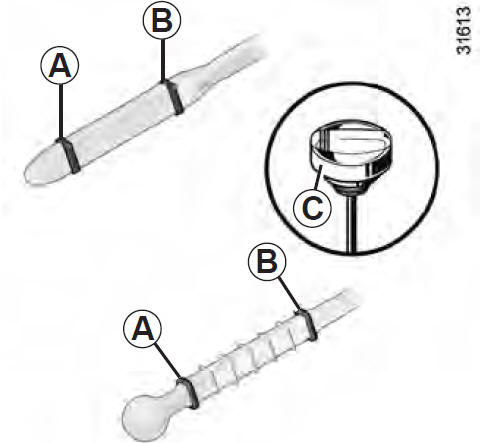
- remove the dipstick and wipe it with a clean, lint-free cloth;
- push the dipstick fully home (for vehicles fitted with the "dipstick cap" C, screw the cap fully in);
- remove the dipstick again;
- read the level: it must never drop below the "MIN" mark A or exceed the "MAX" mark B.
Once the level has been read, make sure to push the dipstick fully home or screw the dipstick cap fully in.
To avoid splashing, we recommend using a funnel when topping up or filling the engine oil. Engine oil above maximum levelThe level must only be read using the dipstick as explained above.
If the maximum level is exceeded, do not start the vehicle; contact a brand representative.
 Deactivate
the Stop and Start function before any work in the engine compartment.
You must never exceed the maximum fill level B: risk of engine and catalytic converter damage.
Test yourself
A quick Renault Clio quiz: every answer comes with an explanation and a link to the manual page.