Seat Belt Hanger (on some models)
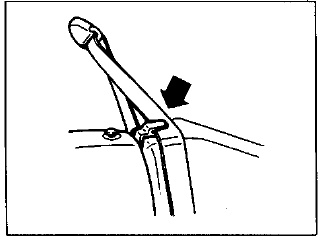
WARNING Seat belt hangers are only intended to hold the belts when the seats are folded. When the belt webbing is hooked onto the hanger during use, the seat belt cannot provide proper protection for the occupant. NOTE When the seatback is moved, make sure the belt webbing is placed on the hanger so that it cannot catch on the seatback, hinge or seat latch. This prevents damage to the belt.
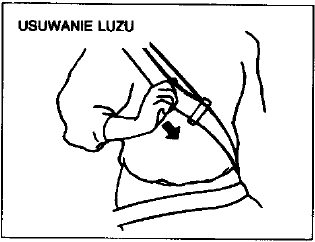
- 3-point non-retractable seat belt: Set the length of the shoulder portion so that there is slight slack. To shorten the belt, pull the free end in the direction of the arrow, as shown in the illustration. To lengthen it, grasp the webbing at the upper anchor point and pull in the direction of the arrow, perpendicular to the anchor point.
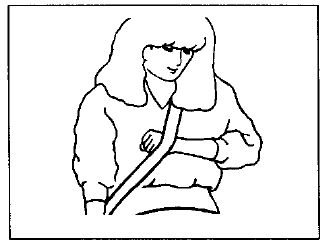
The shoulder portion should have only enough slack to allow a clenched fist to be inserted between the belt and the chest, as shown in the illustration. Excessive slack in the shoulder portion makes the belt ineffective in a collision. The shoulder portion should run along the shoulder (on the outer side) and never under the arm. After use, always hang the belt on the hook located near the upper anchor point.
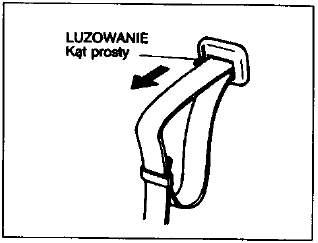
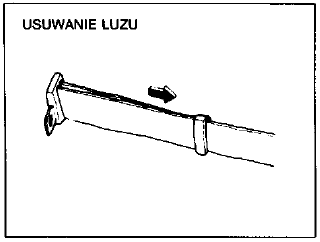
- 2-point non-retractable seat belt: In this type, the adjuster is located in the buckle. To shorten the belt, pull the free end of the webbing along the belt until it fits comfortably against the body.
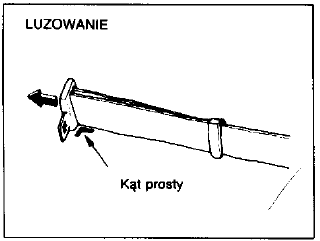
To lengthen the belt, unbuckle it, position the tongue-equipped part perpendicular to the webbing and pull in the direction of the arrow. Then fasten the belt and tighten it as described above.
WARNING Always check all seat belts after any accident. A seat belt assembly that was in use during a collision (except minor ones) must be replaced, even if no damage is visible. A seat belt assembly that was not in use during the accident must be replaced if it does not function properly or is damaged in any way. WARNING
- Never allow a passenger to ride in the luggage area. In a collision, the risk of injury to persons not seated in a seat with a properly fastened seat belt is significantly increased.
- Seat belts must always be positioned so that the lap portion runs low around the pelvis, not around the abdomen. Shoulder portions should run only across the shoulder (on the door side), never under the arm. Belt webbing must never be twisted, and should fit snugly against the body while remaining comfortable. This ensures the protection the belts were designed to provide, since a loose belt is less effective.
- Make sure each tongue is inserted into its correct buckle. In the rear seat, it is possible to cross the buckles.
- The seat belt must not rest against hard or brittle objects in pockets or on clothing. In a collision, objects such as glasses or pens pressed by the belt can cause injury.
- Never use the same belt for more than one occupant, and in particular never allow the belt to be worn around a child held on a passenger's lap. In a collision, this may cause very serious injury to the child.
- Pregnant women should wear seat belts. However, a doctor should provide specific guidance on any restrictions on use.
- Periodically inspect seat belt assemblies for wear and damage. Replace a belt if the webbing is frayed, contaminated or damaged in any way. It is important to replace the complete seat belt after it has been used in a collision, even if no damage is visible.
- Never carry infants or small children without proper restraint. Child restraint systems are available for purchase and should be used. However, make sure that the system you buy meets the applicable safety standards.
The manufacturer's instructions should be read and followed.
- Keep the belts free of contamination from cleaning agents, oils, chemicals, and especially battery acid. Cleaning can be safely carried out with water and a mild soap.
- If the shoulder belt rubs against the neck or face of a child, move the child closer to the center of the vehicle.
Test yourself
A quick Suzuki Swift quiz: every answer comes with an explanation and a link to the manual page.